



Hezbollah’s $14,000 aid program raises questions over funding sources, financial capacity, transparency, and the group’s post-war political challenges in Lebanon.
Hezbollah’s promise: An aid or a financial mirage?
Hezbollah’s promise: An aid or a financial mirage?
By The Beiruter | October 14, 2026

Reading time: 4 min
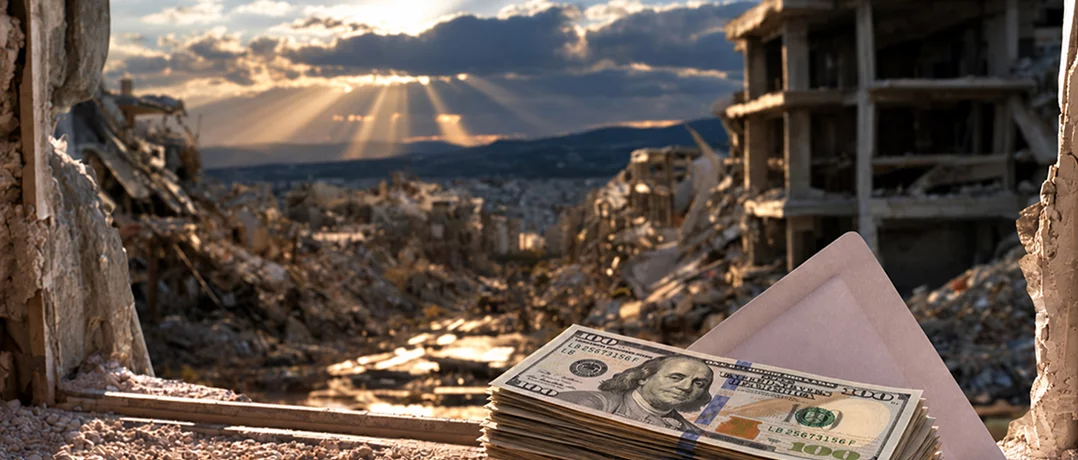
Hezbollah has announced a new financial assistance program for Lebanese families whose homes were destroyed or rendered uninhabitable during the latest armed conflicts with Israel, in 2023-2024 and 2026, pledging payments of up to $14,000 per household.
Hezbollah’s announcement has raised significant questions regarding the group’s ability to finance such a large-scale commitment. Given that Hezbollah is facing increasing financial restrictions, intensified international sanctions, and growing scrutiny over its sources of funding, concerns and criticism revolved around how the group is presumably managing to smuggle illegal funds from illegal sources. Ironically, many of the affected families are enduring the consequences of a conflict precipitated by Hezbollah’s own policies, military adventures, and illegal acquisition of arms.
A “promise” facing financial and political tests
Under the announced framework, titled “Promise and Commitment,” eligible families in Beirut and the southern suburbs will receive up to $14,000. Payments will reportedly be distributed over four installments during one year. Nevertheless, the transparency of the process is heavily questioned, particularly regarding the number of beneficiaries, the total cost of the program, and the mechanisms used to verify eligibility.
The announcement immediately revived questions about Hezbollah’s financial resources. Despite outlining detailed payment mechanisms, Hezbollah did not reveal the total amount allocated to the program, the expected number of beneficiaries, or the source of funding.
The uncertainty became more significant after Reuters reported that Hezbollah had received approximately $200 million from Iran in September 2026 to assist displaced Lebanese families. The report, citing two sources familiar with the transfer, came amid intensified American efforts to restrict Iranian financial networks linked to Hezbollah.
Washington disputed the existence of such funding, with United States (U.S.) officials stating that the reported money was “not there,” framing the “fake announcement” as a design to save the group’s reputation.
We heard a lot today from Hezbollah, but the bottom lines is that the purported money from Iran simply does not exist.
Hezbollah did not confirm or deny receiving the reported amount.
The financing question is particularly important because the announced assistance represents a substantial financial commitment. Even a limited number of beneficiaries could require hundreds of millions of dollars. If thousands of families qualify for the maximum payments, the total cost could rapidly approach or exceed the amounts previously allocated by Hezbollah after earlier conflicts.
The group’s ability to maintain such spending is also challenged by broader economic pressure. The U.S. has repeatedly targeted Hezbollah’s financial networks, imposing sanctions on individuals and companies accused of facilitating fundraising, money transfers, and financial operations linked to the organization. In March 2026, Washington announced additional sanctions targeting what it described as a global network supporting Hezbollah’s financial activities, including individuals and entities accused of money laundering and fundraising operations.
These restrictions have made international transfers increasingly difficult and have placed additional pressure on Hezbollah’s traditional funding channels.
Have previous post-war compensation programs reached
Hezbollah’s latest announcement follows a similar approach adopted after previous conflicts. Following the 2023-2024 war with Israel, which began after Hezbollah opened a front in support of Hamas following the Hamas October 7 attacks, the group announced a compensation program for displaced families.
At the time, Hezbollah declared that it would provide approximately $77 million in assistance. Its Secretary-General Naim Qassem said that most of the funding came from Iran, thanking Tehran for what he described as generous support.
However, reports at the time indicated that the distribution process faced logistical and financial challenges, with questions emerging over whether all promised compensation had reached affected families as many remained displaced and their properties devastated.
Historically, Hezbollah has built part of its political influence through its extensive social service networks, including healthcare, education, and financial assistance programs; including through the illegal Qard al-Hassan (QAH). These services have helped the group maintain support among segments of Lebanon’s Shiite population.
However, the latest initiative comes under different circumstances. Hezbollah emerges from the conflict weakened politically and financially, while Lebanon’s authorities face increased international pressure to strengthen state institutions and place all security and financial activities under official control.
The question thus remains: Will Hezbollah’s promised assistance actually reach affected families?
-
-

-
The Beiruter
-
