



Retired Brigadier General George Nader explains how a Bab el-Mandeb closure could threaten Lebanon’s economy, energy security, trade, and regional stability.
How a Bab el-Mandeb closure would impact Lebanon
How a Bab el-Mandeb closure would impact Lebanon
By The Beiruter | July 21, 2026

Reading time: 7 min
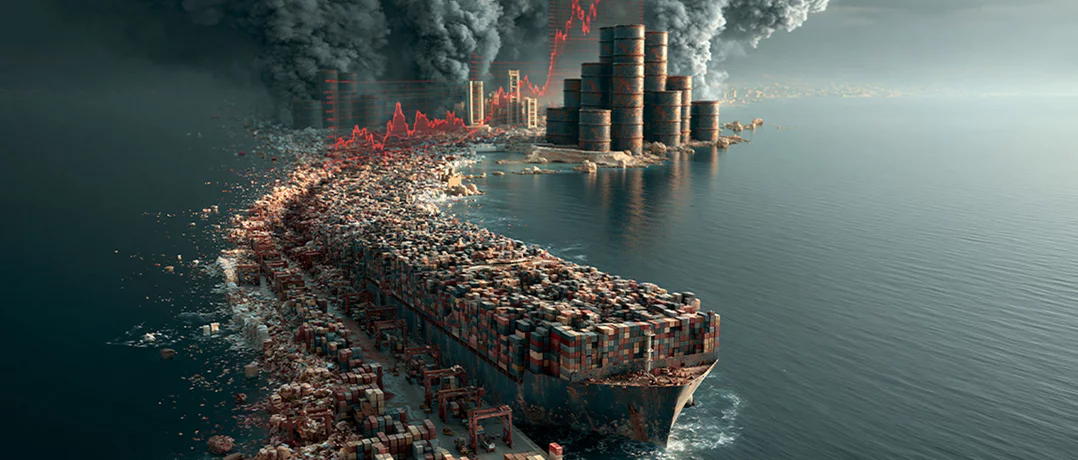
Reports suggesting that Iran has encouraged Yemen’s Houthi movement to prepare to disrupt navigation through the Bab el-Mandeb Strait have renewed concerns about the vulnerability of global trade routes. Although the Strait of Hormuz has traditionally been Tehran’s primary leverage point, Bab el-Mandeb has increasingly emerged as another potential pressure tool capable of affecting global energy markets and international shipping.
Any disruption to navigation through this narrow passage would extend far beyond the Red Sea. It would directly impact global supply chains, energy prices, maritime insurance, and international commerce. For Lebanon, whose economy depends overwhelmingly on imports and remains highly vulnerable after years of financial crisis, the consequences would likely be immediate and severe.
Speaking to The Beiruter, retired Lebanese Brigadier General George Nader examined how such a scenario could affect Lebanon, the broader region, and the prospects of further military escalation.
Lebanon’s economic vulnerability
Nader believes Lebanon would be among the countries most exposed to any disruption in navigation through Bab el-Mandeb because of its dependence on maritime trade.
He explained that a considerable portion of global commerce passes through the Strait before entering the Red Sea, transiting the Suez Canal, and reaching the Mediterranean. Any interruption along that route, he argued, would inevitably affect Lebanon alongside Europe and much of the global economy.
According to Nader, the impact would extend well beyond consumer goods. Oil and liquefied natural gas (LNG) shipments would also be affected, placing additional pressure on international energy markets and increasing costs for countries reliant on imported fuel, including Lebanon.
The Port of Beirut, which serves as one of Lebanon’s principal commercial gateways, would also face significant challenges. Delays in maritime traffic, higher freight costs, and longer shipping routes would inevitably affect imports while reducing the efficiency of regional trade.
The Port of Beirut would certainly be affected, and Lebanon as a whole would face significant economic pressure if the Bab el-Mandeb Strait were closed.
Although Lebanon exports a portion of its agricultural products overland to the Kingdom of Saudi Arabia (KSA) and neighboring Gulf countries, Nader stressed that maritime transportation remains substantially more economical because ships can carry significantly larger quantities than trucks. If maritime routes become less accessible, exporters would face higher transportation costs and reduced competitiveness.
More importantly, he noted, overland transportation cannot replace maritime imports of fuel and LNG from Gulf producers, leaving Lebanon particularly exposed to disruptions affecting international shipping lanes.
The strategic value of Lebanon’s pipeline infrastructure
Beyond the immediate commercial impact, Nader highlighted what he considers one of Lebanon’s overlooked strategic assets: its dormant oil pipeline infrastructure.
He recalled that Lebanon previously benefited from the Iraqi Petroleum Company (IPC) pipeline, which transported Iraqi crude oil to Tripoli, and the Trans-Arabian Pipeline (Tapline), which carried Saudi oil to the Zahrani terminal in southern Lebanon. Both pipelines, however, ceased operations decades ago. According to Nader, rehabilitating these pipelines could fundamentally reduce Lebanon’s vulnerability to maritime crises.
If these two pipelines were reactivated, Lebanon would no longer be vulnerable to either the Bab el-Mandeb Strait or the Strait of Hormuz because oil would reach us through overland pipeline infrastructure.
He argued that transporting petroleum through pipelines is considerably safer, cheaper, and more efficient than relying exclusively on maritime shipping. Having lived near the IPC facilities, Nader recalled the pipeline’s broader economic significance, noting that it employed between 3,000 and 4,000 Lebanese workers while serving as an important component of Lebanon’s energy infrastructure.
In his assessment, restoring these networks would not only strengthen Lebanon’s energy security but also diversify supply routes at a time when maritime chokepoints are becoming increasingly vulnerable to geopolitical tensions.
Can the Houthis actually close Bab el-Mandeb?
While Iran may view Bab el-Mandeb as an important strategic pressure card, Nader remains skeptical that the Houthis possess the military capabilities required to impose a complete blockade.
He acknowledged that the group could disrupt commercial shipping through missile attacks, drones, or other asymmetric tactics. However, permanently controlling one of the world’s busiest maritime corridors would require capabilities that, in his view, the Houthis simply do not possess.
I do not believe the Houthis have either the manpower or the technological capabilities required to control the Strait completely.
Instead, Nader believes the group can create uncertainty, raise insurance costs, and temporarily obstruct maritime traffic without fully shutting down navigation.
He also questioned whether Iran has deliberately refrained from escalating further out of concern that such actions would provoke overwhelming American military retaliation. Tehran, he argued, cannot afford a scenario that leads to devastating strikes against Iran itself or against Houthi-controlled territory in Yemen.
For that reason, Nader believes any Houthi escalation would likely remain limited to disruption rather than an outright closure of the Strait.
Nader also warned that any major Houthi escalation could quickly expand beyond Yemen if Iran chose to activate other actors in what it refers to as the “Axis of Resistance.” He questioned whether Hezbollah would remain outside the conflict should Iran issue direct instructions to intervene.
I do not believe Hezbollah could refuse a directive from the leadership directing it from Iran.
Having already suffered the consequences of previous conflicts, Lebanon could once again find itself facing severe humanitarian and economic devastation should regional escalation spread to its territory.
The geopolitical importance of the strait
The Bab el-Mandeb Strait occupies one of the most strategic locations in the global maritime system. Situated between Yemen on the Arabian Peninsula and Djibouti and Eritrea on the Horn of Africa, it serves as the southern gateway to the Red Sea and the Suez Canal, connecting Europe with Asia through one of the busiest commercial shipping corridors in the world.
Often referred to as the “Gate of Tears,” the strait has been strategically significant for centuries. Since the opening of the Suez Canal in 1869, its importance has grown exponentially, becoming indispensable to international trade and global energy transportation.
A substantial share of world commerce (including oil, LNG, food supplies, manufactured goods, industrial equipment, and consumer products) passes through Bab el-Mandeb every year. Its strategic value has become even greater as energy producers increasingly diversify export routes away from other vulnerable maritime chokepoints.
Because of this importance, several global powers maintain permanent military deployments near the strait. The U.S., France, China, Japan, Italy, and other countries operate military facilities in Djibouti, reflecting the international consensus that safeguarding navigation through Bab el-Mandeb is essential for global economic stability.
Should shipping through the strait be disrupted, vessels traveling between Asia and Europe would have little alternative but to sail around the Cape of Good Hope at the southern tip of Africa. Such a detour would add thousands of nautical miles to each journey, significantly increasing transit times, transportation costs, insurance premiums, and pressure on already fragile global supply chains.
Hence, the Bab el-Mandeb crisis illustrates, once again, how regional conflicts increasingly extend beyond military confrontations, with strategic maritime chokepoints becoming powerful instruments capable of reshaping both regional and global trade, security, and economic stability, including in Lebanon itself.
-
-

-
The Beiruter
-
