



How aesthetic becomes power and power becomes aesthetic
How aesthetic becomes power and power becomes aesthetic
By Razan El Helou | March 17, 2026

Reading time: 4 min
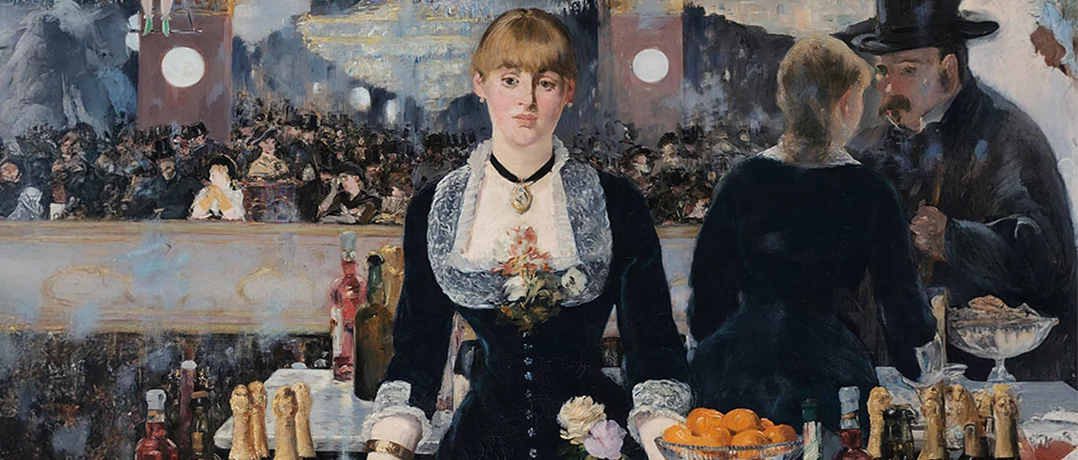
"Un Bar aux Folies-Bergère" by Édouard Manet (1882) - in public domain
“L’Esthétique naquit un jour d’une remarque et d’un appétit de Philosophe”
– Paul Valéry, Discours sur l’Esthétique,1937, p.7.
Aesthetics was once thought of alongside ethics and logic, as one of the areas concerned with how we shape our thinking and lives. If ethics asks what is good, logic asks what is sound, then aesthetics asks three things: what we find beautiful, what we call refined, and what we consider in good taste.
So, what is aesthetics?
Aesthetic, as a term, carries multiple meanings. In everyday language, it can refer to an appreciation of something beautiful. In contemporary culture and social media, it can refer to a curated, recognisable, intentionally shaped mood, vibe, or appearance. Better described as: “it’s giving misunderstood tortured intellect aggressively underlining The Communist Manifesto using an overly sharpened pencil while smoking a hand rolled cigarette at a public café” or the more commonly known: Alo, Matcha, Pilates?
From the slightly romanticised view of Schopenhauer (1818), aesthetic contemplation offers a temporary release from suffering, for in moments of artistic experience we are freed, however briefly, from the restless striving of the will.
While for Hegel (1835), aesthetics shaped the philosophy of art through which society understands itself. This means that through looking at what a society values and categorises as beautiful, you can understand the way it thinks in law, politics, and beyond. A view I am most inclined to in this article.
As for Nietzsche (1872), he takes aesthetics a step further, justifying existence as an aesthetic phenomenon. He invites us to affirm our existence through creation, rather than navigating the world through moral argument. While this is not what I aim to adopt here, it is a stance worth imagining. As for the question of morality, I will cover it in the next article that is concerned with goodness.
Here, I encourage us to focus on aesthetics as having the three aforementioned aims: (1) the rules of art, (2) the laws of the beautiful, (3) and the code of taste. In other words, as a set of measures that inherently include and exclude.
Unlike beauty, aesthetics in this sense is temporary, shifting, and reliant on culture, space, and time. We will take two examples to illustrate the violence of aesthetics, but while reflecting, I hope we manage to observe and describe a phenomenon rather than critique it. What is “right” is once again not the aim of unpacking aesthetics for this article.
These two examples will tackle a purposefully generalised aesthetic for women and for men within Lebanese culture.
The power of aesthetic – Soltat al-Jamal:
Have you ever taken a Pilates session in Beirut? A majority-women class dressed in matching sets, wearing stacks of jewellery, working out intensely and somehow barely sweating. It is visually quite beautiful, yet rather alienating.
Instagram ads from beauty surgeons, and at times unlicensed clinics, offering Botox injections in the armpits to reduce “excessive” sweating. A potentially medical condition promoted as a condition and standard for femininity.
Your youth must be preserved, skin must be flawless, body must be hairless, nails must be done, weight must be managed except in areas that are desirable, lips full, and hair long and straightened. This is not vanity. These standards are seen as expectations to be recognised as a feminine woman who is desirable.
So, this aesthetic, while carrying beauty, while empowering to some, is inherently violent. The power of aesthetics then governs without public declaration.
The aestheticisation of power - Jamal al-Solta:
Can we recognise how aesthetics governs our image of masculinity?
The standard of being a man, of being masculine, becomes tied to positionality and materialistic wealth. As a man, you must man-age.
Stability and control are seen as signs of power, and power as a sign of manliness. Therefore, you must be a manager or own your business. You must have a good car, preferably a big one. You must speak with authority. You must wear an expensive watch and take a photo while looking away with sunglasses on (even on a cloudy day). You must verbalise anger but must not express other emotions.
The two examples form a cycle, feeding into one another. They are not absolute, and they have changed and will continue to change.
I anticipate this article to be scrutinised as an attack on a structure that has nothing wrong with it, or rather a false claim of promoting the opposite of the generalised aesthetics mentioned. I do not wish to make these assertions, I only suggest that aesthetics may dictate who we are and how we act, which at its core create conditions for being, which come hand in hand with violence.
It would be appropriate in this context to recall the popular Lebanese proverb:
“كُل ع ذوقك والبس ع ذوق الناس”
(Kol ʿa zawʾak w lbos ʿa zoʾ el-nās).
This proverb perfectly encapsulates the meaning of aesthetics portrayed here. In it, we are advised that in private matters, like what to eat, we should follow our preferences. However, in public matters, like our appearance, it is best to conform to expectations.
You may choose to agree and conform, or feel frustrated, or simply feel neutral towards it. Afterall, that is your valid personal experience. Whatever your response is, it plays a role in this cycle irrespective of right or wrong.
These proverbs come from somewhere, perhaps as we hear them so often, we rarely stop and ask, what are these sayings telling us?
In the last article, I invited you to reflect on the beauty around you. As for today’s reflection, consider: what is an aesthetic standard you felt you needed to adhere to?
-
-
-
Razan El HelouPhD researcher on peace education, storytelling, and politics
-
