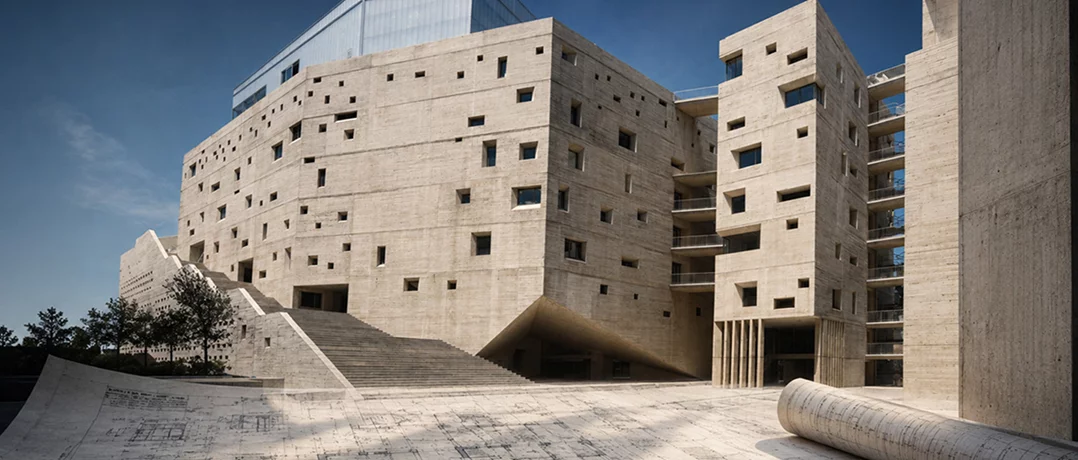
In Lebanon, architecture has never simply been about buildings. Every skyline, apartment block, university campus, and unfinished tower reflects the political, economic, and social ambitions of the era that produced it. Since gaining independence in 1943, Lebanon has experienced periods of extraordinary optimism, devastating conflict, ambitious reconstruction, and prolonged economic collapse. Each chapter has left behind a distinct architectural language, turning Beirut and other Lebanese cities into physical records of the country’s evolving identity. Rather than replacing one another, these architectural movements coexist. A modernist office building from the 1960s may stand beside a brutalist university complex, while a post-war glass tower overlooks an abandoned concrete skeleton left unfinished by the country’s financial crisis. Together, they tell the story of a nation that has repeatedly reinvented itself without ever fully completing the process.
Modernism: Building a new republic
Following independence, Lebanon entered a period of rapid economic growth. During the 1950s and 1960s, Beirut established itself as a regional financial center, attracting banks, international businesses, tourists, and cultural institutions. This optimism found expression in architecture. Modernism became the architectural language of the new republic. Clean geometric forms, reinforced concrete, curtain walls of glass, and minimal ornamentation replaced historical revival styles. Architects embraced functionality and technological innovation while looking toward Europe and North America for inspiration. Buildings such as the Phoenicia Hotel Beirut symbolized a country confident in its future. Hotels, cinemas, banks, and office towers reflected Lebanon’s ambition to become the commercial and cultural crossroads of the Middle East.
Yet Lebanese modernism was never a simple imitation of international trends. Architects adapted their designs to the Mediterranean climate through deep balconies, sun-shading devices, natural ventilation, and locally sourced stone. The result was a distinctly Lebanese interpretation of modern architecture, one that balanced global influences with local environmental conditions. Modernism represented more than architectural progress. It reflected a political vision of Lebanon as an outward-looking, cosmopolitan nation that believed prosperity and modernization would define its future.
Brutalism: The architecture of institutions
As Lebanon expanded its universities, government agencies, and public infrastructure during the 1960s and early 1970s, another architectural movement emerged: Brutalism. Characterized by exposed concrete, monumental forms, and structural honesty, Brutalism became associated with permanence and institutional authority. Universities, government buildings, and public facilities increasingly adopted the style, expressing confidence in education, public investment, and state-building. Many brutalist buildings remain controversial. Some admire their bold sculptural qualities, while others view them as imposing relics of another era. Yet these structures reveal an important moment in Lebanese history, when architecture sought to project stability and institutional strength. Today, renewed interest in Brutalism has encouraged architects and historians to reconsider buildings once dismissed as outdated, recognizing them instead as important examples of Lebanon’s modern architectural heritage.
War and the transformation of architecture
The Lebanese Civil War fundamentally altered the relationship between architecture and the city. Buildings originally designed to symbolize prosperity became military positions. Hotels turned into strategic strongholds, residential buildings became front lines, and countless structures were damaged by shelling and gunfire. Perhaps the most significant architectural consequence of the war was that buildings stopped representing the future and began preserving memory. Many structures still bear visible traces of conflict, reminding residents that architecture can function not only as shelter but also as historical evidence. Unlike monuments deliberately built to commemorate history, these buildings became monuments through survival.
Post-war reconstruction: Rebuilding an economy
Following the end of the civil war, reconstruction became one of Lebanon’s largest national projects. Large sections of central Beirut were rebuilt, introducing luxury residential developments, commercial districts, and restored historic façades. The goal extended beyond repairing damaged infrastructure. Reconstruction sought to revive Beirut’s role as a regional business and tourism hub. The process, however, generated significant debate. Supporters argued that rebuilding was essential for economic recovery and international investment. Critics questioned whether reconstruction prioritized commercial interests over preserving the city’s social fabric and architectural diversity. The restored downtown became symbolic of this debate. While many historic façades returned, some argued that reconstruction created an environment that reflected financial ambition more than everyday urban life. The discussion continues today, raising broader questions about who cities are rebuilt for and whether reconstruction can preserve memory while encouraging development.
Contemporary architecture: Between globalization and identity
Over the past two decades, Lebanon’s skyline has increasingly been shaped by luxury residential towers and internationally influenced architecture. Glass façades, steel structures, and minimalist forms dominate many new developments, reflecting global architectural trends rather than specifically Lebanese traditions. This transformation has prompted architects to reconsider an important question: what makes contemporary Lebanese architecture uniquely Lebanese? Rather than replicating traditional forms, many younger architects have begun reinterpreting local materials, passive cooling techniques, stone craftsmanship, and spatial relationships in contemporary ways. Their work suggests that architectural identity does not require copying the past but understanding it. At the same time, soaring property values and large-scale developments have intensified concerns over the disappearance of mid-century buildings and historic neighborhoods, forcing Lebanon to confront difficult choices between preservation and urban growth.
The architecture of crisis: Unfinished Lebanon
Perhaps no architectural style better captures contemporary Lebanon than the unfinished building. Across Beirut and other cities, concrete frames stand frozen in time. Some projects were interrupted by the civil war. Others stalled after the financial collapse of 2019, while additional developments remain suspended because of rising construction costs and economic uncertainty. Unlike completed towers that project confidence, unfinished buildings reveal uncertainty. Their exposed columns, empty floors, and rusting reinforcement bars have become visual reminders of interrupted ambitions. These structures were originally designed to symbolize growth, investment, and progress. Instead, they have become monuments to economic instability and political paralysis. Ironically, these unfinished buildings may represent modern Lebanon more honestly than any completed skyline. They embody a country whose aspirations have repeatedly collided with crisis, leaving development permanently suspended between what was imagined and what was ultimately achieved.
Lebanon’s post-independence architecture is often described as fragmented. Yet fragmentation may be precisely what defines it. Modernist optimism, brutalist confidence, post-war reconstruction, contemporary globalization, and unfinished developments each represent a different vision of the country’s future. None erased the one before it. Instead, they accumulated, producing a city where multiple versions of Lebanon coexist within the same streets. Architecture therefore becomes more than an artistic discipline. It serves as a political archive, recording moments of confidence, conflict, recovery, and uncertainty in concrete, stone, and glass. Walking through Beirut is not simply moving through neighborhoods. It is moving through successive attempts to imagine what Lebanon could become. As the country continues to debate its future, its architecture offers a powerful reminder that buildings do more than shape cities. They preserve ambitions, reveal failures, and quietly document the history of a nation still under construction.