



Israel’s wars in Gaza and Lebanon are accelerating a new era of robotic warfare with machines increasingly taking frontline combat roles.
How Israel is reshaping war with robots

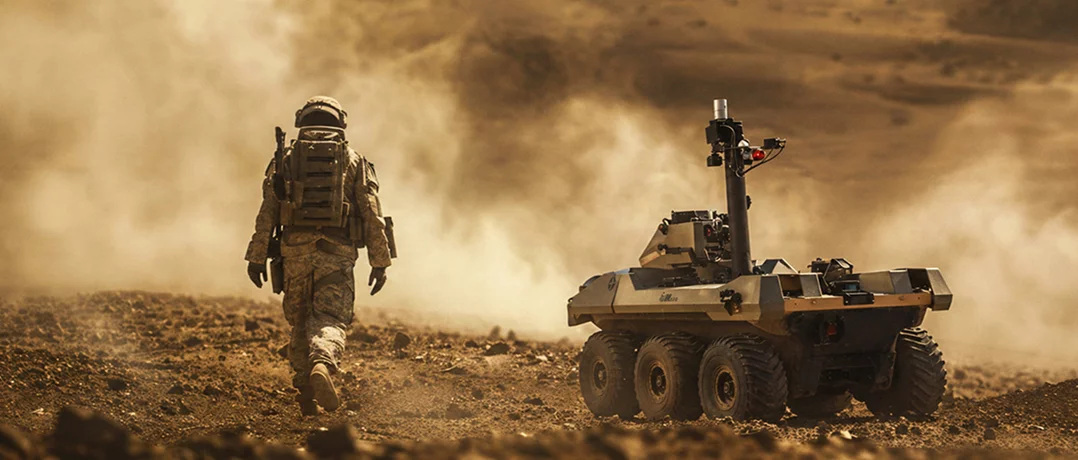
Modern warfare is undergoing a profound transformation. Across active conflict zones, armies are increasingly deploying robotic and automated systems to carry out missions that once required soldiers on the ground, clearing routes, scanning buildings, demolishing fortified positions. The driver is a principle as old as military strategy itself: achieve maximum operational effect while minimizing human cost. What is new is the technology now available to pursue it.
Since the outbreak of war following October 7, 2023, Israel has turned its conflicts into an unprecedented laboratory for robotic warfare at scale. Col. (ret.) Yaron Sarig, head of the AI and Autonomy Program Executive Office within Israel's Defense Ministry, has called the Israel-Hamas war the world's "first robotics war." That designation is now extending northward. The IDF has escalated the use of robots in operations against Hezbollah in Bint Jbeil, deploying them to accelerate the destruction of weapons infrastructure while reducing risk to troops.
The doctrine: Maximum effect, minimum exposure
The strategic logic behind this shift is straightforward. Robotic systems not only reduce the danger to troops but also help offset manpower shortages and enable operations in especially challenging environments, including tunnel networks, densely populated urban areas, and other locations difficult for ground forces to reach. In South Lebanon specifically, the terrain compounds the challenge: Lebanon's rugged, mountainous landscape severely limits the movement of heavy engineering equipment, forcing troops to rely on complex field improvisations amid dense vegetation that conceals militant infrastructure.
An Israeli military official said that the army has been using "robotic tools for over a decade, but in very small numbers. Now it is being used in large-scale warfare." The shift from niche capability to central operational pillar happened fast, and its consequences are still being absorbed by military analysts around the world.
Three systems, three frontiers
Robdozer
The Robdozer, the robotic version of Caterpillar's D9 bulldozer, developed by Israel Aerospace Industries, is used to clear roads for advancing troops, remove rubble, and flatten terrain, all without exposing an operator to fire. Its real battlefield value, however, goes beyond earthmoving. In Gaza and now Lebanon, it carries out precision remote demolitions of booby-trapped structures, neutralizing explosive hazards before soldiers arrive. The lead engineer behind the Robdozer described the platform's enhanced precision and endurance as allowing it to handle high-risk missions "even better than a human," and Andrew Fox, a retired British army major and research fellow at the Henry Jackson Society, called it "a really big development" that is "changing the paradigm" of warfare.
Jaguar
Developed by Israel Aerospace Industries, the Jaguar is a semi-autonomous robotic system built on a six-wheeled chassis and equipped with a 7.62 mm MAG machine gun that operates both while stationary and on the move. It integrates high-resolution cameras, transmitters, powerful headlights, a remote-controlled public address system, dozens of sensors, and an automated driving system. Crucially, it has the ability to self-destruct if it falls into enemy hands. Originally deployed to patrol the Gaza perimeter, the Jaguar has since been adapted for a wider range of missions, including advancing into buildings and urban areas where soldiers would otherwise face direct fire. Its armored shell and remote operation make it one of the IDF's most versatile front-line assets.
Vision 60
Vision 60 units are semi-autonomous dog-shaped walking robots created by US-based Ghost Robotics, used by Israeli forces in tunnels to identify traps and enemy positions, and for the surveillance of alleged enemy positions. Equipped with sensors, recording equipment, and systems that enable operation in unknown environments, they can cover up to 10 km at three meters per second and can adjust their pace or halt without human command. They are also capable of 3D mapping of their surroundings using laser radar, helping them locate hidden explosive charges.
From Gaza to Lebanon: A Live Field Test
The IDF's Yahalom commando unit, the elite arm of the Combat Engineering Corps, has deployed robots inside Hezbollah tunnels and other confined spaces where traditional operations pose elevated risks. The systems are used for tasks such as detonating booby-trapped structures and scanning hazardous zones, with photographs relayed by the robots accelerating the identification and destruction of Hezbollah's long-term weapons infrastructure. The IDF plans to expand deployment of robots to high-risk demolition missions targeting large, strategic infrastructure in areas previously beyond the reach of ground forces.
The broader context matters. The IDF's new five-year plan, known as "Hoshen," covering 2026-2030 and reflecting lessons from over two years of continuous war, places heavy emphasis on robotics and autonomous systems, intending to dramatically expand the use of unmanned platforms across land, sea, and air forces, both independently and in coordination with human soldiers.
Power and its questions
The tactical advantages of robotic warfare are significant and real. But the proliferation of autonomous and semi-autonomous systems also raises questions that the battlefield cannot answer. When a machine makes a lethal decision, or enables one at a remove, questions of accountability, proportionality, and the laws of armed conflict become harder to resolve. While such systems are currently operated by humans, future versions could be autonomous, raising ethical and legal concerns over the uncharted future of warfare being shaped by the Israeli military in the Gaza war.
What is certain is that the model is spreading. The robotic battlefield being tested in the rubble of Gaza and the hills of South Lebanon is not a regional experiment, it is a preview. Armies worldwide are watching, learning, and preparing to follow.
-
-

-
Jenna GeageaReporter/Writer
-
