



From its historical roots to modern artistic movements, Arabic calligraphy continues to evolve as a powerful expression of cultural heritage, national identity and artistic innovation.
How Lebanese artists reimagined the Arabic letter
How Lebanese artists reimagined the Arabic letter
By The Beiruter | October 27, 2026

Reading time: 4 min
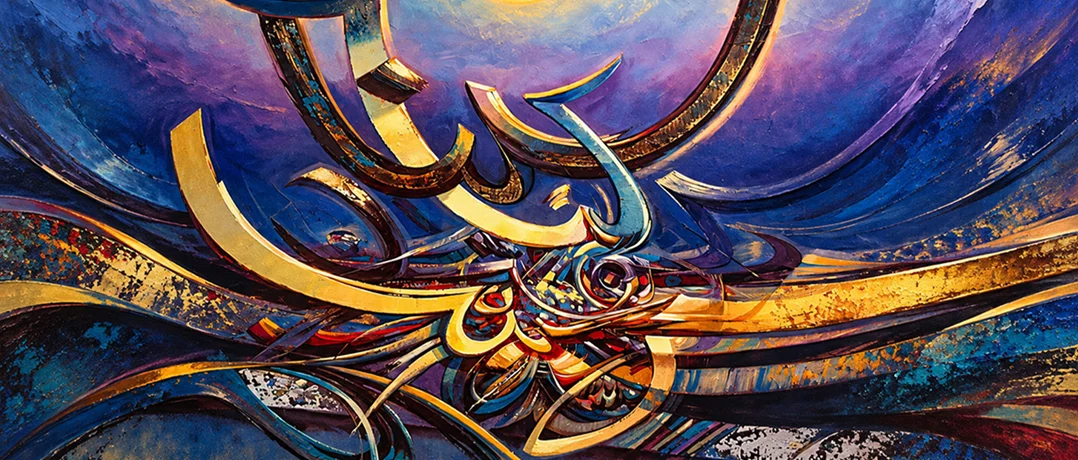
Calligraphy is deeply rooted in the Arabic language, cultural heritage and national identity. Defined by its fluid rhythm of vertical lines, curves and horizontals, Arabic script brings together artistic expression and structural precision.
A single vertical stroke, the alif, is the unit by which the entire Arabic script is measured. Calligraphers reckon every other letter against its height and against the diamond-shaped dot of the pen. That humble line has become the starting point for one of the Arab world’s most inventive artistic conversations.
The script itself dates to the fourth century and is now the second most widely used alphabetic system on earth. Two principal forms emerged early in the Muslim era, angular Kufic, named for the Mesopotamian town of Kufah, and the suppler Naskh. By the ninth century, writing had outgrown its practical role.
In 1733, a monastery press at Shuwayr in Mount Lebanon began producing books in Arabic type cut by Abdallah Zakhir, among the earliest such presses in the Arab world. The region’s scribal and printing traditions fed the intellectual awakening of the nineteenth century, when questions of language and belonging moved to the center of public life.
As French spread through schools and administration, Arab intellectuals and artists turned to calligraphy as a defense against cultural displacement. By the late nineteenth and early twentieth centuries, the art had become a potent emblem of national identity, fusing aesthetic, religious and political discourse. It blurred the line between East and West and asserted an Arab originality that no mandate could erase.
An artistic movement
The Hurufiyya movement, which took shape in the 1960s, turned that assertion into a modern idiom. Its artists placed Arabic letters inside abstract compositions, celebrating heritage while embracing modernity. No one embodied the spirit better than Etel Adnan (1925-2021). Raised under the French mandate, when Arabic was barred from her schools, she came to painting in Arabic as an act of reclamation. Her poetic, deliberately imperfect handwriting, which she believed dissolved the boundary between drawing and writing, turned words into forms and forms into a language of their own.
Alongside her, Wajih Nahle (1932-2017) coaxed letters into what might be called visual symphonies, their colors and lyrical abstraction echoing the movements of choreographed dance. Hussein Madi (1938-2024), in his “Arabic Alphabet” series, reduced letters to geometric shapes and found unity in repetition and symmetry.
Two figures stand at the movement’s center. Samir Sayegh (b. 1945), artist and university professor, merged traditional calligraphy with geometric minimalism, drawing on the angular Kufic of early Quranic manuscripts. His ink-and-acrylic works on paper or fabric echo the fluidity of Far Eastern calligraphy while remaining fixed in Arab tradition. Sayegh liberated the letter from its linguistic confines.
Rafic Charaf (1932-2003) travelled a different road. From the mid-1970s he wove Quranic calligraphy together with Arab talismans, charms and Byzantine-inspired motifs, lifting traditional artistry into high art. His work bridged the sacred and the secular, and it read as a commentary on identity, heritage and the human condition.
The script has also stepped off the page. Mona Saudi (1945-2022) carved verses inspired by Adonis into stone, staging a dialogue between text and form. Saloua Raouda Choucair (1916-2017) drew on Sufi poetry to create geometric sculptures whose rhythms recall poetic meter. Kameel Hawa (b. 1947) builds typographic sculptures around the Arabic word for art, testing the symmetry latent in the letters themselves.
A younger generation carries the inquiry forward. Ghaleb Hawila (b. 1992) sets Islamic motifs and abstract geometry in mixed-media installations of wood and steel. Zena El Khalil (b. 1976) turns to handmade inks and performance, shaping themes of healing and peace around the concept of Spanda, the universe’s creative pulse. Paper, canvas, textile, stone, glass and digital screens have all become their surfaces.
Not every encounter with the script deserves the name calligraphic art, and critics insist on the distinction. Western painting has often dropped Arabic lettering into representational scenes without grasping its purpose. Genuine modernization, by contrast, respects the foundational principles of line, point and circle while seeking new forms and media.
That discipline explains the art’s endurance in Lebanon. A tradition once governed by strict rules of proportion and continuity has proved elastic enough to hold sculpture and performance while remaining tied to language. Each work links past and present, and tells a story through a powerful intertwining of art and literature.
-
-
-
The Beiruter
-
