



Muqtada al-Sadr’s transformation from armed resistance leader to political heavyweight reflects Iraq’s evolving struggle between state authority and competing powers.
How Muqtada al-Sadr reinvented his movement

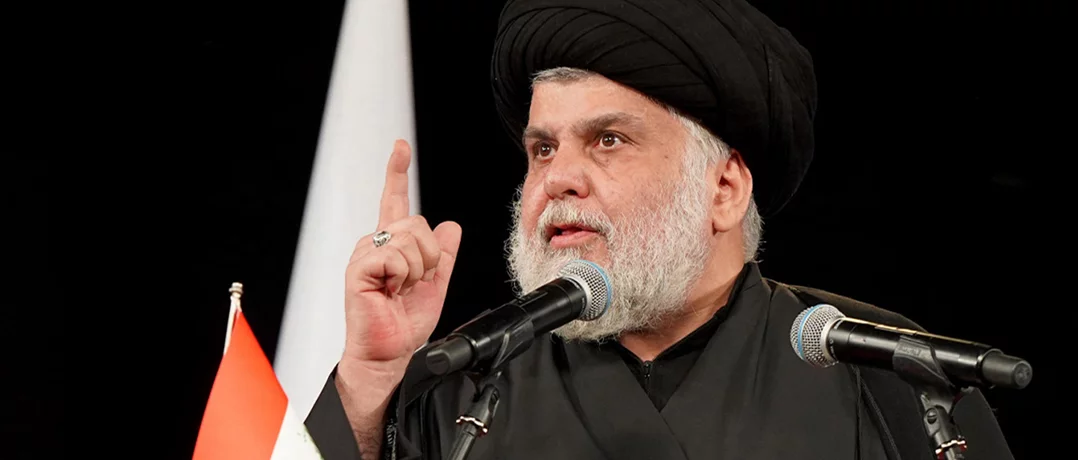
Muqtada al-Sadr remains one of the most influential and complex figures in post-2003 Iraq. At the center of his influence is the Sadrist movement. The latter has evolved from an insurgent force into a major electoral and institutional player, while maintaining a strong popular base among millions of Iraqis.
The recent decisions to integrate the movement’s armed wing, Saraya al-Salam (Peace Brigades), into Iraq’s official security institutions and dismantling the Promised Day Brigade represent another major turning point.
Muqtada al-Sadr: A religious legacy transformed into political power
Muqtada al-Sadr’s rise cannot be separated from the legacy of the Sadrist family, one of the most influential Shiite religious families in modern Iraqi history. Born in Najaf in 1973, Sadr is the son of Grand Ayatollah Muhammad Muhammad Sadiq al-Sadr, a prominent cleric who challenged Saddam Hussein’s regime during the 1990s by building a strong social and religious following among Iraq’s marginalized Shiite communities. His assassination in 1999, alongside two of his sons, elevated his status among many Shiites and created a legacy that would later be inherited by Muqtada.
Despite lacking the senior religious credentials of traditional Shiite clerics, Muqtada al-Sadr succeeded in converting his family’s symbolic authority into a powerful political identity. After the United States (U.S.)-led invasion of Iraq in 2003, he emerged as a prominent opponent of foreign occupation and quickly became a central figure among young and disadvantaged Shiite communities.
Initially, Sadr’s influence was built around resistance. Through the Mahdi Army, he challenged U.S. forces and became one of the most important armed actors during the early years of post-Saddam Iraq. However, his political strategy gradually evolved. Recognizing that long-term influence required institutional participation, he moved toward electoral politics and positioned himself as both an outsider challenging the system and an insider capable of influencing it. His ability to mobilize millions of supporters has made him a decisive actor in government formation, political negotiations, and moments of national crisis.
Unlike some Shiite political actors closely aligned with Tehran, Sadr has focused on an independent Iraqi identity, criticizing both American intervention and excessive Iranian influence.
The Sadrist movement: From grassroots religious network to political powerhouse
The Sadrist movement represents more than a political party; it is a broad social and ideological network rooted in religious institutions, community organizations, and popular mobilization.
Following the 2003 invasion, the movement initially emerged through the Mahdi Army, which served both as an armed organization and a social force filling the vacuum left by weakened state institutions. The group gained influence by providing security and services in areas where government authority was limited. However, its involvement in armed clashes and sectarian violence during Iraq’s civil conflict damaged its reputation and eventually pushed Sadr toward restructuring the movement.
In 2008, Sadr announced the suspension of the Mahdi Army’s military activities, shifting the movement toward political and social engagement. The transformation continued in 2014 when Saraya al-Salam was created following the rise of ISIS, officially presenting itself as a force dedicated to protecting holy sites and fighting extremist groups.
Politically, the Sadrist movement gradually became one of Iraq’s strongest electoral forces. It participated in elections, entered governments, and gained control over important political positions and ministries. However, it maintained an opposition-oriented identity by criticizing corruption, sectarian quotas, and the traditional system of political consensus.
This combination of institutional participation and anti-establishment rhetoric became the movement’s defining characteristic. It allowed the Sadrists to benefit from political power while maintaining their image as a reform movement challenging the existing order.
The movement’s influence reached its peak during the 2021 parliamentary elections, when the Sadrist bloc won the largest number of seats. Sadr attempted to establish a majority government that would exclude several rival Shiite factions, particularly those within the Coordination Framework. Although this strategy eventually failed and his lawmakers resigned, it demonstrated the movement’s ability to reshape political calculations and pressure competing factions.
A shift toward state-centered politics?
The decision to integrate Saraya al-Salam (Peace Brigades) into Iraq’s official security institutions represents one of the most significant developments in Muqtada al-Sadr’s political trajectory.
Under the new framework, Saraya al-Salam would end its separate organizational identity by abandoning independent headquarters, weapons, uniforms, and structures outside official state institutions. Instead, its members would be incorporated into Iraq’s formal security apparatus under the authority of the government and the commander-in-chief of the armed forces.
This decision follows a broader pattern of steps taken by Sadr to distance his movement from independent armed activity. With the conclusion of the International Coalition’s mission in Iraq and the withdrawal of U.S. forces, Sadr announced the dissolution of the Promised Day Brigade, another armed formation associated with the Sadrist movement. The move was presented as part of his call for strengthening Iraq’s official security institutions, empowering the armed forces, and ensuring that military capabilities remain exclusively under state authority.
The dissolution of the Promised Day Brigade and the integration of Saraya al-Salam represent a significant transformation compared with the movement’s early years after 2003, when armed resistance was a central component of the Sadrist project. By gradually moving away from independent military structures, Sadr has sought to redefine his movement as a political force committed to state sovereignty rather than parallel security arrangements.
The developments carry important implications. They not only reinforce the principle of state monopoly over armed force, but they also increase pressure on other armed factions, particularly those that continue to maintain independent military structures. By calling on other groups to follow a similar path, Sadr has transformed the issue of weapons control into a broader debate over the future of Iraq’s political and security order.
However, questions remain regarding the practical implementation and long-term consequences of these decisions. Iraq’s experience with integrating armed groups into state structures has often been complex, and previous announcements of restructuring have not always resulted in the complete disappearance of independent command networks. The effectiveness of Sadr’s initiative will depend on whether state institutions can ensure genuine integration, unified command, and accountability.
-
-

-
The Beiruter
-
