The story of Blessed Jacques the Capuchin and the enduring legacy of compassion that gave rise to Deir El Salib, one of Lebanon’s largest psychiatric care institutions.




The story of Blessed Jacques the Capuchin and the enduring legacy of compassion that gave rise to Deir El Salib, one of Lebanon’s largest psychiatric care institutions.

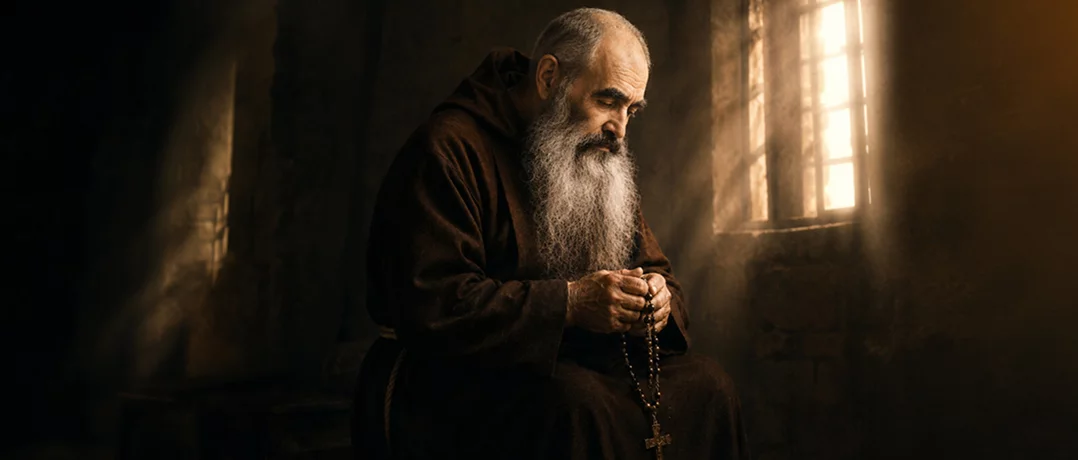
For many of its residents, Deir El Salib is the place where they found care when no one else could provide it.
Behind its gates, nearly 800 patients live with psychiatric illnesses, intellectual disabilities, and chronic conditions. Some have families who visit. Many do not. For some, the institution has become the only home they have ever known.
For decades, Deir El Salib has served as a refuge for some of Lebanon's most vulnerable people, growing into one of the largest psychiatric hospitals in the region. Yet its story is not primarily one of medicine. It is the story of a priest who believed that the value of a society could be measured by how it treats those whom everyone else forgets.
That priest was Blessed Jacques the Capuchin.
This year, on the anniversary of his beatification, his legacy continues to shape the lives of thousands.
Born Khalil Haddad in Ghazir on February 1, 1875, Blessed Jacques grew up in a deeply religious Maronite family. At sixteen, he left Lebanon to work as a teacher in Alexandria, Egypt, helping support his family.
There, two encounters would alter the course of his life. One priest inspired him through his holiness. Another disappointed him through his conduct.
The contrast stayed with him.
"I will be a priest like him," he said of the first.
"I will be a priest in his place," he said of the second.
In 1894, he entered the Capuchin order and received the name Jacques. Seven years later, he was ordained a priest.
Those who knew him would later remember him as an extraordinary preacher, educator and organizer. By 1910, the network of schools under his supervision had grown to 230 institutions serving approximately 7,500 students across Lebanon. He preached throughout Lebanon, Syria, Palestine and Iraq, wrote extensively, organized pilgrimages and founded charitable associations.
But it was not his sermons that would leave the deepest mark on Lebanon. It was his response to suffering.
During World War I, Lebanon was devastated by famine, disease and poverty. Father Jacques distributed bread to the hungry, buried abandoned bodies and cared for those left behind by society.
The experience transformed his understanding of charity.
For him, mercy could not be selective. The poor mattered. The elderly mattered. The disabled mattered. And so did those suffering from mental illness.
At a time when psychiatric patients were often hidden away or abandoned altogether, Father Jacques saw something different. These individuals were not burdens. They were human beings deserving of love and care.
What eventually became Deir El Salib began modestly.
In 1919, Father Jacques established a refuge on a hill. Over time it welcomed elderly priests, the disabled, the abandoned and those who had nowhere else to go.
The institution continued to expand until it was officially recognized by the Lebanese government on February 5, 1951 as a psychiatric hospital.
Today, the Hospital of the Cross consists of five pavilions, outpatient clinics, rehabilitation units, laboratories, occupational therapy workshops and specialized care facilities. It receives around 2,200 patients annually and currently houses approximately 800 residents.
More than half of its patients are non-Christians.
The fact would not have surprised its founder.
One phrase became synonymous with Father Jacques' mission:
"My sect is Lebanon, and the suffering."
Deir El Salib was only one part of Father Jacques' vision. Throughout his life, he built schools, orphanages, homes for elderly and sick priests, and institutions dedicated to caring for people living with disabilities, chronic illnesses, and mental health conditions.
Among the institutions that emerged from his mission were the Hospital of Deir El Qamar for girls with disabilities, the Hospital of Our Lady in Antelias for the chronically ill and elderly, Saint Joseph Hospital in Dora, the Sisters of the Cross School in Brummana for orphaned and vulnerable children, and the Hospice of Christ the King in Zouk Mosbeh.
To ensure this work would continue beyond his lifetime, Father Jacques founded the Franciscan Sisters of the Cross in 1930, entrusting them with a mission centered on mercy and service to society's most vulnerable.
Today, the congregation operates 23 institutions in Lebanon and abroad, including hospitals, schools, rehabilitation centers, and homes for the elderly and disabled. At Deir El Salib alone, more than 40 sisters work alongside doctors, nurses, and medical professionals, while 20 elderly bedridden sisters continue supporting the mission through prayer.
By the time of his death in 1954, Father Jacques had transformed a simple calling to serve into one of the most remarkable charitable legacies in modern Lebanese history—one that continues to touch thousands of lives every day.
When Father Jacques died on June 26, 1954, thousands gathered to mourn him.
His reputation for holiness continued to grow long after his death. In 1992, the Vatican recognized his heroic virtues. In 2007, Pope Benedict XVI approved a miracle attributed to his intercession. The following year, on June 22, 2008, he was beatified in Lebanon, marking the first beatification ceremony ever held outside the Vatican.
Yet his greatest legacy is not found in a title or a ceremony.
It lives on the corridors of Deir El Salib, in the sisters who have dedicated their lives to the forgotten, in the nurses and caregivers who show up every day, and in the hundreds of patients who have found dignity, care, and often a home.
More than seventy years after his death, Father Jacques' mission remains remarkably simple: no one should be left behind.