

Nearly twenty years after Lebanese authorities attempted to ban Persepolis, Marjane Satrapi's memoir continues to resonate with Lebanese audiences who see in its themes of war, exile, and loss echoes of their own experience.
How Persepolis found a Lebanese audience

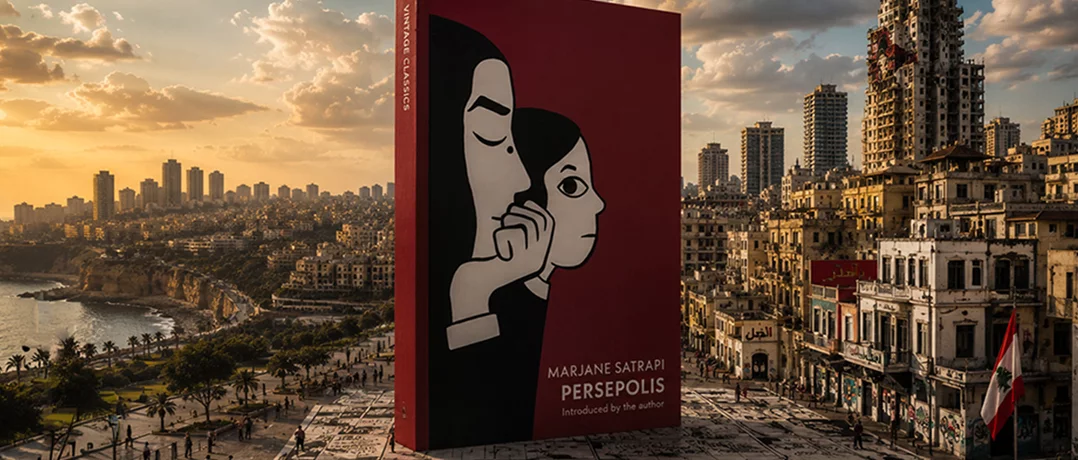
Few works of Middle Eastern literature have traveled as widely, or endured as successfully, as Marjane Satrapi's Persepolis. By 2024, the graphic memoir had sold more than 3.5 million copies in the United States alone, been translated into at least 24 languages, and earned a place on The New York Times' list of the 100 Best Books of the 21st Century. First published in French between 2000 and 2003, Satrapi's autobiographical account of growing up during and after Iran's Islamic Revolution transformed a deeply personal story into one of the most influential and widely read portrayals of modern Iran.
The book's success soon extended beyond the page. In 2007, Persepolis was adapted into an animated film that won the Jury Prize at the Cannes Film Festival and later received an Academy Award nomination for Best Animated Feature. Yet Lebanese audiences encountered the film under very different circumstances: authorities banned Persepolis in 2008 before a wave of criticism from artists, intellectuals, and political figures forced them to reverse the decision.
Nearly two decades later, however, the significance of Persepolis in Lebanon extends well beyond the controversy surrounding its release. While its themes of war and political upheaval have long been familiar to Lebanese audiences, the memoir now speaks not only to Iran's history, but also to questions many Lebanese continue to confront about exile, loss, and estrangement.
A book before it was a film
Long before Persepolis became the subject of a censorship dispute in Lebanon, it was already an international literary success.
Combining stark black-and-white illustrations with personal narrative, the work recounts her childhood during the Iranian Revolution, the Iran-Iraq War, and her eventual departure for Europe. The memoir was translated into Arabic in 2001, helping introduce readers across the region to a perspective on Iran that differed sharply from both official state narratives and Western political commentary.
The book arrived at a moment when graphic memoirs remained relatively uncommon in global publishing. By blending autobiography, political history, and illustration, Satrapi helped bring international attention to a literary form that was often dismissed as niche or juvenile. The work's success eventually made her one of the most recognizable literary voices associated with modern Iran.
Yet despite its distinctly Iranian setting, many readers outside the country found elements of their own experiences reflected in the story. That would prove especially true in Lebanon.
The ban that sparked curiosity
Censorship in Lebanon has long operated through a peculiar combination of official prohibition and practical impossibility. When the film Persepolis faced a ban in 2008, there existed no realistic mechanism to prevent determined viewers from accessing it. The film, which had already won the Jury Prize at Cannes and would later receive an Academy Award nomination, was denied a permit for theatrical exhibition. Yet bootleg copies circulated widely through the informal DVD networks that flourished across Lebanon before the rise of streaming services.
For political analyst and The Beirut Banyan host Ronnie Chatah, the controversy became his introduction to the work.
“I discovered the story because of its censorship in Lebanon,” he recalled.
The ban itself was widely understood as political. Although authorities never issued a detailed public explanation, officials acknowledged concerns that the film's criticism of Iran's revolutionary government could provoke tensions with Hezbollah and other pro-Iranian constituencies. The decision quickly drew criticism from artists, intellectuals, and even figures within the political establishment, ultimately forcing authorities to reverse course. The attempt to suppress Persepolis ultimately exposed more viewers to it than might otherwise have encountered it.
An Iranian story through a Lebanese lens
Yet the lasting significance of Persepolis in Lebanon lies not in the controversy it generated, but in the unexpected parallels readers drew between Satrapi's Iran and their own country.
At first glance, Satrapi's memoir appears removed from Lebanon. It is an Iranian story told by an Iranian woman reflecting on the upheavals of the Islamic Revolution and the Iran-Iraq War. Yet the work occupies an unusual cultural space. Written in French rather than Persian, it speaks through a language that remains deeply familiar to many Lebanese readers educated in francophone schools and universities. The result is a story that feels simultaneously foreign and recognizable.
“This is not a Lebanese story. This is an Iranian story,” Chatah said. “Yet listening to this girl in French made it almost feel like this could be a Lebanese girl's upbringing.”
That resonance deepened after 2006. The war between Hezbollah and Israel, which killed more than 1,000 Lebanese and displaced nearly one million people, marked a turning point in how many Lebanese viewed Iran's role in the country. As Syria's influence gradually receded following its military withdrawal in 2005, Iran became an increasingly prominent actor in Lebanese political life.
Looking back, Chatah argues that Persepolis offered an unusually human way of understanding those changes. Rather than presenting Iran through the language of geopolitics or ideology, the memoir explored how revolution and political upheaval reshape ordinary lives. As Iran became a larger part of Lebanese political discourse, many Lebanese found themselves paying closer attention to the country and its trajectory.
What made Persepolis different, he argued, was the perspective through which readers encountered that story. Rather than learning about Iran from government officials or political institutions, they encountered it through the experience of a young woman navigating revolution, war, and displacement.
"It's about getting to know Iran better, even when you don't want to," Chatah said.
You're getting to know Iran through its best advocates. Not the regime, not the Iranian ambassador, but a storyteller who fled the country and eventually sought asylum.
Exile and the geography of loss
If the memoir's political themes initially attracted Lebanese readers, its treatment of exile may explain why it continues to resonate.
The narrative depicts a girl growing up in a society organized around perpetual conflict, where questions of security gradually eclipse every other aspect of public life. By adulthood, she has become estranged from the country she remembers, unable to reconcile her memories of Iran with the reality she encounters when she attempts to return.
For Chatah, this dimension of the story has become increasingly powerful as Lebanon has experienced one of the largest waves of emigration in its modern history. Since 2019, economic collapse, political paralysis, the Beirut port explosion, and repeated conflicts have pushed hundreds of thousands of Lebanese to seek opportunities abroad.
"The story really is one of forced exile," he said.
It's that familiar pain of losing yourself and losing a country you love, then finding yourself far away and unable to identify that place anymore. That's how almost everyone I know abroad thinks about this country.
For Chatah, the emotional core of Persepolis is not departure itself but the realization that home may no longer exist in the form one remembers. Satrapi leaves Iran physically, but she also becomes estranged from the version of Iran she carries in her memory. That experience, he argues, has become familiar to many Lebanese both at home and abroad.
"The story becomes one of loss," Chatah said.
There's no recovery, there's no reclamation. It's simply losing something you love.
In that sense, the memoir speaks to what he describes as a shared state of mourning. Although the historical circumstances differ, both Iranians and Lebanese have watched countries central to their identities transformed by war, political upheaval, and emigration. The power of Persepolis lies not only in its portrayal of Iran, but in its ability to capture the grief that accompanies the loss of a place that still exists physically yet feels increasingly difficult to recognize.
Yet the resonance of Persepolis is not limited to Lebanese who left. For younger readers who came of age during the aftermath of the 2006 war, the economic collapse, the Beirut port explosion, and renewed conflict, the memoir offers a glimpse of something many feel they never experienced themselves: the memory of a more hopeful past.
The story hints at an Iran before 1979, allowing readers to understand that the country's current reality was neither inevitable nor permanent. Chatah believes younger Lebanese may find a similar lesson in Satrapi's memoir.
“It's the same story of a generation growing up unaware of a better time,” he said.
Beyond Iran
Part of Persepolis' enduring appeal lies in its refusal to remain confined to its original context.
Although rooted in the history of revolutionary Iran, the memoir speaks to experiences that extend far beyond national borders. Questions of memory, belonging, displacement, and identity resonate across societies shaped by conflict and migration.
Chatah compares Satrapi's work to that of Milan Kundera, whose novels explored exile and the experience of loving a homeland that no longer exists in recognizable form. In both cases, the subject is not simply politics but the psychological consequences of historical rupture.
Satrapi did not set out to write about Lebanon. Yet for many Lebanese readers, particularly those who have experienced displacement or watched their country transform beyond recognition, Persepolis has become something more than an Iranian memoir.
“I doubt she thought about Lebanon," Chatah said. “I’m sure her focus was on her life story and Iran.”
But that's the power of storytelling. It becomes universal.
In Lebanon, that universality has given Persepolis a lasting afterlife. What began as a memoir about revolutionary Iran has become, for many Lebanese readers, a meditation on exile, memory, and the unsettling experience of watching a country you love become increasingly difficult to recognize.
-
-

-
The Beiruter
-
