

In a city shaped by crisis and fatigue, Run Club Beirut has emerged as a grassroots movement where running becomes a form of collective healing, connection, and quiet resistance against fragmentation.
How Run Club Beirut turned running into community
How Run Club Beirut turned running into community
By The Beiruter | January 20, 2026

Reading time: 4 min
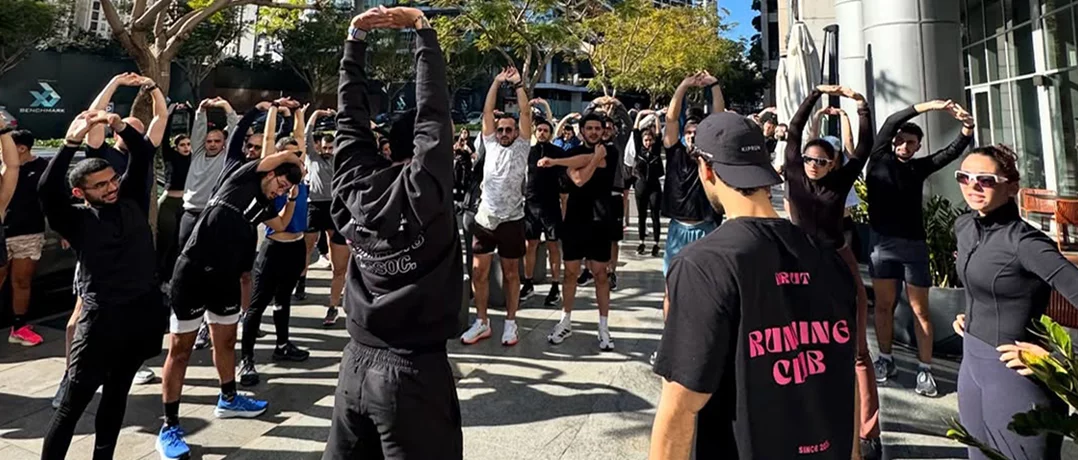
In a city long defined by rupture and the exhaustion that follows, a new kind of gathering has been taking shape on Beirut’s streets. It asks only that you show up, tie your shoes, and run. “Run Club Beirut” is, at first glance, a social running group. In reality, it has become something closer to a collective release, a space where movement replaces rhetoric, and routine stands in defiance of instability.
In an exclusive with The Beiruter, founders Jack Kassabian, Christopher Saab, and Hikmat Khattar, detail their project and journey. “Run Club Beirut is a social run club,” says Jack. “But more than that, it’s a community. We meet twice a week, Wednesdays and Sundays, to connect, to move with purpose, to heal.”
A club born from collapse and recovery
Run Club Beirut officially launched on March 12, 2025, founded by three friends. All three studied physical therapy and are currently pursuing advanced degrees in osteopathy, working across hospitals in Lebanon and Europe.
Besides professional ambition, the club emerged from personal fracture. A year and a half ago, Jack survived a near-death medical complication following what should have been a routine appendicitis. The recovery was slow, physically, and more painfully, mentally. “I was very depressed,” he says. “I isolated myself. I wasn’t the person I am today.” Running had once been part of his life, but never seriously. During recovery, it became a possible way back.
At the same time, he noticed a pattern abroad, in cities like Sydney, New York, Paris, Dubai, where run clubs had become modern gathering points, especially for young people craving structure and connection. He shared the idea with his closest friends. What started as a single run between a handful of people quickly turned into a shared vision.
From eight friends to a citywide community
The first Run Club Beirut run was modest by design. Eight friends. A simple route from Mar Mikhael to Saifi and back. Twelve people in total. The run was called “Rouha w Raj3a”, out and back.
Then they posted. Slowly, messages started coming in. How can we join? When is the next run? Where do you meet? What people responded to, Jack believes, was the atmosphere. “They liked the vibe. The idea behind it.” Today, less than a year later, Run Club Beirut draws runners of all backgrounds and abilities. The demographic skews young, mostly between 22 and 35, but age has never been a barrier. Teenagers run alongside people in their sixties. Athletes line up next to first-time runners.
“We don’t want an exclusive environment,” Jack says. “Our runs are designed with different levels, advanced, intermediate, beginner. Everyone runs together.”
Running without labels
In a country where identity is often filtered through sect, party, and position, Run Club Beirut operates on a deliberate refusal. Religion and politics are off-limits. “People come from all religions. Sunni, Shia, Christian, Druze… everyone,” Jack explains. “Even if people have different political views, talking about that is not allowed.”
The choice is intentional. Jack points to the post-2019 years, when moments of unity gave way to fragmentation, fatigue, and distance. “We were united for a while,” he says. “Then we drifted apart. We became further from each other in real life.” Run Club Beirut attempts something deceptively simple: removing the labels altogether. “It’s about good vibes, running, sport,” he says. “Spreading positivity and peace.”
Social wellness
What emerges from the runs is connection. “People who didn’t know each other before have formed real friendships,” Jack says. “Literal groups. Just like any friend group you already have.” Some relationships stay within the bounds of the run. Others extend outward, into coffees, routines, shared lives.
“What’s special is that it’s not divided,” he adds. “There’s no tension, no competition. It’s a safe environment.” The founders refer to this as social wellness, a concept increasingly emphasized in global health studies, and one often overlooked in Lebanon’s survival-driven culture. “Everyone talks about wellness,” Jack says. “But social wellness is just as important. Being connected directly affects your mental and physical health.”
Beyond Beirut
What began as a local response is now expanding outward. Run Club Beirut has already hosted runs in Paris and California. A London chapter, Run Club Beirut UK, is launching soon. “Our goal is to represent Beirut around the world,” Jack says. “And spread this mentality everywhere.”
The international presence has also turned the club into an unexpected meeting point for expats and foreigners. “Many people tell me, ‘When I used to come to Lebanon, I only saw the people I already knew,’” Jack says. “Here, you always meet new people. There are always new faces.”
What it wants to be remembered for
When asked what he hopes Run Club Beirut will ultimately stand for, “First of all, unity,” he says. “No matter the religion, no matter the political party, we are Lebanese.” He pauses. “We need to hold each other’s hands and build the country we want.”
Through running, he believes, even a simple message can carry unexpected weight. “If running can help spread positivity and hope,” he says, “I believe that alone can move mountains for Lebanon.” In a city where movement has long been synonymous with leaving, Run Club Beirut turns it into an act of presence: a collective choice to stay, to show up, and to keep moving forward.
-
-

-
The Beiruter
-
