



Lebanon’s 2026 budget is unraveling as war drives daily revenue losses and pushes the country back toward deficit and financial instability.
How the war blew up budget assumptions

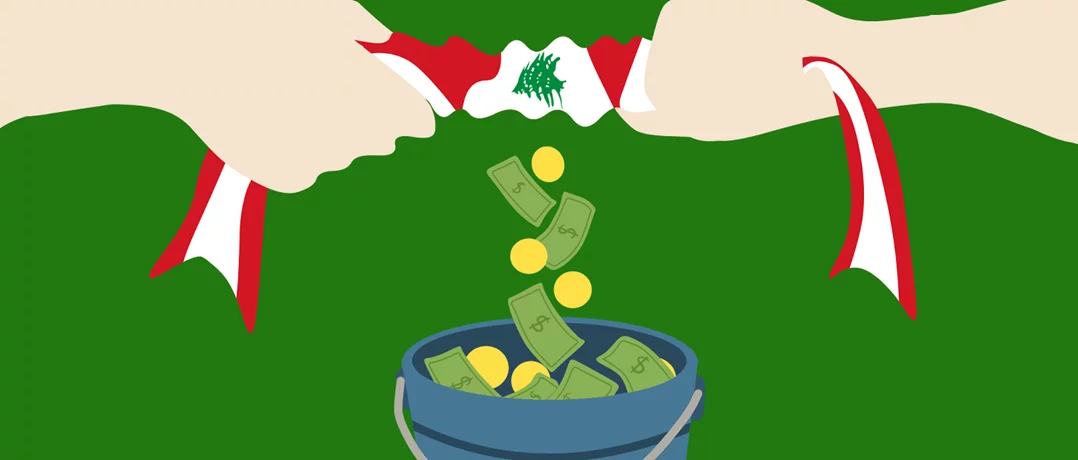
Lebanon’s problem is no longer confined to the budget figures engineered by the government on the assumption of stability. The war launched by Hezbollah in support of Iran has upended that assumption at its core, turning all financial projections into highly fragile bets.
The 2026 budget, built on the premise of achieving a zero balance between revenues and expenditures, has, since Hezbollah entered the war, come to belong to a different reality, one that is now placing pressure on public finances, administration, the economy, and even the state’s ability to collect revenues and spend.
Days ago, the “Arab Center” released estimates examining the budget figures and revealing the war’s impact. On the surface, the numbers suggest an attempt at control: expenditures of LBP 538,415 billion and revenues largely based on taxation, with a clear bet on a primary surplus of at least 2% of GDP and projected economic growth of 3.5% in 2026, driven by expected external financing, loans, and aid.
In substance, however, the report shows that the budget was built on a stable political and security environment and on a recovery path said to have begun after the autumn 2024 war. Once fighting resumed, with rocket exchanges and a widening conflict, the foundations of these projections collapsed.
Revenues in free fall
The first problem appeared quickly in revenues. The report clearly shows that war not only weakens economic activity but directly undermines the state’s ability to collect revenues. In the first nine months of 2024, average monthly revenues stood at LBP 26,222 billion, before dropping in the last three months, once the effects of war became evident, to LBP 23,345 billion.
The monthly gap of LBP 2,877 billion translates into a daily loss of approximately LBP 95.9 billion, around $1 million in public revenues per day, or an 11% daily decline. This is not just a technical figure; it signals that the treasury begins to bleed with every additional day of war.
Breaking down this decline reveals a deeper contraction. Customs revenues were among the hardest hit, due to reduced imports, falling domestic demand, and disruptions to transport and trade chains. Value-added tax (VAT) revenues also declined as consumption contracted and the state’s ability to collect weakened during wartime. Telecommunications revenues fell as well, reflecting the broader slowdown in economic activity.
The only relative exception was real estate fees, which increased, likely due to delayed transactions and settlements rushed before the end of the fiscal year. But this does not alter the overall trend: war strikes at core revenue streams precisely when spending needs are rising.
Rising costs, hidden pressures
On the expenditure side, the risks are no less severe, even if the government has attempted to project discipline. The report notes that reconstruction costs were not meaningfully included in the 2025 budget. Instead, only limited allocations were made to the High Relief Commission and the Council for the South, alongside modest transfers for debris removal, at a time when estimated reconstruction costs exceed $10 billion.
Worse still, future pressures may go beyond rebuilding damage to include housing allowances and compensation for destroyed homes, meaning the treasury faces additional burdens at a time when it is already weighed down by the legacy of the 2019 financial collapse.
These obligations extend beyond war and reconstruction. The report highlights major pending liabilities outside the immediate fiscal picture: restructuring Eurobond debt, payments owed to Iraq for fuel shipments, the need to recapitalize Special Drawing Rights, and the cost of improving public sector wages after years of collapse in their real value.
The government has approved additional increases and grants for the public sector worth LBP 69,810 billion (around $780 million), attempting to finance them through higher fuel consumption taxes. But rising global oil prices have increased the burden further, opening the door to inflationary pressures that will affect both prices and public finances.
More concerning is that part of the spending does not appear transparently in the budget. According to the report, the government has expanded off-budget spending through loans from the World Bank and the European Union, totaling around $964.8 million, covering reconstruction, agriculture, renewable energy, and water projects.
While these funds may address urgent needs, they remain debt with deferred costs. The government is not only postponing solutions but also delaying the appearance of the true fiscal burden. The paradox is clear: the state is relying on borrowing to drive growth, even as rising debt will later weigh on the budget and complicate future debt sustainability negotiations.
From surplus to deficit
In this context, achieving a primary surplus appears increasingly unrealistic. The budget assumes significant increases in VAT, customs duties, domestic consumption taxes, and income and profit taxes. But these projections depend on an economy capable of consumption, imports, growth, and effective tax collection, conditions that war directly undermines.
The report therefore concludes that achieving the targeted surplus will be extremely difficult, and that a return to deficit is the more realistic scenario.
In essence, the Arab Center’s analysis suggests not just that the 2026 budget suffers from imbalances, but something more serious: the war has pushed Lebanon back toward the pre-collapse scenario of twin deficits, both fiscal and current account.
Back to the Brink
If the current monetary stability is inherently fragile, then the continuation or expansion of the war, or even its lingering effects, could render all the assumptions underpinning the budget obsolete.
At that point, the question will no longer be how the government maintains a balanced budget, but how it prevents a new collapse, one driven by declining revenues, rising expenditures, growing debt, and an already strained administration.
-
-

-
The Beiruter
-
