



Russia and North Korea have transformed a wartime partnership into a strategic alliance built on weapons transfers, troop deployments, transport links and growing economic cooperation.
How Ukraine war redrew Russia–North Korea ties
How Ukraine war redrew Russia–North Korea ties
By Nami El Khazen | September 09, 2026

Reading time: 7 min
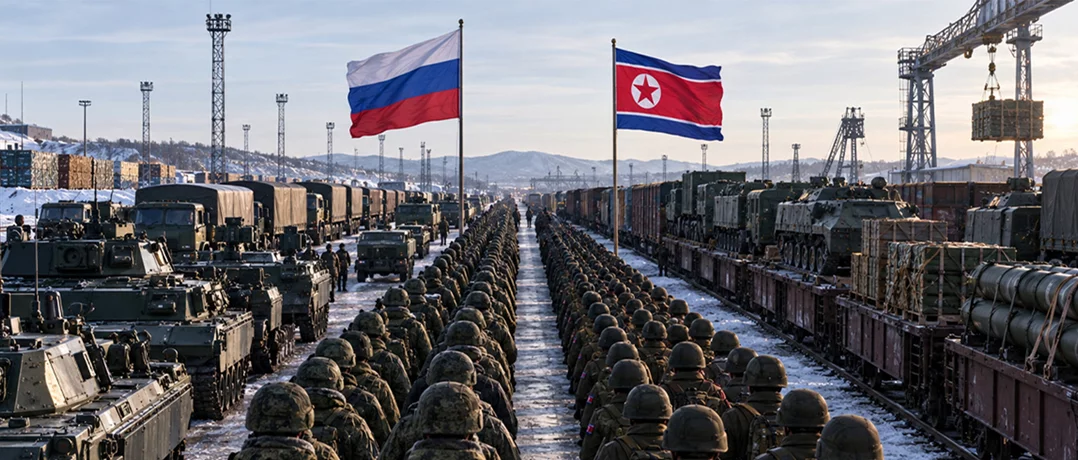
“Relations between Russia and the DPRK are currently at an unprecedentedly high level of comprehensive strategic partnership,” Russian Prime Minister Mikhail Mishustin said as the two countries opened their first road bridge across the Tumen River on September 7.
The roughly one-kilometer crossing gives Russia and North Korea a direct road connection for the first time, ending decades in which their shared border had relied almost entirely on a Soviet-era railway bridge.
More than a transport project, the bridge offers a useful measure of how far relations between Moscow and Pyongyang have moved in only a few years.
Ukraine creates the opening
For years, the relationship had offered little indication of such a transformation. Russia remained a secondary economic partner for North Korea, particularly when measured against China, while political ties had never recovered the importance they held during the Soviet era.
The war in Ukraine changed that calculation. As the conflict settled into a grinding artillery war, Russia developed an enormous appetite for ammunition. At points in 2023, Ukraine was firing roughly 4,000 to 7,000 artillery shells a day, while Russian expenditure was far higher, reaching around 20,000 rounds daily earlier in the year; by October, the Institute for the Study of War assessed Russian fire at roughly 10,000 to 15,000 rounds a day.
North Korea, with decades of accumulated stockpiles and an arms industry built around Soviet-standard systems compatible with much of Russia’s arsenal, was unusually well placed to meet that demand. Shipments began moving to Russia in September 2023, and by the following month the White House confirmed more than 1,000 containers of North Korean military equipment and munitions had already been delivered. South Korean officials estimated the number had risen to roughly 2,000 containers by November 2023.
By 2024, both governments were ready to formalize the relationship that had taken shape around the war.
From wartime bargain to strategic alliance
That formalization came on June 19, 2024, when Vladimir Putin traveled to Pyongyang for his first visit to North Korea in 24 years. The summit produced the Treaty on Comprehensive Strategic Partnership, giving the relationship a political and security framework far broader than the wartime exchanges that had brought the two countries closer.
Its most consequential provision was Article 4. If either country entered a state of war as a result of armed aggression, the other committed to providing military and other assistance without delay, using the means at its disposal. The language closely resembled the mutual-defense commitment contained in North Korea’s 1961 treaty with the Soviet Union, effectively restoring a security guarantee that had disappeared after the Cold War.
The significance of that commitment became clearer within months. North Korean troops were deployed to Russia in late 2024 and took part in fighting against Ukrainian forces in the Kursk region. Pyongyang and Moscow initially avoided openly acknowledging their role, but both confirmed the deployment in April 2025. North Korea ultimately sent around 14,000 troops, including reinforcements.
Military cooperation was also moving in the opposite direction. Russia trained North Korean personnel and transferred air defense systems, while the war gave Pyongyang something harder to obtain at home: repeated combat testing of its weapons.
North Korea’s Hwasong-11A ballistic missile, or KN-23, used by Russian forces in Ukraine, reportedly improved from kilometer-level miss distances in 2024 to 50–100 meters by early 2025, with Ukrainian intelligence later claiming errors of just one to five meters by April 2026.
Building beyond the battlefield
The military partnership was soon accompanied by efforts to make movement between the two countries easier. In June 2025, direct passenger trains between Moscow and Pyongyang resumed after a five-year suspension. A month later, the first direct Moscow-Pyongyang passenger flight since the 1990s took off, adding another connection between capitals that had previously maintained surprisingly limited transport links.
Labor and financial ties were expanding as well. According to the Multilateral Sanctions Monitoring Team, North Korea sought visas for around 8,000 workers in Russia in 2024, with thousands more planned for construction and forestry. Russian-linked institutions also opened ruble accounts that allowed sanctioned North Korean banks to conduct transactions outside much of the Western financial system.
The new Tumen River bridge now adds a permanent road connection to that network. Once fully operational, the crossing is designed to handle up to 300 vehicles and more than 2,300 people a day, and it will connect directly with Russia’s federal road system. Together with restored rail and air links, it gives Moscow and Pyongyang several regular channels for moving people and goods, alongside new mechanisms for financial exchange, across a relationship that only a few years earlier remained remarkably limited.
What Kim has gained
For Kim Jong Un, the rapprochement has delivered more than military technology. Putin’s decision to travel to Pyongyang in 2024, after Kim had made the journey to Russia the previous year, also gave the North Korean leader the political prestige of being courted by one of the world’s major powers.
The economic gains have been more tangible. South Korea’s central bank estimates that North Korea’s economy grew by more than 3 percent for three consecutive years through 2025, including 3.7 percent in 2024 and 3.5 percent in 2025. It attributed the recovery partly to expanding cooperation with Russia, alongside recovering trade with China and state investment. Manufacturing grew 6.6 percent in 2025 and construction 6.3 percent. South Korea’s Institute for National Security Strategy estimates that North Korea earned more than $10 billion from weapons sales to Russia over the past three years.
Some of the broader recovery is now visible on Pyongyang’s streets. The capital’s once sparsely trafficked roads are starting to experience congestion severe enough to create new demand for parking lots and electric-vehicle charging stations. Private cars, identified by increasingly common yellow license plates, have multiplied, although most are Chinese and remain concentrated among the elite and entrepreneurial classes.
That picture should not be mistaken for nationwide prosperity. Pyongyang remains heavily privileged, and the recovery coexists with severe economic pressures. By August 30, 2026, the market exchange rate in the capital had weakened to about 68,200 won to the dollar, while rice prices had risen to roughly nine times their early-2024 level.
China also remains far more important to North Korea’s civilian economy than Russia. Bilateral trade with China reached about $1.51 billion in the first half of 2026 alone, around 20 percent higher than a year earlier. By contrast, officially recorded North Korea-Russia trade stood at only about $34.4 million, although that figure does not capture sanctioned military transfers and other opaque exchanges between the two countries.
Russia, China and life after Ukraine
Russia’s rise does not mean North Korea is turning away from China. Beijing remains Pyongyang’s economic lifeline, while Moscow has increasingly filled a different role: providing military technology, combat experience and a political partner prepared to challenge the sanctions regime surrounding North Korea. The two relationships are therefore becoming complementary rather than directly competitive: North Korea continues to depend overwhelmingly on China for civilian trade, while Russia has become increasingly important to its security, military development and sanctions-resistant economic activity.
The larger question is whether that division survives the war that created it. An end to the fighting in Ukraine could reduce Russia’s immediate need for North Korean shells and troops, removing the original engine of the rapprochement. Yet the relationship now extends well beyond ammunition. Moscow and Pyongyang are negotiating longer-term military cooperation, developing transport links and discussing greater integration of their defense industries.
The Tumen River bridge may therefore prove more significant after the war than during it. Built from a partnership forged by battlefield necessity, it is also an investment in what comes next.
-
-

-
Nami El KhazenJournalistFocusing on geopolitics and international affairs.
-
