



Lebanese former Member of Parliament (MP) and military and strategic expert General Wehbe Qatisha, speaking in an interview with The Beiruter, analyzes the implications and strategic significance of Israel’s latest expansion of its presence in southern Lebanon.
IDF expands footprint to 18 posts in southern Lebanon
IDF expands footprint to 18 posts in southern Lebanon
By The Beiruter | March 12, 2026

Reading time: 6 min
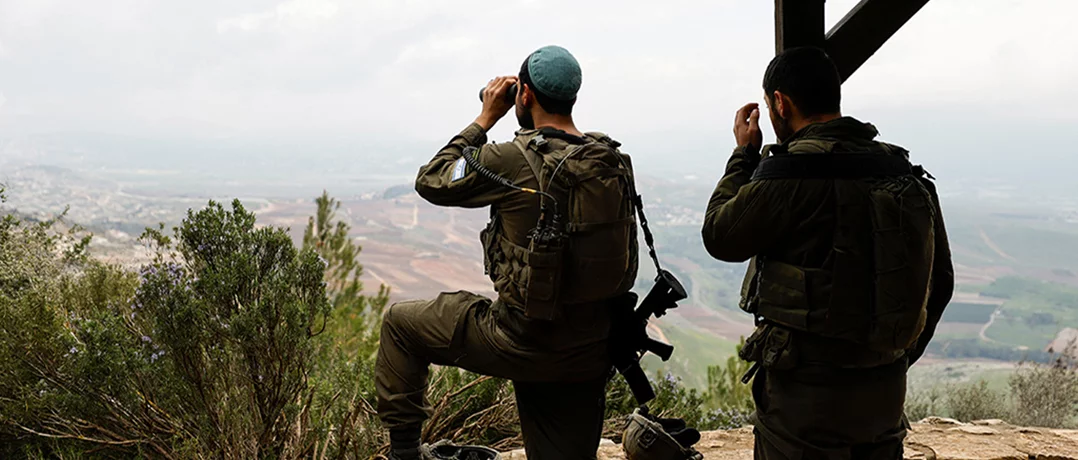
Recent Israeli advances into several positions inside southern Lebanon have raised significant questions about the evolving security dynamics along the Lebanese-Israeli border. After Israel Defense Forces (IDF) had expanded its “strategic” presence in the south from 5 posts prior to the current conflict to around 18 today, the development has intensified concerns regarding a potential escalation of the conflict and the future of the military balance in the region.
In an exclusive interview with The Beiruter, Lebanese former Member of Parliament (MP) and military and strategic expert General Wehbe Qatisha analyzes the implications of Israel’s move in southern Lebanon. According to Qatisha, the development signals the emergence of a new security reality that places increasing pressure on both the Lebanese state and Hezbollah.
A new security reality on the southern front
General Qatisha explains that the current situation reflects the emergence of a new security reality, which he considers a natural outcome of recent developments on the ground.
The Israeli advance into the aforementioned positions in southern Lebanon represents a significant escalation in pressure directed primarily at the Lebanese state and at Hezbollah. According to Qatisha, such moves inevitably alter the strategic environment and impose new constraints on the Lebanese government.
This development suggests 2 possible scenarios:
The first possibility is that Israel is preparing for further advances, potentially expanding the areas under its control to cover a much larger portion of southern Lebanon, perhaps even reaching the Litani River.
The second possibility is that Israel aims to impose a new and sustained pressure mechanism on the Lebanese government. By establishing a presence in additional strategic locations, Israel may be attempting to push the Lebanese authorities to confront the issue of Hezbollah’s weapons or find a political solution to it.
In this sense, the advance should be understood primarily as a tool of pressure. The underlying message, according to Qatisha, is clear: if the problem of Hezbollah’s weapons remains unresolved, the current tactical advances could evolve into a much broader military operation.
Thus, the occupation of these additional positions in southern Lebanon serves not merely as a tactical maneuver but as a warning signal of potential escalation.
Is Israel trying to impose a new deterrence equation?
When asked whether Israel’s move represents an attempt to impose a new deterrence equation along the border, Qatisha rejects this interpretation. According to him, such advances do not fundamentally change the military balance or create a new deterrence framework.
Even if Israel were to advance only to the border strip, Hezbollah’s rockets would still be capable of launching from areas located north of the Litani River, as well as from regions such as Akkar and the Bekaa Valley. In other words, the core issue would remain unresolved.
For this reason, Qatisha describes the current Israeli strategy as a form of gradual escalation of pressure rather than the establishment of a new military equation.
This incremental pressure may serve 2 purposes. It could be intended to signal to the Lebanese government what is expected of it, or it may constitute a preliminary phase before a larger military operation in southern Lebanon.
From Israel’s perspective, Qatisha argues, partial tactical arrangements or limited border agreements will not solve the problem. The only effective solution, in Israel’s view, would be for Hezbollah’s weapons to come fully under the authority of the Lebanese state.
The role of UNSC Resolution 1701, the LAF, and UNIFIL
General Qatisha believes that United Nations Security Council (UNSC) Resolution 1701 (2006) is no longer effectively operational.
According to him, the continued launching of rockets from southern Lebanon demonstrates that the resolution’s mechanisms are no longer functioning as originally intended. Likewise, the Lebanese Armed Forces (LAF) is no longer playing the role envisioned for it under the framework established after the 2006 July War.
As for the United Nations Interim Force in Lebanon (UNIFIL), Qatisha argues that it has never functioned as a true deterrent force in southern Lebanon. Consequently, it is no longer possible to speak about the “rules of engagement” that governed the situation following the 2006 armed conflict.
At that time, the arrangement essentially meant that Israel accepted the presence of an armed group on Lebanese territory, provided that tensions remained limited while awaiting a broader political solution. That larger confrontation, according to Qatisha, is now unfolding within the wider regional struggle involving Iran and Hezbollah.
Under the current circumstances, he argues, neither the LAF, Resolution 1701, nor UNIFIL is capable of resolving the issue of armed groups operating in the south.
Although Lebanon’s president has recently proposed an initiative aimed at resolving the crisis, Israel has not responded to it. According to Qatisha, the reason lies in the structure of the proposal itself. The presidential plan places the issue of Hezbollah’s weapons as the 4th step, to be addressed only after a ceasefire is reached.
Israel, however, rejects this sequencing. From its perspective, the problem has persisted for 4 decades, particularly affecting Israeli communities in the south. As a result, Israel is unlikely to accept the continued existence of an armed organization operating outside the authority of the Lebanese state, even if that organization were located in distant regions such as Hermel or Akkar.
The Lebanese Army and the question of disarmament
In Qatisha’s view, the responsibility now falls primarily on the LAF, which would need to assume a central role in addressing the issue of Hezbollah’s weapons.
Such a step would require a clear government decision instructing the army to implement the disarmament of non-state armed groups. According to Qatisha, many international partners and allies of Lebanon support this approach.
At a minimum, he argues, the LAF would need to demonstrate seriousness in implementing such a policy. For example, even a limited confrontation with Hezbollah in a specific location, resulting in the army asserting control, could signal that the state intends to enforce its authority. Such a development would indicate that the army is acting on behalf of the state to implement its decisions.
Following that, and even before launching a broader disarmament campaign, the authorities could move to detain senior Hezbollah figures who issue orders regarding the use of weapons. Qatisha mentions individuals such as Mahmoud Qomati among those who could theoretically face such actions.
According to him, the arrest of one of these figures during a military operation would fundamentally alter the situation, both internally within Lebanon and internationally among Lebanon’s partners and allies.
In conclusion, General Wehbe Qatisha’s assessment portrays Israel’s advance in southern Lebanon not as a definitive military breakthrough but as a calculated effort to increase pressure on the Lebanese state. By occupying additional positions, Israel may be signaling its readiness for broader military action while simultaneously demanding that Lebanon confront the issue of Hezbollah’s weapons. In his view, the only decisive factor capable of reshaping the security landscape would be a clear and assertive role played by the Lebanese state itself, particularly through the LAF.
-
-

-
The Beiruter
-
