



If machines can think, what should universities teach?
If machines can think, what should universities teach?

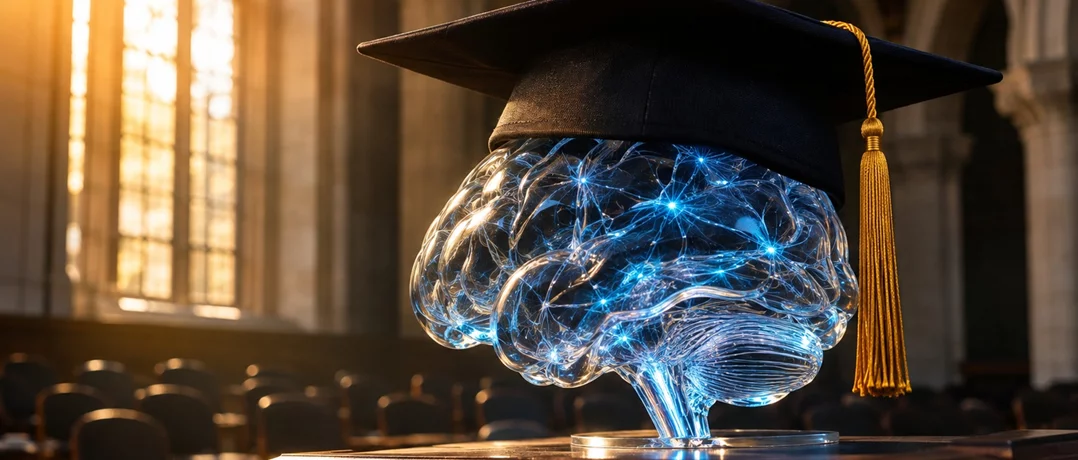
Cogito ergo sum. It is an unassuming phrase – three words, six syllables — but one that has become one of the most influential propositions in Western philosophy since its first articulation by French philosopher René Descartes in 1637. I think, therefore I am. Thinking, in other words, is fundamental to the experience of being human. They are intertwined. Indivisible. Inextricable. It was this centuries-old proposition that Fr. Joseph Moukarzel, president of the Holy Spirit University of Kaslik (USEK), invoked during an international conference on artificial intelligence in higher education held in Lebanon. Bringing together academics, policymakers and technology experts from 23 countries, the conference explored the changing purpose of higher education as machines acquire capabilities once considered uniquely human. “The more sophisticated our technological tools become, the less intellectual effort we may need to produce sophisticated answers,” Moukarzel said. Perhaps, he suggested, Descartes’s famous proposition required an update for the age of artificial intelligence — one that acknowledges this newfound ability to prompt machines without surrendering the human capacity, or responsibility, to think. Prompto sed cogito, ergo humanus sum. I prompt, but I think. Therefore, I am human. Universities have long occupied a privileged position in the production and transmission of knowledge. Professors taught, students listened, and academic institutions provided access to expertise that was difficult to obtain elsewhere. Artificial intelligence has dismantled that arrangement. Laid waste to it, more like it. “Universities have traditionally been warehouses of knowledge, but AI has broken that model,” said Dr. Jean-Paul Arnaout, dean of the School of Business at Abu Dhabi University. Yet the democratization of information does not necessarily diminish the importance of universities. It changes the intellectual responsibilities they must assume. Where education once emphasized acquiring and retaining knowledge,several speakers argued that universities must now place greater emphasis on interpreting information, questioning assumptions, and exercising independent judgment. "If AI is providing answers, we have to make sure that our students can ask better questions,” Dr. Danielle Khalife Freiha, dean of USEK Business School, said. “And if AI generates content, we have to make sure that our students can challenge it.” To challenge those answers, however, requires both effort and a foundation of knowledge from which to evaluate them. The convenience of artificial intelligence may encourage students to delegate not only routine tasks, but the intellectual processes through which understanding is developed. A machine capable of constructing a persuasive argument can save considerable time, but relying on it without scrutiny risks weakening the reasoning skills education is intended to cultivate. “We need to make sure students have a minimum threshold of core knowledge,” Dr. Karim Rebeiz, dean of the Faculty of Business and Management at the University of Balamand, said. And intellectual dependence carries another risk. As artificial intelligence becomes capable of performing a growing range of academic and professional tasks, students may begin to neglect the development of the individual abilities that distinguish their contributions from those of others. The danger is not simply that machines will do more of the work, but that individuals will become less certain of what they themselves have to offer. “I worry that we are beginning to outsource our uniqueness,” Arnaout said. Such a commitment to intellectual independence requires reconsidering not only what students learn, but how they learn it. Assignments designed primarily to test the reproduction of information are particularly vulnerable to automation. Practical assignments, industry collaboration and exposure to professional environments can give students opportunities to apply theoretical knowledge in situations where answers are rarely straightforward. Such experiences also develop capabilities that remain difficult to reduce to automated processes. In Lebanon, these questions carry particular urgency. Universities operate in a country where professional opportunities are constrained and the departure of skilled graduates remains a persistent concern. Artificial intelligence may provide new avenues for international collaboration and access to work, but realizing those opportunities depends on continuous, institutional investment and connections with employers. “Lebanon has an extraordinary wealth of human capital,” Mazen Abdallah, head of Google for Education in the Middle East, North Africa and South Asia, said. Yet access to these opportunities cannot be assumed. The cost of advanced AI subscriptions, differences in technological infrastructure and uneven faculty preparedness risk creating new inequalities among students and institutions. Universities that integrate artificial intelligence into their curricula must therefore consider not only how extensively it is adopted, but who can afford to participate. Nova was an unlikely master of ceremonies. Standing roughly the height of a ten-year-old child, she had piercing green eyes and spoke in a high-pitched, yet oddly melodic voice. She also wasn’t human. Developed by USEK's robotics laboratory, Nova was, indeed, a robot. With a gold graduation sash bearing the university's insignia draped around her neck, she gave every impression of a proud alumna. Beyond the spectacle of a machine assuming a distinctly human role, Nova's presence offered a curious introduction to one of the conference's more philosophical concerns: As machines become capable of performing activities associated with human intelligence, educators must also consider how to preserve a conception of human worth that is not determined by productivity or technological competence. Dr. Mariette Awad, an associate professor at the American University of Beirut, questioned whether the objectives guiding AI development adequately account for this distinction. Artificial intelligence systems, she explained, are designed to optimize measurable outcomes, including speed, accuracy and cost. “But are these systems incorporating human dignity into that process?” she asked. “Probably not.” The logic of technological optimization, despite its appeal as a measure of progress, is poorly suited to evaluating human beings. Efficiency, accuracy and productivity may determine the usefulness of a machine, but they cannot adequately account for the value of a person. “We should never confuse the ability to perform a task with the value of a human being,” Dr. Ra’ed Masa’deh, editor-in-chief of the Jordan Journal of Business Administration, said. Higher education, he warned, is particularly vulnerable to this tendency, as technological proficiency risks becoming a convenient measure of student achievement. The university's responsibility, then, is not simply to prepare students for a world in which machines can think, but to ensure that human beings continue to do so. Descartes could hardly have imagined the technological possibilities of the twenty-first century. His insistence on the centrality of thought, however, is perhaps even more applicable as machines increasingly think on humans’ behalf.Here lies the danger: not that artificial intelligence will become more capable, but that human beings may gradually abandon the effort of thinking for themselves.
What should universities teach now?
AI can make us intellectually lazy, and without that foundation, students won't be able to use the technology to its fullest potential.
Each of us has particular strengths and perspectives that make us distinctive. Develop it, strengthen it, and use university as a place where you can cultivate that uniqueness.
Universities, particularly private institutions, should immediately take advantage of technological infrastructure available internationally while strengthening partnerships with the Lebanese diaspora.
The human question
Human dignity means recognizing the inherent worth of every individual, regardless of their productivity, economic contributions, or technological capabilities.
-
-

-
The Beiruter
-
