

Lebanese Army Commander’s visit to Pakistan highlights evolving military cooperation, regional balancing, and indirect diplomacy amid Middle Eastern tensions dynamics.
Implications for LAF Commander visit to Pakistan
Implications for LAF Commander visit to Pakistan
By Dr. Paula Abi Hanna | June 09, 2026

Reading time: 6 min
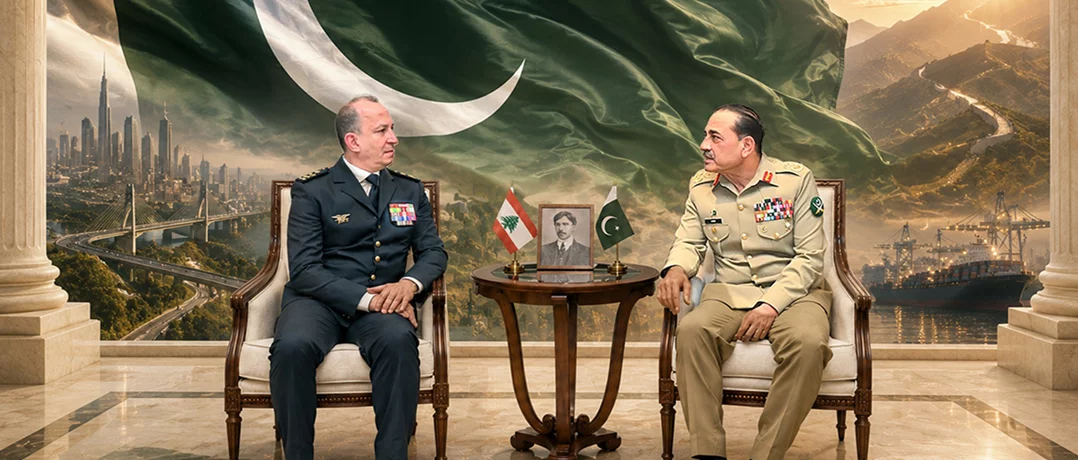
At a highly complex regional moment, where security arenas from Lebanon to the Gulf intersect under the shadow of the U.S.-Iran confrontation, Pakistan is emerging as an actor that is being rediscovered rather than redefined, amid a growing search for unconventional channels for crisis management.
In this context, the visit of Lebanese Army Commander General Rodolphe Haykal to Pakistan cannot be interpreted merely as a routine stop within the framework of military cooperation. Although the visit carries a clearly technical character, it comes at a sensitive Lebanese and regional juncture, as Lebanon faces mounting security challenges and reassesses the role of the military institution as one of the country’s primary pillars of stability.
However, the significance of this visit extends beyond its bilateral dimension and reaches into the broader context in which international relations operate today. Mediation is no longer confined to traditional diplomacy; it is increasingly expanding toward more flexible and often unofficial forms of communication between conflicting parties.
Within this framework, the event can be examined on three interconnected levels.
At the first level, the military and technical dimension, the visit falls within a clear framework of cooperation between the two armies, encompassing training, the exchange of expertise, and potentially the development of logistical and technical support capabilities. Pakistan holds particular importance in this regard due to its advanced experience in counterterrorism, border management, and unconventional operations; areas that have become urgent priorities for the Lebanese Armed Forces amid escalating security pressures.
At the political and diplomatic level, this outreach reflects Lebanon’s need to diversify its partnerships rather than rely exclusively on the traditional Western track. Pakistan, on one hand, maintains close relations with Gulf states, while on the other, it does not engage in direct hostility toward Iran. This positions it as a country capable of operating within a delicate balancing space without being classified as an adversary by any major regional axis. This does not, however, mean that Pakistan is an “acceptable mediator for all parties” in an absolute sense. Rather, it is better described as a relatively non-provocative actor within a complex network of relationships.
At the third level, the more sensitive regional dimension, the visit takes place amid rising tensions across multiple arenas, from southern Lebanon to the broader dynamics of the U.S.-Iran confrontation. In this environment, any external engagement by the Lebanese military establishment can be interpreted through the lens of wider regional balances, even when its primary nature is technical or training-related.
This interconnectedness cannot be separated from the nature of the regional landscape, where local arenas are linked to a broader system of interactions involving Washington, Tehran, and Tel Aviv. As a result, any discussion regarding the Lebanese Army’s role or its external relationships is inevitably shaped by this complex triangular dynamic. Within this context, the United States continues to play a central role in supporting Lebanon’s military institution, while political and operational constraints remain tied to the security environment and to Israeli calculations aimed at regulating military activity along the border without allowing it to spiral out of control.
Against this backdrop, engagement with Pakistan can be understood as part of a policy of diversifying military partnerships rather than a strategic shift in alliance structures. At the same time, it opens the door to a broader discussion regarding Pakistan’s position within an evolving regional order.
The state founded by Muhammad Ali Jinnah was not built as a conventional rising power but rather as a country balancing a highly complex regional environment with multidirectional international networks. As the role of the military establishment has evolved under the leadership of Asim Munir, Pakistan has acquired a greater capacity to operate in spaces where security considerations intersect with indirect diplomatic channels.
It is noteworthy that Pakistan’s national anthem, written in Urdu and infused with vocabulary of Persian origin, reflects the layered cultural and historical foundations of Pakistani identity. Indian, Persian, and Islamic linguistic influences converge within a single symbolic framework. This observation is not presented here as a direct political factor but rather as an indicator of the nature of Pakistan’s identity formation itself, which emerged within an environment shaped by multiple cultural and historical references. This, in turn, is indirectly reflected in the country’s balancing approach to regional and international relations.
Despite this growing presence, it remains essential to distinguish between theoretical potential and actual influence. Although Pakistan possesses a network of relationships that includes the Gulf states, the United States, and Iran to varying degrees, it remains far from possessing the capacity to serve as a direct mediator in complex files such as Lebanon. It is not a rejected actor, but neither is it a central player in the regional balance of power.
From another perspective, the notion that Pakistan is “acceptable to everyone” requires careful scrutiny. Israel does not regard it as a natural mediator, while Iran views it through a pragmatic lens without granting it any clear political mandate. Consequently, Pakistan’s position is closer to a gray zone than to universal acceptance.
Within this framework, the Pakistani role does not appear as an alternative to the major powers but rather as a potentially supportive element rather than a principal actor; whether through military training, indirect communication channels, or contributions to reducing tensions in specific areas without becoming directly involved in the core political settlements.
The sectarian dimension that is sometimes raised in public discussions likewise does not necessarily reflect a genuine political function within the Pakistani state structure. Despite its diverse social composition, Pakistan does not formulate its foreign policy on sectarian foundations but rather on the basis of complex strategic balances involving the Gulf, Iran, and the West simultaneously.
Ultimately, the visit of the Lebanese Army Commander to Pakistan cannot be regarded as a strategic transformation in the balance of influence. Yet neither is it a trivial or insignificant event. It reflects three overlapping layers: necessary military cooperation, carefully calibrated diplomatic outreach, and a turbulent regional environment that is reshaping the mechanisms through which crises are managed.
The decisive factor remains that the Lebanese file, particularly its southern security dimension, continues to be governed by major triangular balances involving the United States, Israel, and Iran. Consequently, any new external role, including that of Pakistan, remains secondary or complementary at best rather than a substitute for the region’s actual centers of decision-making.
Amid these evolving balances, one question remains open: are we merely witnessing a reorganization of cooperation networks, or the gradual emergence of a broader circle of actors capable of operating behind the scenes without occupying the center of the stage?
