Inside Beirut’s displacement shelters, women have become the quiet organizers of daily life, caring for families and sustaining fragile communities amid war and uncertainty.




Inside Beirut’s displacement shelters, women have become the quiet organizers of daily life, caring for families and sustaining fragile communities amid war and uncertainty.

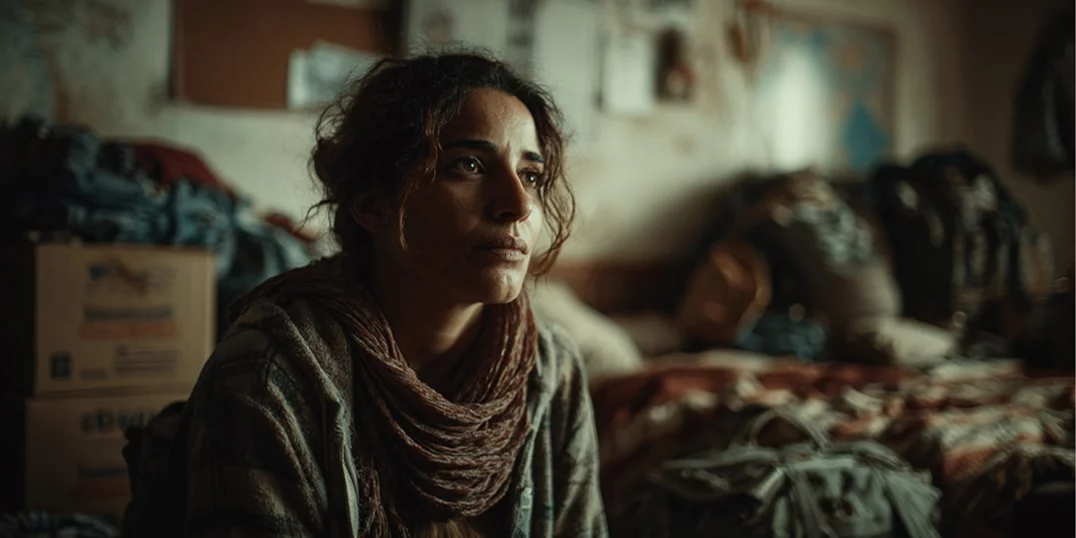
In a converted classroom on the third floor of a school-turned-shelter in Beirut, Sara and Sabah stand before a small group of children, Majed, Mohammad, Cécline, and Eline, entertaining them with a card game. Both in their twenties, the two women had fled Dahiyeh earlier that week when the war first began. Sara arrived at the shelter after a tense journey via car. Sabah, on the other hand, walked with her family on foot. By the time she reached the shelter, morning had already broken.
They are both mothers, young mothers at that. Two-year-old Céline is Sara’s daughter, while Eline, 1 year and two months, is Sabah’s. Majed and Mohammad seemed to belong to another family in the hallway, though it was difficult to tell.
Although they had only been at the shelter for a little over a day, they had already begun sharing childcare responsibilities. As Eline started to cry, Sabah picked up the restless child and cradled her in her arms. And when Céline began to choke on an apple she was eating, it was Sara who rushed over to her side
Sara and Sabah and the attention and care they displayed in those small moments are not anomalies. Across Lebanon’s emergency shelters, it is often women who have taken on the critical role of organizing the rhythms of daily life. They are the ones who hold these fragile communities together
Similar scenes are playing out in shelters across the country. According to Lebanon’s Disaster Risk Management Unit, nearly 96,000 internally displaced people from more than 21,000 families were living in 441 collective shelters as of March 5.
At the Rene Mouawad school in Sanayeh, the transformation inside is immediate. Classroom desks have been pushed to the edges of the room, thin mattresses line the floors, and plastic bags of clothing and food are stacked against the walls. Families cluster together in small spaces loosely marked off by blankets or personal belongings.
While men frequently trickled in and out of the building, temporarily leaving shelters during the day to search for supplies and food, the women remained inside, managing the daily routines of shelter life.
The dynamics unfolding inside the school mirror patterns long observed in displacement settings. Humanitarian researchers who study displacement frequently observe that women become central organizers of daily survival in collective shelters. According to a 2024 Rapid Gender Analysis published by UN Women on gender and internal displacement in Lebanon, women are often expected to take on caregiving and domestic responsibilities even in emergency settings, roles that frequently expand during displacement when formal services are disrupted. These informal roles frequently determine whether shelter life remains organized and stable for families living in close quarters.
Inside the Rene Mouawad school, that pattern has quickly taken shape. Much of the day-to-day organization inside the school now unfolds through these informal efforts.
Even when families remain together in designated areas of a room, collective shelters create challenges that affect women particularly acutely. Bathrooms, hallways, and washing areas are shared by dozens, sometimes hundreds, of people. Access to showers is limited, as these schools were never designed for residential use.
Gender specialists studying displacement in Lebanon have repeatedly identified privacy and sanitation as among the most pressing concerns for women in shelters. A crisis update from the United Nations Population Fund (UNFPA) on the impact of the 2026 escalation in Lebanon notes that overcrowded public schools repurposed as shelters often lack adequate sanitation, lighting, and privacy. These conditions, the report warns, can shape how women and girls navigate shelter environments, influencing when they feel able to move around the facility or access shared bathrooms and washing areas.
These challenges do not necessarily mean that families are separated or unsafe. But they create a constant negotiation of dignity and privacy in spaces never meant to house large civilian populations.
Tasks such as changing clothes, managing menstruation, or bathing children become more complicated when dozens of families rely on the same bathrooms. In some shelters, women may avoid using shared facilities after dark if lighting is insufficient. Others limit how often they leave their family’s sleeping area, particularly when corridors are crowded.
These adjustments are subtle, but they shape daily routines inside shelters.
Women in the shelters are also carrying much of the caregiving burden that displacement creates. Many are responsible for multiple children, elderly relatives, or family members with illnesses.
Mariam, who fled Nabatieh, stood beside her grandfather in a corridor overlooking the school playground. “He has cancer,” she said, nodding gently in his direction. “He should be inside a hospital.”
As she spoke, another elderly woman approached and stood beside them. She explained that she had no access to her diabetes medicine, having left it behind during the displacement from Nsar. Mariam listened patiently, softly murmuring reassurances to them both.
Moments like this reveal the quiet responsibilities many women now carry. Even simple tasks such as preparing meals, keeping children occupied, or helping elderly family members move through crowded hallways, become more complex in shared spaces housing dozens of families.
Caregiving burdens often intensify for women during wartime displacement. The UN Women analysis, for instance, notes that women frequently assume expanded caregiving and household responsibilities in displacement settings, particularly when formal services are disrupted and families rely more heavily on internal support networks.
At the Rene Mouawad school, these pressures appear in small daily interactions: mothers attempting to quiet restless children, daughters helping elderly relatives up the stairs, and women moving between families to check whether anyone needs assistance.
Among the displaced population are also women who are pregnant, adding another layer of concern in environments where rest, privacy, and consistent medical access can be difficult to secure. According to the United Nations Population Fund, displacement significantly increases health and protection risks for women, particularly for those who are pregnant or require reproductive health services during conflict.
Several pregnant women are currently staying at the school, sharing classrooms with other displaced families. For many women in the shelters, displacement has meant managing these concerns while continuing to care for those around them.
Despite the uncertainty surrounding how long displacement may last, a form of order has begun to emerge inside the school. Children establish informal play areas in corners of classrooms, Mattresses are shifted and rearranged as families carve out small areas of privacy. Meals become regular gathering points where residents exchange news about the current conflict's trajectory.
Women often stand at the center of these small systems.
Their work, aiding with meals, maintaining shared spaces, calming children unsettled by the constant sound of drones over Beirut, and assisting neighbors with daily needs, forms the infrastructure of daily life in the shelters
Outside the building, the conflict that forced these families from their homes continues to unfold. Inside the classrooms of the Rene Mouawad school, the routines that allow the thousands of displaced people across Lebanon to endure life are sustained through the steady, often overlooked efforts of the women who sustain the daily rhythms of shelter life.

