



A sharp examination of the killing of Lebanese journalists in war, exploring the gap between international law, battlefield perception, and the responsibility of media institutions.
In respect of duty, beyond division

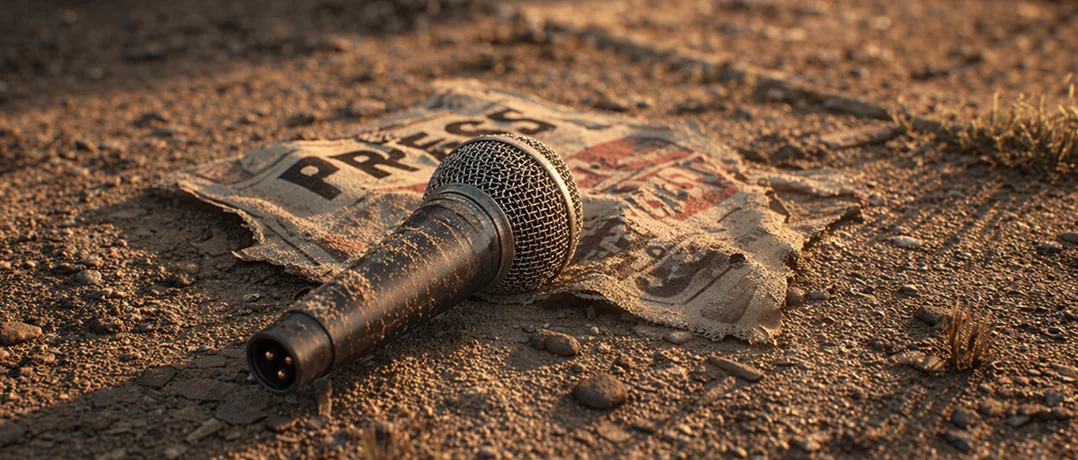
The killing of Amal Khalil and the targeting of Zeinab Faraj in southern Lebanon is not an isolated incident. It sits within a pattern, one that Lebanese officials, international watchdogs, and journalists themselves have increasingly described as systematic.
What happened in the South
On a Wednesday in southern Lebanon, what began as a strike turned into a sequence.
Amal Khalil, a correspondent for Al-Akhbar, and freelance photographer Zeinab Faraj were traveling together when an Israeli air strike hit a vehicle ahead of them, killing two men. The two journalists sought shelter in a nearby house.
According to Lebanese officials, the location was then struck again.
Faraj was wounded. Khalil was trapped under the rubble. Hours passed before rescue teams could reach the site.
What followed raised even more questions than the strike itself. A Lebanese Red Cross ambulance attempting to reach the journalists was reportedly obstructed, with warnings and fire preventing access. Emergency teams were forced to withdraw before eventually returning under coordination to recover the victims.
The Israeli military denied targeting journalists, stating that the strike was aimed at individuals it identified as posing an “immediate threat” after leaving what it described as a Hezbollah-linked structure.
But on the ground, the sequence remained the same: a first strike, a place of refuge, a second strike, and delayed rescue.
It is this sequence, not just the outcome, that now demands scrutiny.
The law is clear, reality is not!
Under the Geneva Conventions, journalists are civilians. This is not a moral argument. It is a legal classification.
Article 79 of Additional Protocol I to the Geneva Conventions states that journalists operating in conflict zones must be protected as civilians, provided they take no direct part in hostilities. The principle is reinforced by Article 51, which prohibits attacks against civilians, and Article 57, which obliges parties to take all feasible precautions to avoid or minimize civilian harm.
The implications extend further.
Medical teams and ambulances are also explicitly protected under the First Geneva Convention. Obstructing their access, or targeting them, falls outside the grey zones of war. It is a violation.
Taken together, these provisions do not merely describe ideal conduct. They define thresholds, lines that, when crossed, move actions from battlefield consequences into potential war crimes.
From violation to accusation
That threshold is no longer being discussed only by legal experts.
Prime Minister Nawaf Salam has explicitly accused Israel of committing war crimes following the strike. His framing was direct: targeting journalists, obstructing rescue teams, and striking locations again after they have been reached by relief efforts are not incidental, they are violations.
More importantly, he described the repeated targeting of media workers in southern Lebanon as “an established approach,” signaling that the issue is not a single event, but an alleged pattern.
The thin line Lebanese Journalists walk
Lebanon’s media landscape is not neutral terrain. Journalists here often operate within a system where political alignment is visible, sometimes openly declared, sometimes structurally embedded within the outlets they represent.
In another context, this might be dismissed as bias. In war, it becomes risk.
The line between freedom of expression and overexposure is thin. Lebanese journalists are among the most transparent about where they stand, politically, ideologically, and institutionally. That openness is part of the country’s media culture. It is also what makes them more vulnerable.
International humanitarian law does not strip journalists of protection based on their opinions. It does not distinguish between “neutral” and “aligned” reporting. A journalist remains a civilian.
But war does not always operate within legal clarity. When narratives are weaponized, those who carry them risk being seen not as observers, but as participants. And that shift, even if legally unfounded, can be deadly.
The responsibility behind the camera
There is another layer that receives far less scrutiny: the institutions behind the journalists.
Newsrooms, media companies, and platforms are not passive actors in war coverage. They make decisions, who goes, where, and under what conditions. In a competitive media environment, presence on the ground is currency. Being there matters. But so does survival.
The question is no longer whether journalists are willing to take risks. They are. Lebanese journalists have consistently shown that they will go where the story is, even when it means entering active conflict zones.
The question is whether enough is being done to protect them.
Are risk assessments rigorous, or routine?
Is safety training standardized, or selective?
Are evacuation plans operational, or theoretical?
Freelancers, like Zeinab Faraj, often operate at the edge of this system, exposed to the same dangers with fewer protections.
Organizations such as Committee to Protect Journalists and Reporters Without Borders have long warned that the burden of safety cannot fall solely on individuals. Protection is not just a personal responsibility. It is institutional.
After the camera falls silent
Amal Khalil was a journalist doing her job: documenting, verifying, transmitting reality as it unfolded. Zeinab Faraj did the same, through her lens.
Their story is now part of a larger one, about law and responsibility.
Because in wars where everything is contested, territory, narrative, legitimacy, the people who carry the story are increasingly carrying the risk of it as well.
And a camera, no matter how powerful, was never meant to be mistaken for a weapon.
-
-

-
The Beiruter
-
