



War has devastated southern Lebanon’s farmland and orchards, threatening rural livelihoods, national food security and agricultural production for years to come.
In southern Lebanon, war is burning the harvest
In southern Lebanon, war is burning the harvest
By Christiane Tager | October 04, 2026

Reading time: 8 min
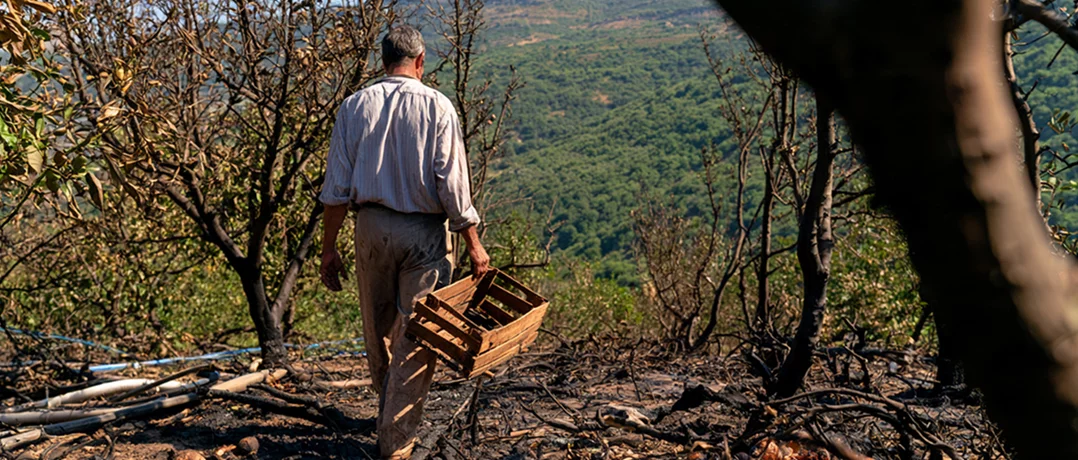
Citrus, bananas, avocados, olives and herbs: the conflict in southern Lebanon has left scorched farmland, abandoned orchards and lost harvests. By September 2026, agricultural losses were running into billions of dollars, threatening not only farmers’ incomes but food supplies, rural livelihoods and the productive capacity of an already fragile economy.
In southern Lebanon, the cost of war is measured not only in destroyed homes and damaged roads. It is also visible in fields farmers can no longer reach, orchards that will take years to recover and harvests that were never brought to market.
More than 56,000 hectares of agricultural land have been affected, according to Lebanon’s Ministry of Agriculture, representing more than 22.5 per cent of the agricultural area covered by the assessment. Some 52,000 hectares are located in the governorates of South Lebanon and Nabatiyeh.
The bill is still rising. In July 2026, Agriculture Minister Nizar Hani said that losses in Lebanon’s agricultural sector had exceeded $1bn following updated technical assessments.
A strategic agricultural region under pressure
Southern Lebanon is one of the country’s main centers of fruit production. Citrus, bananas, avocados and other fruit crops are heavily concentrated there, making the region difficult to replace when production is disrupted.
A May 2026 assessment by the Ministry of Agriculture identified fruit trees, citrus, bananas and olives among the crops most affected, with more than 11,000 hectares of orchards and about 6,600 hectares of olive groves impacted.
The consequences extend well beyond individual farms. Reduced production affects wholesale markets, prices, exports and Lebanon’s already vulnerable food supply.
Citrus: almost $100mn in losses
Citrus has been among the hardest-hit crops. An assessment by the Food and Agriculture Organization, Lebanon’s Ministry of Agriculture and the National Council for Scientific Research-Lebanon, covering October 2023 to November 2024, estimated losses in the citrus sector at almost $97mn.
The damage has come from two directions. Bombardment and fires have destroyed trees and plantations, while farmers have frequently been unable to reach their land during critical harvesting periods.
For perennial crops, the economic impact is particularly severe. Replacing a mature citrus tree does not restore production in the following season; it takes years for a new tree to reach meaningful yields.
A lost harvest is an immediate loss of income. A destroyed orchard can mean years of lost production.
Bananas: a concentrated production base
Bananas face a similar problem, compounded by the concentration of production in the south.
A scientific study published in 2026 estimates that 461 hectares of banana plantations were destroyed by fires in the areas studied, in addition to losses resulting from farmers being unable to cultivate some fields.
For growers, the destruction of a banana plantation means losing plants, irrigation systems and, in some cases, associated agricultural infrastructure. It also removes a source of future income.
The shock spreads through rural economies. Small farms account for about 80 per cent of agricultural holdings, meaning that losses affect not only farmers but agricultural laborers, transport companies, fertilizer suppliers, wholesalers, packing facilities and traders.
Avocados: a long-term investment put at risk
Avocado production illustrates another dimension of the crisis: the loss of agricultural investment.
An avocado orchard requires years to reach full productive capacity. When trees are destroyed or abandoned, farmers lose not only the current crop but future harvests and revenues.
For a country seeking to develop higher-value agricultural exports, the interruption of avocado production in the south therefore represents a setback that extends well beyond a single season.
Thyme, sage and the rural economy
The impact is not limited to large commercial crops.
Thyme, sage and other aromatic herbs are harvested in several rural areas of southern Lebanon. When farmers cannot reach their land, these crops are left unharvested.
For some households, such products provide an important supplementary income. Their loss therefore hits smaller producers particularly hard and disrupts a broader chain encompassing harvesting, processing, packaging, transport and retail.
Fire has destroyed thousands of hectares of orchards
Bombardment has also triggered widespread fires.
A 2026 scientific study estimates that 2,154 hectares of orchards were destroyed by fires in the governorates of South Lebanon and Nabatiyeh. The total includes 637 hectares of citrus and 461 hectares of bananas, as well as about 814 hectares of olive groves, 192 hectares of mixed orchards and 48 hectares of vineyards.
For farmers, the destruction is not simply the loss of vegetation. It represents years of planting, irrigation, pruning and maintenance erased in a matter of hours.
When fires spread across neighboring plots, the damage becomes regional, reducing not only current output but the area’s capacity to produce in the years ahead.
White phosphorus and the question of soil contamination
The use of white phosphorus adds an environmental dimension to the agricultural crisis.
United Nations reports have documented the use of white phosphorus munitions in southern Lebanon and recorded phosphorus levels in some affected soils as high as 900 times average levels. The UN report notes that such contamination can contribute to increased soil acidity and reduced fertility.
By September 12 2024, Lebanon’s National Centre for Natural Hazards and Early Warning had recorded 290 phosphorus-munition impacts: 169 in Marjayoun, 54 in Tyre, 45 in Bint Jbeil, 19 in Hasbaya and three in Nabatiyeh.
White phosphorus is highly incendiary and can cause vegetation fires. Its combustion products may also contribute to soil acidification and pose risks to water resources.
There is, however, an important scientific distinction. The presence of elevated phosphorus in some soils does not establish that all crops in southern Lebanon are contaminated. Determining contamination and its consequences requires site-specific testing of soil, water and vegetation.
The long-term environmental consequences also remain incompletely quantified. A scientific study published in September 2026 called for systematic monitoring to distinguish documented environmental damage from potential longer-term ecological and health effects.
Water: the other constraint on production
Even orchards that survived bombardment may no longer have reliable access to water.
Irrigation infrastructure has been heavily damaged. A 2026 study estimates that 77 kilometres of irrigation canals were destroyed, while pumps, wells and solar-powered systems were also damaged.
For citrus, bananas and avocados, the implications are immediate. Without irrigation, a surviving tree can become economically unproductive.
The result is a chain reaction: bombardment, damaged infrastructure, disrupted irrigation, abandoned land and lost output.
Three agricultural seasons lost
The most difficult cost to recover may be time.
According to the agriculture minister, the hardest-hit areas have lost three consecutive agricultural seasons.
Three seasons represent more than three missed harvests. They mean fields left uncultivated, orchards left unpruned, irrigation systems deteriorating, agricultural labour displaced and households temporarily abandoning their livelihoods.
A return to production will therefore require more than simply restoring physical infrastructure.
$530.5mn in lost production
A scientific assessment published in June 2026 by the National Council for Scientific Research-Lebanon and the Ministry of Agriculture, with support from the FAO, UNDP and WFP, estimated direct agricultural damage at $41.2mn in the areas studied.
The larger figure was lost production: $530.5mn across 56,320 hectares.
The distinction matters.
Damage refers to the destruction or impairment of land, buildings, equipment and infrastructure. Losses refer to production and income that could not be generated.
In other words, the economic cost lies not only in what the war has destroyed, but also in what farmers have been unable to produce.
From $704mn to more than $1bn
The first major FAO and Ministry of Agriculture assessment, published in April 2025 and covering October 2023 to November 2024, put direct agricultural damage at $118mn and production losses at $586mn, for a combined $704mn.
Subsequent assessments have significantly increased the estimated cost.
By July 2026, the agriculture minister said that agricultural damage and losses had exceeded $1bn following updated technical assessments.
The figures should not be added together: they cover different periods and use different assessment methodologies. But the direction is clear. As the conflict persists and more agricultural areas are assessed, the economic bill continues to rise.
From an agricultural crisis to a food-security risk
The consequences extend beyond southern Lebanon.
When citrus, bananas, avocados, vegetables and other crops disappear from local production, Lebanon must rely more heavily on supplies from elsewhere, including imports.
That comes as the country is already facing significant food-security pressures. An IPC analysis published in April 2026 indicated that almost one quarter of the population assessed was at risk of acute food insecurity during the period under review.
The agricultural crisis in the south is therefore also a national supply issue.
Every hectare that stops producing reduces Lebanon’s ability to meet domestic food demand from its own agricultural base.
Rebuilding an orchard takes years
Authorities and international organisations have begun programmes aimed at agricultural recovery.
In April 2026, the FAO and Ministry of Agriculture launched a Japanese-funded programme targeting about 230 vulnerable farming households, representing roughly 1,150 people, in South Lebanon and Nabatiyeh.
The ministry is also working to restore agricultural infrastructure, including greenhouses and irrigation systems.
But the economics of agricultural reconstruction are unforgiving.
A greenhouse can be rebuilt within months. An avocado, citrus or other fruit orchard may take years to become productive again. Restoring degraded soils, rebuilding irrigation networks and enabling farmers to return safely to their land will take longer still.
The cost may be measured in future harvests
By September 2026, the agricultural cost of the conflict has moved well beyond the crops already burned or abandoned.
More than 56,000 hectares affected.
More than 22.5 per cent of the assessed agricultural area impacted.
$530.5mn in lost production in the latest specific assessment.
$41.2mn in direct damage in that assessment.
More than $1bn in agricultural losses and damage according to the ministry’s updated estimate.
Almost $97mn in citrus losses in the earlier national assessment.
2,154 hectares of orchards destroyed by fire in the areas studied.
Behind these numbers are farmers who cannot harvest, families who have lost income and orchards that may take years to recover.
For southern Lebanon, agricultural reconstruction will require more than replanting trees. It will mean restoring soils and irrigation, rebuilding infrastructure, reopening supply chains and enabling farmers to return to their land.
When an orchard disappears, it is not only this year’s harvest that is lost. It is part of Lebanon’s future productive capacity.
