



In an exclusive interview with The Beiruter, priests in South Lebanon recount Pope Leo XIV surprise call while living under siege and requiring Israeli approval to leave their villages.
Inside the closed-door Vatican call with South Lebanon’s priests
Inside the closed-door Vatican call with South Lebanon’s priests
By Michella Rizk | May 08, 2026

Reading time: 5 min
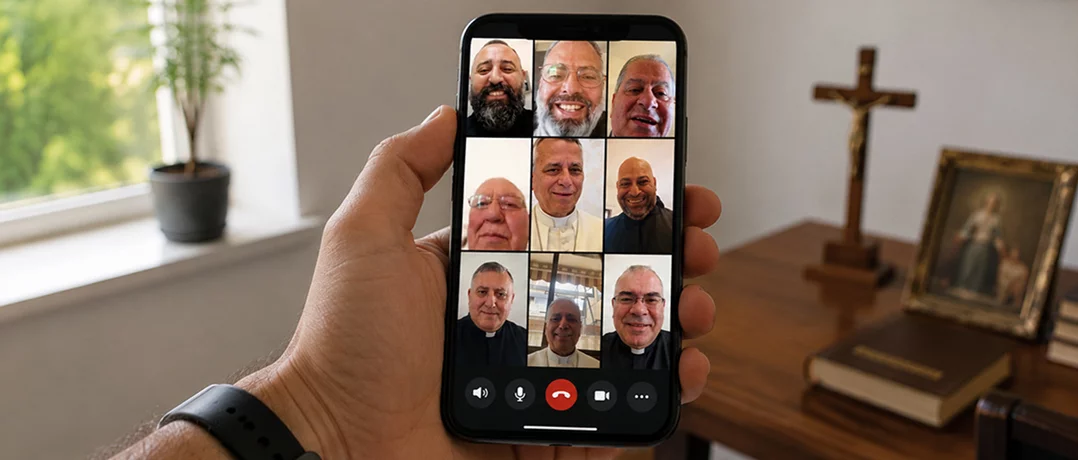
In a village where residents still need Israeli approval to leave, a phone screen suddenly lit up with the face of Pope Leo XIV.
For priests and residents living through bombardment, isolation, and displacement in South Lebanon, the brief video call became more than a symbolic gesture from the Vatican. It felt like recognition.
In a special interview with The Beiruter, one of the priests serving in the southern border village of Rmeish recounted the emotional moment Pope Leo appeared live on his screen to speak directly with priests from South Lebanon.
A call nobody expected
The story began the night before the call, when the Papal Ambassador to Lebanon, Archbishop Paolo Borgia, created a WhatsApp group gathering priests from several southern villages including Rmeish, Debel, Ain Ebel, Marjayoun, and Qlayaa.
The group was named “Prêtres du Sud” (“Priests of the South”).
At the time, the ambassador was in Rome. He informed the priests that he would contact them the next morning between 9:30 and 10:00 a.m., without revealing any further details.
“We were waiting to see what the Papal Ambassador wanted from us.”
When the video call finally began around 9:45 a.m., Archbishop Borgia greeted the priests from the Vatican before revealing he had a surprise waiting for them.
Moments later, he turned the camera toward Pope Leo.
“We were honestly shocked and overwhelmed with joy. None of us knew the Pope would join.”
The Pope only spoke for a few seconds, but the emotional impact lasted far longer. “He greeted us, blessed our efforts, told us he was praying for us, and gave us the Apostolic Blessing.”
His message itself was simple:
I bless your efforts. I am praying for you.
Yet inside villages shaped by war and uncertainty, those few seconds carried extraordinary emotional weight.
“The Pope knows us one by one”
The Vatican has remained closely informed about the realities unfolding in southern Lebanon. Archbishop Paolo Borgia has repeatedly visited the border region since the escalation began. “He probably came here more than fifteen or even twenty times.”
Through those visits, reports from isolated villages continued reaching the Vatican directly, keeping Pope Leo informed about conditions on the ground. “The proof was yesterday. When the Pope saw us, it was clear he knew exactly what was happening here.”
One moment during the call particularly stayed with the priests. Before ending the conversation, Archbishop Borgia pointed toward one of the priests on screen and told the Pope: “This is the priest from Debel.”
The remark carried deep emotional significance. Debel had endured some of the harshest siege conditions in the region, and the ambassador had frequently spoken to the Vatican about the village, its priests, and the isolation residents were living through.
For priests serving inside these border towns, the exchange suggested something rare: that their names, villages, and struggles had reached the Vatican individually, not collectively.
“It felt as though he knew us one by one.”
For many residents, the call symbolized something far greater than a blessing delivered through a screen.
“The Church never abandoned us. Not spiritually, not emotionally, not materially.”
Support from the Patriarchate, religious orders, monks, and organizations such as Caritas has continued throughout the war, helping villages endure months of fear, displacement, and uncertainty.
“To leave the village, we need Israel’s approval”
Beyond the emotional symbolism of the Pope’s call lies the reality of daily life in South Lebanon’s border villages.
Residents of Rmeish continue to live under severe movement restrictions, with entering or leaving the village often dependent on a lengthy approval process involving multiple authorities.
We speak to the municipality, the municipality speaks to the UN, and the UN speaks to Israel before permission is given.
According to the priest, obtaining authorization can sometimes take several days. The process has left many residents feeling effectively trapped inside villages still shaped by siege conditions and ongoing tensions along the border.
“We are still under siege.”
In that context, the Pope’s appearance on the screen carried even deeper emotional significance for many residents and clergy alike.
Sleepless nights under bombardment
Daily life inside Rmeish continues under the sound of explosions, airstrikes, trench demolitions, aircraft noise, and gunfire.
“We have not slept properly for a very long time.”
Even after months of escalation, nighttime bombardments continue to wear residents down physically and psychologically. Yet amid the exhaustion, faith remains central to how many residents cope with the crisis.
“We are praying more than ever before. Fear never truly entered the village.”
The village remains deeply attached to the Virgin Mary, Saint Charbel, and Saint George, figures many residents describe as sources of protection and endurance.
“Half the school is missing”
The war has also transformed education across the border villages.
At the beginning of the conflict, schools shut down completely for nearly fifteen days, with neither online nor in-person learning possible during the height of the escalation.
“At first, there was no online teaching and no physical classes.”
Many students came from neighboring villages heavily affected by the fighting. As bombardments intensified, entire families were displaced after losing homes, farmland, and livelihoods.
“Their lands were gone, their homes were gone. Some no longer have houses at all.”
Out of approximately 514 enrolled students, only around half remain physically present today in villages such as Rmeish and Ain Ebel.
The reopening of the road between Rmeish and Debel recently allowed some students to cautiously begin returning to classrooms again. “Yesterday, the road between Rmeish and Debel finally reopened.”
The return, however, remains slow and uncertain. “They started coming back little by little, very timidly.”
For the past three weeks, partial in-person teaching has resumed for students still living inside Rmeish, while displaced students continue following classes remotely.
“This land is an extension of Galilee”
For many in South Lebanon, the border is not only political. It is spiritual.
Villages such as Rmeish, Debel, and Ain Ebel are viewed not merely as frontier towns, but as part of a sacred geography.
Geographically, this land is an extension of Galilee and Jerusalem.
That connection has become another source of resilience during the war.
“Jesus certainly passed through Rmeish. He passed through Debel and Ain Ebel too.”
Residents continue to hold onto the belief that these lands remain spiritually blessed despite the violence surrounding them.
For the priests who received the Pope’s call, the exchange lasted only seconds. But in villages where nights are measured by explosions and permissions, even a brief blessing can feel like proof that the world has not forgotten them.
“God is with us.”
-
-
-
Michella RizkContent Manager/WriterFocusing on social affairs.
-
