



German investigation into Nord Stream sabotage alleges Ukrainian-led team carried out attack on pipelines reshaping Europe’s energy geopolitics debate ongoing.
Inside the Nord Stream sabotage

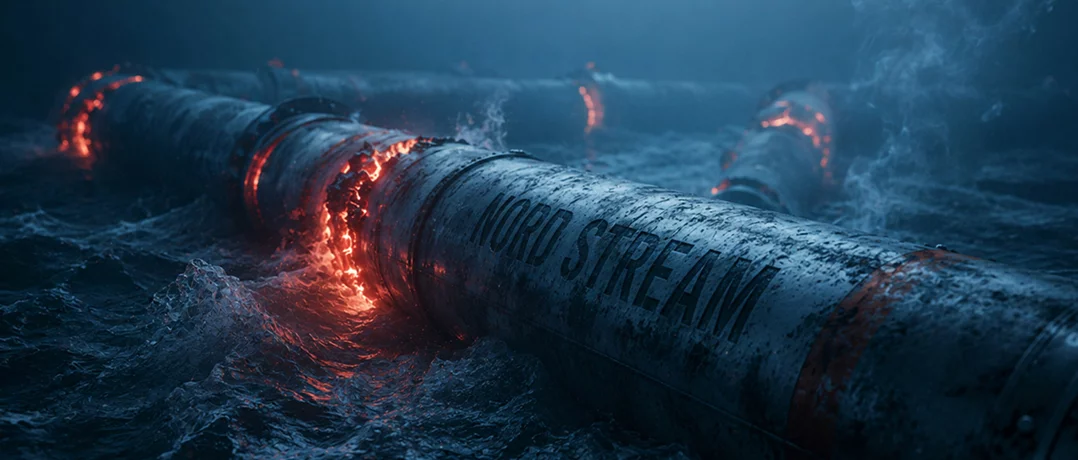
Few acts of sabotage in recent history have generated as much controversy, speculation, and geopolitical consequence as the destruction of the Nord Stream gas pipelines in September 2022. The underwater explosions, which crippled 3 of the 4 pipelines linking Russia to Germany beneath the Baltic Sea, fundamentally reshaped Europe’s energy landscape and intensified an already volatile geopolitical environment following Russia’s full-scale invasion of Ukraine in February 2022.
For nearly 3 years, responsibility for the operation remained one of Europe’s greatest unresolved mysteries. Competing theories accused Russia, the United States (U.S.), or other state actors of orchestrating the attack. However, German prosecutors now believe they have reconstructed the operation and identified those allegedly responsible.
According to their investigation, the sabotage was not carried out by a major navy or an intelligence service, but by a small team of Ukrainian civilians and former military personnel operating from a rented sailing yacht. If these allegations are ultimately proven in court, the operation would represent one of the most sophisticated covert missions ever executed by a non-state team, highlighting how a relatively small group was allegedly able to disable billions of dollars’ worth of critical infrastructure with limited resources.
The Nord Stream pipelines and their strategic importance
The Nord Stream system consisted of 2 parallel pipeline networks stretching approximately 1,200 kilometers across the Baltic Sea from Russia to Germany. Nord Stream 1 had become one of Europe’s principal routes for Russian natural gas, while Nord Stream 2 had been completed but never entered commercial service after Germany suspended its certification shortly before Russia invaded Ukraine.
For years, the pipelines symbolized Europe’s extensive dependence on Russian energy. Supporters viewed them as commercially beneficial infrastructure capable of ensuring reliable energy supplies at low cost, while critics (especially the United States) argued they strengthened Russia’s geopolitical influence over Europe and bypassed traditional transit countries such as Ukraine, depriving Kyiv of significant transit revenues and increasing its strategic vulnerability.
Although gas deliveries through Nord Stream had already ceased by September 2022, the pipelines remained valuable strategic assets whose destruction permanently altered Europe’s energy calculations.
How the sabotage was allegedly planned
According to German prosecutors, the operation was organized months before the explosions occurred. Investigators allege that a team consisting of 7 individuals (including experienced deep-sea divers, an explosives specialist, a skipper, and an overall coordinator) chartered a sailing yacht named “Andromeda” using forged identities.
The vessel departed from Germany’s Baltic coast in early September 2022, presenting itself as an ordinary recreational sailing trip. Unlike military vessels that would have attracted attention, the relatively small yacht blended naturally with civilian maritime traffic, allowing the team to move across the Baltic Sea without raising suspicion.
German investigators allege that Serhii K., a 50-year-old Ukrainian national and former soldier, served as the operation’s coordinator rather than participating directly in the underwater diving or handling explosives. Prosecutors claim he supervised the mission while the specialized divers executed the underwater work near Denmark’s Bornholm Island, where they attached explosive charges.
The operation reportedly relied on careful logistical planning, detailed knowledge of the pipelines’ locations, and extensive preparation to transport military-grade explosives without detection. The resulting blasts destroyed 3 of the 4 pipelines, releasing unprecedented quantities of methane into the Baltic Sea and rendering the infrastructure permanently inoperable.
The German investigation and criminal charges
Following years of multinational investigations involving Germany, Denmark, and Sweden, German prosecutors gradually assembled what they describe as compelling evidence against the alleged participants.
Investigators reportedly traced the rental of the Andromeda, recovered forensic evidence from the yacht, analyzed travel records, and intercepted communications that they believe linked the suspects to the operation. Prosecutors also allege that Serhii K. made incriminating statements during monitored telephone conversations while detained in Italy pending extradition.
After his arrest in Italy in August 2025, he was extradited to Germany several months later and remains in pre-trial detention in Hamburg. German prosecutors have charged him with attacking civilian energy infrastructure, causing explosions, and destroying critical infrastructure.
His defense team rejects the accusations, maintaining that he was in Ukraine at the time of the sabotage and arguing that he should ultimately be acquitted.
Political and geopolitical implications
The legal proceedings carry significant political sensitivity.
Ukraine has consistently denied any state involvement in the sabotage, while President Volodymyr Zelenskyy has stated that Kyiv has not received sufficient official information to comment fully on the German charges.
No government has been formally accused of directing the operation, and German investigators have thus far stated that they have found no conclusive evidence linking the attack directly to the Ukrainian government.
Nevertheless, the investigation has exposed divisions among European allies. Germany insists that attacks on civilian infrastructure must be prosecuted regardless of political considerations, highlighting the rule of law and the protection of critical infrastructure.
Elsewhere, reactions have been more divided. In several Eastern European countries, many observers regard the destruction of Nord Stream as having eliminated a strategic instrument of Russian influence. Some political leaders have questioned whether prosecuting those allegedly responsible serves Europe’s broader security interests, given Russia’s invasion of Ukraine and the pipelines’ controversial geopolitical legacy.
The case therefore illustrates the complex intersection of criminal justice, wartime realities, and alliance politics.
-
-

-
The Beiruter
-
