Rival Iranian groups are increasingly bringing their political battles to London’s streets, exposing deep divisions over Iran’s future and the alliances being formed abroad.




Rival Iranian groups are increasingly bringing their political battles to London’s streets, exposing deep divisions over Iran’s future and the alliances being formed abroad.

London has long been a centre for Iranian intrigue. Monarchists versus Islamists who in turn oppose secular socialists versus liberals, and so on. In recent months Iranian groups have become louder and more visible on the city’s streets. Monarchists recently marched with the anti-Muslim demagogue Tommy Robinson while pro-Tehran elements, on the same day, attached themselves to a huge pro-Palestine demonstration. So, what exactly is going on?
On 16th of May, just weeks ago, two rival marches squared off against each other. Braving police lines, I moved among both crowds, deeply hostile to each other. On one side, thousands filed past the Victorian gentlemen’s clubs in Pall Mall for a rally commemorating Nakba 78. These marchers from the political Left, Muslim groups, trade unions, and other pressure groups were expressing their solidarity with Palestine while also opposing the other demonstration a mere ten-minute walk away.
Amidst the sea of Palestinian flags, was a smattering of Iranian regime flags. Pro-Iranian groups in London have framed Tehran as the leading state backer of Palestinian resistance, funding and arming groups like Hamas and Palestinian Islamic Jihad. Plus, nobody in Lebanon needs reminding that Iran backs Hezbollah.
To some on the British left, for whom Palestine has become a totemic cause, all those ranged against Israel must be friends. This is a complete abandonment of the left’s opposition to the Iranian regime in the 1980s. Back then, the mullahs were seen as reactionary, misogynist, and trampling on human rights. Meetings were held to protest the death penalty being widely used against opponents.
But then came the Iraq wars and Iran was gradually re-cast as a bulwark against western imperialism. Some on the “hard” left turned a blind eye to rights abuses. And even though Iran has been implicated in at least 15 plots to kill Britons or British residents who oppose the regime, since 2022, it’s given a soft ride by many on the left. The logic being that any enemy of the United States and Israel can’t be all bad. The Trump administration’s bombing of Iran early this year has only served to cement that view.
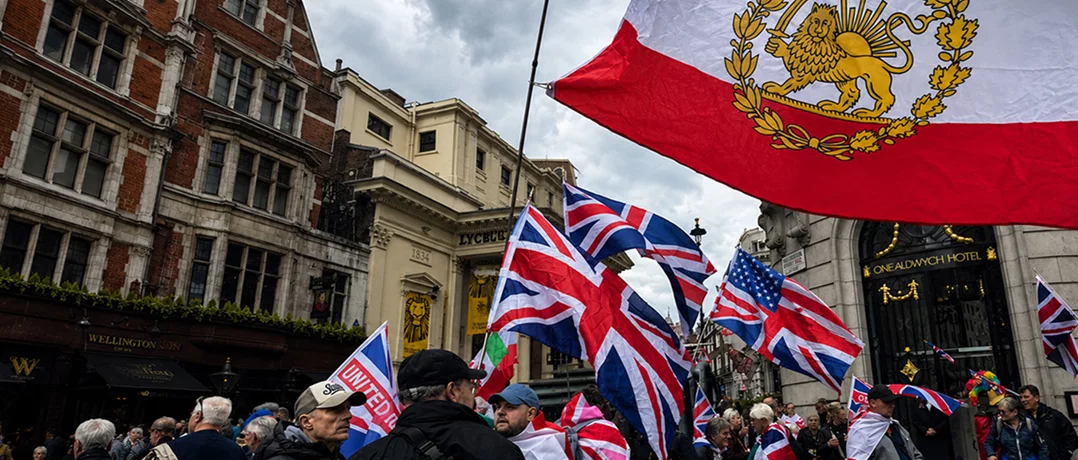
In complete contrast to the pro-Palestine march, on the other side of the political divide, marching from Kingsway to Parliament Square, was the Unite the Kingdom demonstration led by a controversial figure, Tommy Robinson (real name, Stephen Yaxley-Lennon). His event was a sea of Union Jacks punctuated by both Israeli and Iranian monarchist flags.
In the 1970s, the British extreme Right, led by the National Front, was rooted in antisemitic conspiracy theories. But over the last 30 years, the anti-Jewish focus has been replaced by an anti-Muslim ideology with Israel, especially under the Netanyahu government, now framed as an ally. The talk is of a clash of civilisations and protecting Christianity though many of these demonstrators did not strike me as regular churchgoers.
Robinson has a string of criminal convictions yet retains a fiercely loyal extreme-Right follower base. The imagery on his rally combined football, the Knights Templar, Christian crucifixes, and anti-migrant messaging. He began his speech by asking: “Are you ready for the Battle of Britain?” His coalition includes members of political parties like Reform, Restore, and Advance that are anti-migration, anti-European Union, anti-Muslim, and increasingly emphasise Christianity as the core religion of Britain.
Dozens of Iranian monarchists were in attendance waving the royal Lion and Sun Flag, banned in Iran since the mullahs took over in 1979. In recent months, they have taken to the streets of London in support of the exiled Crown Prince Reza Pahlavi and his stated wish to play a role in leading Iran away from being an Islamic republic.
Many of them are angered at the refusal of British prime minister Keir Starmer to give full-throated approval to the American conflict with Iran. Although on this issue, Starmer has majority opinion in the UK on his side, according to most surveys.
The monarchist presence has been hard to ignore in recent months if you walk through Trafalgar Square or Whitehall, the nerve centre of the British government. In addition. The Iran International satellite TV channel is based in London, promoting Crown Prince Reza Pahlavi, and funded by Saudi Arabia.
Not all London-based opponents of the regime in Tehran support the monarchist position. Liberal, secular, and left-wing groups that want a non-Islamic republic turn up in Trafalgar Square, in smaller numbers than the monarchists, to make their presence felt. They do not believe that Pahlavi is the answer to Iran’s problems.
These groups include the People’s Mojahedin of Iran (PMOI/MEK) and the National Council of Resistance of Iran (NCRI). Between 2001 and 2008, the MEK was designated as a terrorist organisation by the UK government because of funding from Iraq’s Saddam Hussein and failure to officially renounce terrorism. However, in recent years, with changing circumstances, it’s been courted by both American and British politicians.
In December 2022, its offices in the Cricklewood district of London were firebombed, an act blamed by the group on Tehran. The leader of the NCRI is Maryam Rajavi who has encouraged other women to take leading roles in the organisation.
Secular leftists with a base in London encompass the United Republicans of Iran (URI), National Front of Iran, Worker-Communist Party of Iran, and the Tudeh Party. The latter was a pro-Soviet party under the Shah in the 1970s that split with others on the left to support the 1979 Islamic revolution. If they were expecting gratitude from Ayatollah Khomeini, they got none. In the early 1980s, the mullahs purged and executed their members. These groups find themselves in opposition to both the mullahs and the monarchists.
As the two demonstrations on 16th of May showed very clearly, things are very polarised for the Iranian diaspora in London. The two groups making the most noise, and cutting through right now, are the Iran government, and its stooges plus left-wing “useful idiots” on one side, and the Iranian monarchists, with new friends on the far Right, on the other side. Whether the alliances they are forming deliver what they are hoping for, remains to be seen.