



Iran’s reported rocket-delivered sea mines could reshape maritime security, threatening Hormuz shipping through low-cost asymmetric tactics and strategic disruption.
Iran’s new mine threat that could disrupt Hormuz Strait
Iran’s new mine threat that could disrupt Hormuz Strait
By The Beiruter | September 03, 2026

Reading time: 6 min
The United States (U.S.) has carried out its first acknowledged military strike inside Iran since late July, targeting what it described as an imminent Iranian attempt to deploy sea mines in the strategically vital Strait of Hormuz.
The operation marked a renewed phase in the ongoing confrontation between Washington and Tehran, coming only days after U.S. forces announced they had cleared the main international shipping lane of previously laid naval mines.
Preventing a new mine threat
U.S. Central Command (CENTCOM) described the operation as a “limited and precise” strike aimed at preventing an imminent threat to international shipping. U.S. officials said intelligence and surveillance assets had detected Islamic Revolutionary Guard Corps (IRGC) personnel preparing rocket launchers capable of dispersing sea mines into the Strait of Hormuz.
The U.S. argued that the operation was defensive rather than offensive, highlighting that it sought to ensure freedom of navigation and protect commercial shipping. According to CENTCOM, Iran created the immediate danger by preparing to deploy new mines after the U.S. military had recently completed an extensive mine-clearing campaign in the area.
President Donald Trump had previously warned Tehran that any attempt to place additional mines in the strait would trigger an immediate military response. Following the latest strike, U.S. forces remained on heightened alert, with officials stating that they would continue monitoring the area to guarantee the uninterrupted flow of maritime commerce.
Iranian media reported that the strike killed two people and wounded two others. Tehran condemned the attack as a violation of its sovereignty and pledged retaliation.
Iranian retaliation raises regional risks
Iran responded within hours by launching ballistic missiles toward U.S. military facilities in Jordan, while additional reports indicated attempted attacks against American positions elsewhere in the region, including the United Arab Emirates (UAE).
U.S. officials stated that several missiles were intercepted before reaching their intended targets, resulting in no casualties or significant damage. Jordan confirmed that its air defense systems successfully intercepted multiple incoming missiles over its territory.
Meanwhile, President Trump warned that any attacks on American personnel or interests would provoke a powerful response. Despite the military escalation, Iranian President Masoud Pezeshkian reiterated that Tehran still seeks a diplomatic agreement with Washington, arguing that continued conflict serves neither country’s interests and that dialogue remains the preferred path toward resolving disputes.
A possible new generation of Iranian naval mines
One of the most significant aspects of the latest U.S. strike is the weapon that American officials say Iranian forces were preparing to employ. According to CENTCOM, the launchers targeted on Larak Island were configured to fire artillery rockets carrying small sea mines; a capability that has received little public attention and, if confirmed, would represent a new evolution in Iran’s asymmetric maritime arsenal.
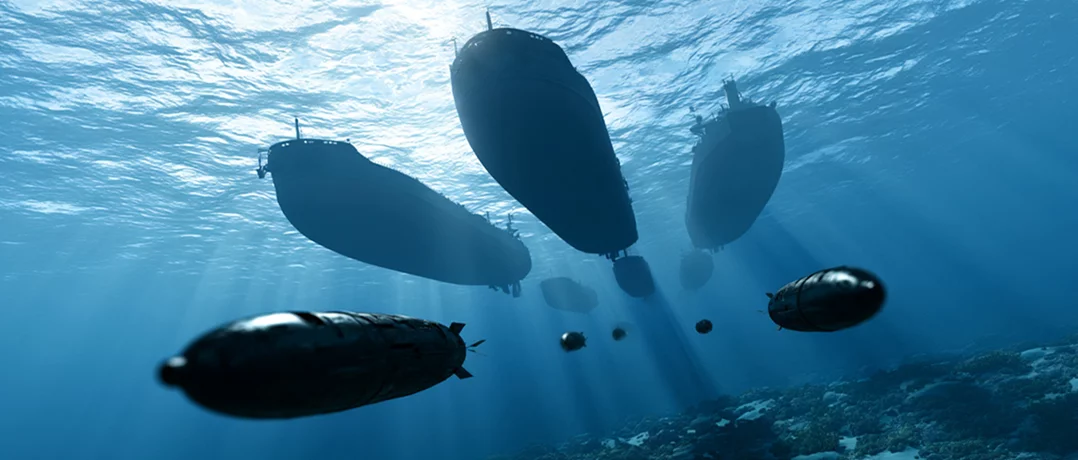
Unlike conventional naval mines, which are typically deployed from ships, speedboats, or submarines and anchored to the seabed or attached directly to a vessel’s hull, these munitions would be delivered by land-based artillery rockets. Once launched, the rocket would release a compact floating mine over the water, allowing it to drift with ocean currents and wind before potentially striking a vessel. This method enables Iran to threaten maritime traffic without exposing naval vessels or mine-laying boats to interception, while also allowing launch sites to remain on Iranian territory.
Although relatively little is publicly known about the system, maritime analysts believe it could be based on a modified version of Iran’s Fajr-5 artillery rocket. During military exercises in recent years, Iran reportedly demonstrated a variant capable of dispensing a single free-floating mine into the water, suggesting that Tehran has explored alternative methods of disrupting maritime navigation beyond traditional mine-laying operations.
The weapon is not believed to possess the destructive power of larger anchored naval mines, which often contain several hundred pounds of explosives and are capable of sinking major commercial vessels. Instead, the rocket-delivered mine is likely much smaller, limited by the rocket’s diameter and payload capacity, and would probably contain only several dozen pounds of explosives. Consequently, it would be unlikely to sink modern double-hulled oil tankers, which are specifically designed to withstand localized hull damage without catastrophic oil spills.
Nevertheless, defense experts caution that the danger lies less in the explosive yield than in the uncertainty the weapon creates. Drifting mines are difficult to track because they move unpredictably with winds and sea currents, potentially traveling far from their original point of release. Even a small number could force commercial shipping to halt while naval forces conduct time-consuming detection and clearance operations. They could also pose a serious threat to fishing vessels, patrol boats, and smaller commercial ships, while causing localized flooding or damage to lightly protected naval vessels. If carried into the open sea or washed ashore, such mines could also endanger civilians who unknowingly encounter them.
If the reported system exists and enters regular service, it would represent another example of Tehran’s long-standing strategy of developing low-cost, asymmetric weapons designed to complicate maritime security operations, disrupt commercial navigation, and impose disproportionate costs on adversaries without engaging in conventional naval warfare.
Iran’s evolving maritime strategy
Iran has long relied on asymmetric naval tactics to offset the conventional military superiority of the U.S. and its regional partners. Rather than attempting to match Western naval power directly, Tehran has invested heavily in fast attack boats, anti-ship missiles, armed drones, submarines, and an extensive inventory of naval mines.
Historically, Iran has employed several categories of mines, including limpet mines attached by divers to ship hulls and larger anchored mines capable of inflicting catastrophic damage on commercial vessels. The apparent development of rocket-delivered drifting mines would represent another adaptation designed to complicate maritime security operations while requiring relatively limited resources.
Although these smaller mines may pose less danger individually than traditional naval mines, they could still create widespread uncertainty, delay shipping, increase insurance costs, and force naval forces to devote considerable resources to detection and removal.
Whether the reported rocket-delivered sea mines represent a significant technological evolution or a limited tactical innovation, the incident illustrates the continuing adaptation of Iran’s asymmetric maritime strategy. As long as tensions persist in the Gulf, the Strait of Hormuz is likely to remain both a strategic flashpoint and a focal point of international security concerns.
-
-

-
The Beiruter
-
