



Iran’s transformation amid war and the Islamabad talks
Iran’s transformation amid war and the Islamabad talks

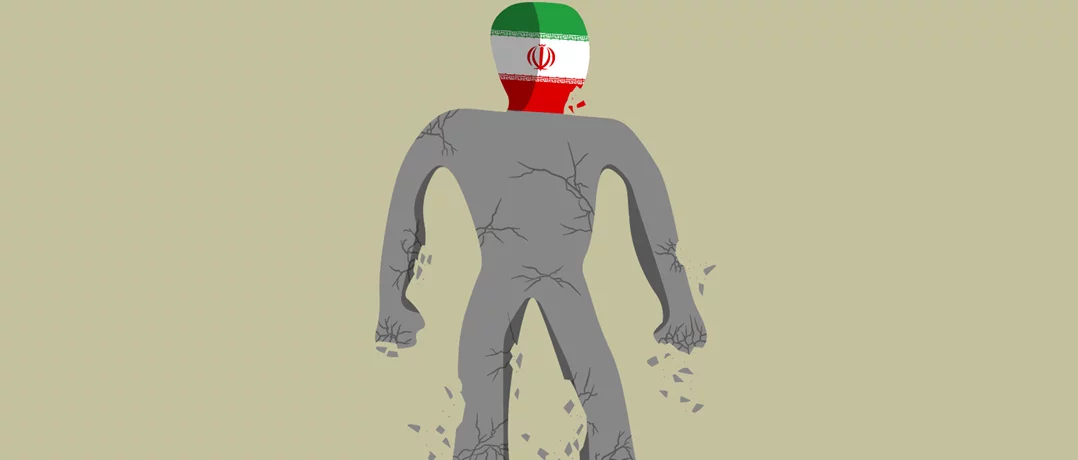
Iran today no longer resembles the country that entered the Islamabad negotiations, neither in form nor in how power is exercised. It is certainly not the same Iran as in the 2015 nuclear deal, when the system negotiated from a unified, centralized position under the direct supervision of Supreme Leader Ali Khamenei, who acted as a “conductor”, balancing competing factions within the Islamic Republic.
That structure now appears to have collapsed entirely following the military and political upheaval triggered by what became known as the “Forty-Day War” between the United States and Israel on one side and Iran on the other.
Khamenei’s assassination was not just a political killing; it marked a turning point that reshaped the system itself. His absence dismantled the traditional hierarchy that once governed relations between state institutions. What has emerged instead is a fragmented network of competing military and security power centers. In this vacuum, the system has lost its ability to produce a unified position and has instead become an arena of open internal conflict.
In response, the swift appointment of Mojtaba Khamenei as the new Supreme Leader was clearly an attempt -largely driven by the Islamic Revolutionary Guard Corps (IRGC) to fill the vacuum. But rather than stabilizing the system, his appointment exposed the depth of the crisis that had long been masked by his father’s authority.
Mojtaba, who was expected to embody continuity, has not appeared publicly since his appointment and has not directly addressed the Iranian people. Instead, statements attributed to him have circulated without confirmation, reinforcing the perception of a “hidden leader”, echoing Shiite notions of the absent Imam. According to multiple reports cited in, he was seriously injured during the early airstrikes that launched the war. He reportedly underwent multiple surgeries, suffering injuries to his leg and hand, along with severe facial burns that have impaired his ability to speak. As a result, communication has been limited to written statements read on state television.
This absence is not merely a health issue in a system built around a single dominant leader. It has become a structural factor in a deepening crisis of legitimacy. For the first time since the Iran-Iraq War in the 1980s, Iran is facing a major war while lacking an active supreme authority. Combined with unprecedented internal political and economic pressure, this vacuum has allowed the IRGC to step in not only as a military force but as the dominant political decision-maker.
Figures such as Ahmad Vahidi, the new IRGC commander, have emerged as key actors shaping policy, especially in security and negotiation files. This shift at the top has reshaped internal dynamics, turning differences into outright power struggles.
Reports suggest that tensions have escalated sharply between Parliament Speaker Mohammad Bagher Ghalibaf and the IRGC, despite Ghalibaf’s own roots in the Guard. The dispute centers on control of negotiations with the United States. According to these reports, the IRGC imposed direct communication channels with negotiators, limiting Ghalibaf’s ability to maneuver or make decisions even though he holds the highest formal position within the negotiating team. This prompted objections from him, particularly over the increasing role of military officers lacking his diplomatic experience.
At the same time, the Foreign Ministry, led by Abbas Araghchi, appears to have adapted to this new reality shaped by the IRGC, even at the expense of diplomatic initiatives. This shift may also signal a break with reformist elements who favor ending the war and securing an agreement that would allow Iran to return to some degree of normalcy.
These divisions are no longer confined behind closed doors. They were clearly reflected in the Islamabad negotiations, which have become a mirror of Iran’s internal crisis. Tehran sent a large delegation of 88 members representing various factions, from hardliners and IRGC figures to government officials aligned with reformists. The size and diversity of the delegation highlighted the absence of centralized decision-making that once rested with Khamenei.
Rather than strengthening Iran’s position, this diversity created confusion. Each faction entered the talks with its own vision: a government wing seeking a settlement to ease economic pressure and end the war; a parliamentary bloc favoring limited compromises to preserve the regime; and the IRGC, which rejects any strategic concessions and continues to push for escalation. Some within this camp believe Iran could eventually develop a nuclear weapon that would force global recognition of a new Iranian role. This position aligns, at least temporarily, with hardline factions that oppose any agreement and even advocate for a prolonged war they believe could weaken Israel and push the United States out of the region.
What is most significant is that this division is no longer a calculated negotiating tactic as it was in past talks, when Tehran balanced “moderates” and “hardliners” within a unified strategy. Today, it has become a genuine internal struggle, with no faction capable of controlling the others.
This reality was evident in the failure of the first round of negotiations on April 11. The breakdown was due not only to disagreements with Washington but also to internal fragmentation within the Iranian delegation, which forced negotiators to return to Tehran to consult multiple competing centers of power.
Meanwhile, inside Iran, an unprecedented level of uncertainty prevails, worsened significantly by strict internet restrictions. With connectivity either cut or heavily limited, and foreign journalists largely barred from entering the country, obtaining reliable or independent information has become extremely difficult. The disruption has also hit Iran’s economy, particularly sectors reliant on online connections with international markets.
This information blackout has not only obscured reality but reshaped it. Available accounts now depend largely on scattered personal testimonies that are often impossible to verify. These suggest that while daily life has not completely stopped, the atmosphere is deeply affected by fear of repression intensified after protests in January and further exacerbated by the war, as well as by mounting economic hardship.
Without reliable data, it is difficult to assess the scale of public discontent or protest activity. This uncertainty complicates analysis not only for external observers but even for decision-makers within the system itself.
Economically and militarily, Iran faces immense pressure. The U.S. naval blockade has severely disrupted oil exports, while military strikes have damaged key infrastructure, including military sites and nuclear facilities. The currency has collapsed, and the cost of living has surged, fueling internal unrest. In response, the IRGC has expanded recruitment of Basij forces to suppress dissent and has reportedly increased executions of political activists.
Under these conditions, the Islamabad talks appear less about reaching a comprehensive agreement and more about managing the crisis to prevent total collapse. Each faction believes it holds leverage, but the absence of unified leadership makes it difficult to translate that leverage into a coherent strategy.
Iran is no longer facing only an external crisis; it is undergoing a profound internal one centered on the nature of its political authority. A system that once managed its contradictions through careful balance is now trapped in an open struggle among competing power centers, without a leader capable of imposing discipline.
As economic and military pressures continue and negotiations falter, the country appears to be heading toward a prolonged period of instability, where external conflict and internal fragmentation feed into one another.
The central question is no longer whether Iran will make concessions, but who has the authority to make them. In this fragmented landscape, the answer may be that no one does, leaving any potential agreement fragile and vulnerable to collapse at any moment, especially as hardline factions retain multiple tools to disrupt the situation, both internally through repression and externally through allied militias in Lebanon, Iraq, and Yemen.
