

Ukraine’s Caspian Sea strikes expose the expanding Russia-Iran partnership, transforming a strategic maritime corridor into an increasingly volatile geopolitical flashpoint.
Iran’s war expands to the Caspian Sea

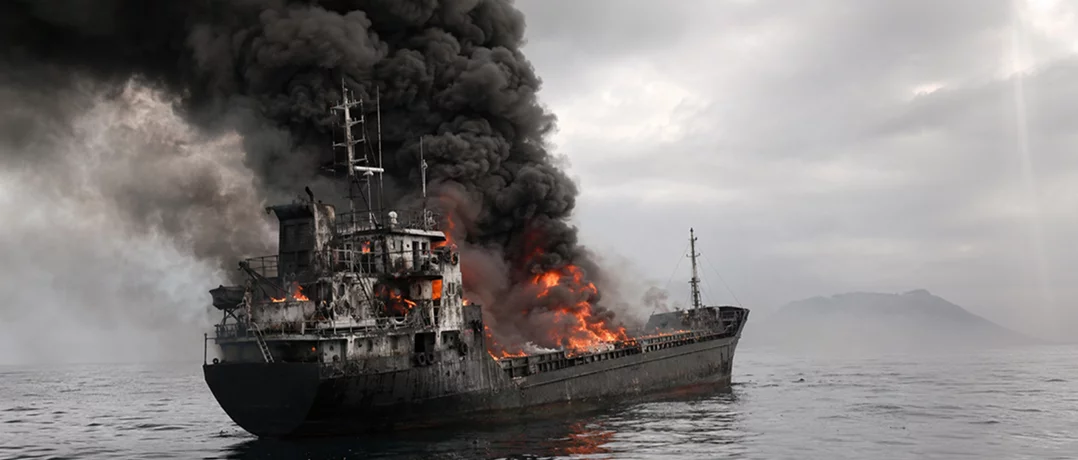
The Caspian Sea, the world’s largest inland body of water, has become an increasingly important theater in the interconnected security crises involving Russia, Ukraine, Iran, and the West. Long valued for its energy resources and commercial shipping routes, the sea has now acquired greater military significance as the strategic partnership between Moscow and Tehran continues to deepen.
Recent Ukrainian drone strikes against vessels operating in the Caspian have brought this previously insulated region into the broader geopolitical confrontation, intensifying diplomatic tensions between Iran and Ukraine.
The Caspian Sea’s growing strategic importance
Bordered by Russia, Iran, Kazakhstan, Turkmenistan, and Azerbaijan, the Caspian Sea has traditionally served as an important hub for regional trade, energy exports, and transportation. In recent years, however, its strategic value has increased considerably.
For Iran, restrictions on maritime trade through the Persian Gulf and the Gulf of Oman have elevated the importance of northern trade routes. The Caspian provides Tehran with an alternative commercial corridor connecting it to Russia, Central Asia, and, indirectly, European markets through rail and multimodal transport networks.
Russia likewise considers the Caspian an essential logistical corridor linking its southern regions with Iran and Central Asia. Unlike maritime routes exposed to greater Western naval monitoring, the Caspian remains largely controlled by its littoral states, making it comparatively insulated from external military interference.
Beyond commercial activity, the waterway has evolved into an important channel supporting the expanding economic, technological, and military partnership between Moscow and Tehran.
Ukraine expands its long-range campaign
The latest escalation followed Ukraine’s announcement that its drones had struck Russian vessels operating in the Caspian Sea. According to Ukrainian officials, the targeted ships were transporting military cargo connected to cooperation between Russia and Iran, alongside a Russian missile boat.
President Volodymyr Zelensky stated that the operation formed part of Ukraine’s broader effort to weaken Russia’s military logistics and disrupt supply routes supporting its invasion.
Iran, however, presented a sharply different account. Tehran maintained that one of the vessels struck was an Iranian commercial ship carrying iron cargo from Russia’s Astrakhan port to Iran’s Anzali port. Iranian authorities reported that one sailor was killed and several others were injured.
The conflicting narratives immediately transformed what Kyiv described as a military operation into a diplomatic confrontation involving a third country directly affected by the strike.
Escalating diplomatic tensions
The attack prompted swift diplomatic reactions from both sides.
Iran summoned Ukraine’s chargé d’affaires in Tehran to protest what it described as an attack on civilian property and warned that the incident “cannot go unanswered.” Iranian Foreign Minister (FM) Abbas Araghchi subsequently raised the issue during separate discussions with Russian FM Sergei Lavrov and European Union foreign policy chief Kaja Kallas.
Ukraine rejected Iran’s accusations, arguing instead that Tehran has become an active military supporter of Russia through its supply of drones and other equipment used during the war. Ukrainian FM Andrii Sybiha dismissed Iranian threats of retaliation, asserting that Iran bears responsibility for enabling Russian attacks against Ukrainian civilians by providing military technology since the beginning of the full-scale invasion.
These exchanges demonstrate how Ukraine’s campaign against Russia’s logistical infrastructure now carries increasingly significant diplomatic consequences beyond Europe.
The Russia-Iran military partnership
The Caspian Sea occupies a central role in the growing strategic relationship between Russia and Iran.
Since 2022, Iran has supplied Russia with Shahed-series attack drones that have been extensively employed against Ukrainian infrastructure. Although Russia now manufactures modified versions domestically, early shipments reportedly crossed the Caspian before reaching Russian territory.
Western officials have also expressed concerns regarding transfers of Iranian ballistic missile technology and other military equipment through this maritime corridor. Previous reports indicated that vessels operating between Iranian ports and Russia’s Astrakhan were suspected of transporting drone components and missile systems intended for Russia’s war effort.
Iran has consistently denied providing offensive military assistance beyond officially acknowledged cooperation. Nevertheless, the growing defense relationship between the two countries remains a major source of concern for Ukraine and its Western partners.
Meanwhile, President Zelensky recently alleged that Russian satellite intelligence had helped Iran prepare attacks against United States (U.S.) military facilities in the Middle East by providing surveillance imagery before and after planned operations. According to Kyiv, this intelligence-sharing reflects an increasingly integrated strategic partnership between Moscow and Tehran.
These contrasting statements illustrate the uncertainty surrounding the precise scope of cooperation between Moscow and Tehran and the difficulty of independently verifying many intelligence-related claims made during ongoing conflicts.
A broader regional conflict
Military analysts suggest that Ukraine’s operation represents less an attempt to open a direct confrontation with Iran than an expansion of its strategy to disrupt Russian supply chains wherever they exist.
In recent months, Ukraine has increasingly targeted oil infrastructure, ports, cargo vessels, logistics hubs, and maritime transport supporting Russia’s economy and military operations. The Caspian Sea fits naturally into that broader campaign because it serves as one of Russia’s most secure transportation corridors.
At the same time, the strike demonstrates how regional conflicts are becoming increasingly interconnected. The war in Ukraine, tensions involving Iran, instability in the Middle East, and competition among global powers are no longer isolated developments but increasingly influence one another through shared alliances, military cooperation, and strategic infrastructure.
-
-

-
The Beiruter
-
