



In an interview with The Beiruter, Iraqi military and strategic expert General Jamal Al-Halbousi analyzes how Iraq has become increasingly exposed amid the growing regional confrontation and its implications for the country’s internal stability, security institutions, and energy resources.
Iraq: The battlefield between rival powers

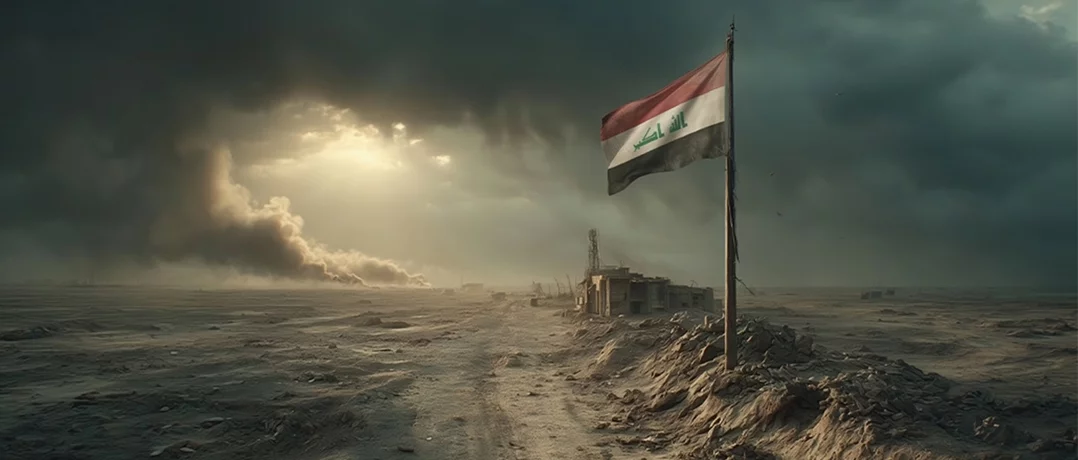
Iraq once again finds itself at the center of a complex regional confrontation. While the ongoing conflict involves multiple actors, including the United States (US), Israel, Iran, and various armed groups, Iraq appears particularly exposed to attacks and military activity from both contending parties.
In an exclusive interview with The Beiruter, Iraqi military expert General Jamal Al-Halbousi offers a comprehensive assessment of the situation. He explains that the current escalation can be understood within a broader historical framework of Gulf conflicts and highlights Iraq’s unique geopolitical position between competing powers.
A conflict that resembles a “4th Gulf war”
According to General Al-Halbousi, the current situation can be described as a form of 4th Gulf war, although it remains relatively limited compared to previous conflicts.
The first Gulf war involved the conflict between Iraq and Iran in the 1980s. The second followed Iraq’s invasion of Kuwait in 1990, which prompted a large international coalition to intervene. The third also involved a broad international coalition during the 2003 invasion of Iraq.
In contrast, the present confrontation differs in structure and scope. If the conflict were limited strictly to the US and Israel on one side and Iran on the other, Al-Halbousi notes that it might remain relatively contained. In that case, it could resemble the previous 12-Day War in 2025.
However, the equation has now changed. The duration of the fighting has increased, and the scope of military operations has expanded significantly.
Both sides, the US and Israel on one hand, and Iran on the other, have widened their operational theaters. Military activities now extend across the Gulf Cooperation Council (GCC) states, northern and northeastern Iran, Iraq, Lebanon, and even Yemen.
This vast geographical expansion, Al-Halbousi argues, will inevitably produce numerous military and political consequences. Within this broader regional battlefield, Iraq occupies a central position.
Baghdad maintains a security agreement with Washington related to defense and protection, while simultaneously maintaining relations and agreements with Iran. As the conflict escalates, both sides are exploiting Iraqi territory in order to target what they perceive as hostile actors.
The US and Israel have targeted armed groups in locations such as southern Lebanon and Iraq. These strikes have focused on faction headquarters, individuals affiliated with those groups, and logistical support networks across several Iraqi provinces.
Iran, for its part, has targeted American military bases in Iraq, including Harir Air Base and Ain al-Asad Air Base. After American forces withdrew from Ain al-Asad, attention shifted toward the Harir base in Erbil, as well as the US consulate and embassy in Baghdad.
Recent days have also witnessed the interception of explosive-laden suicide boats and attacks on 2 oil tankers within Iraqi territorial waters. As a result, both sides are targeting locations that could harm their opponent; whether through military installations or through economic and energy-related infrastructure.
The issue of shared oil fields
Another sensitive issue concerns shared oil fields between Iraq and Iran.
According to Al-Halbousi, there are between 9 and 11 joint oil fields located along the border between the 2 countries. Most of these fields are currently almost inactive. A similar situation exists with the 6 shared oil fields between Iraq and Kuwait.
Even the Iraqi Ministry of Oil’s 6 licensing rounds did not adequately address the issue of shared fields. Although meetings have taken place between oil ministry delegations from Iraq, Kuwait, and Iran, these discussions have not produced concrete results.
Meanwhile, investment by Iran and Kuwait in these fields continues, while Iranian restrictions remain in place on certain Iraqi oil sites, particularly in the Faqa field near Amarah, as well as other locations in Diyala and Wasit provinces.
According to Al-Halbousi, the overall equation is not favorable to Iraq. This is partly linked to the country’s internal political divisions. Iraq’s political system, based on power-sharing quotas, has created deep divisions among political factions.
In this respect, he notes, the Iraqi situation bears significant similarities to the Lebanese political model.
Iraqi government response
So far, Al-Halbousi says, the Iraqi authorities have not taken measures that could be described as deterrent actions. The only response issued was a limited statement of objection from the Iraqi Ministry of Defense.
Regarding the Iraqi government’s ability to restrain armed factions operating within the country, Al-Halbousi believes this is largely impossible. Many of these factions are ideologically driven and maintain connections with authorities outside Iraq, specifically with Iranian ideological and political networks. As a result, they do not fully represent Iraqi state authority.
Officially, these factions are considered part of the military structure under the Iraqi Commander-in-Chief of the Armed Forces. In practice, however, some of them operate according to orders issued from outside the country, while others remain committed to directives from Iraq’s Joint Operations Command.
These factions are deeply intertwined with the army, police, and security forces, which makes it extremely difficult to fully control or restrict their activities. According to Al-Halbousi, even the senior leadership of these factions may not be able to completely halt their operations.
The role of military and security institutions
According to Al-Halbousi, Iraq’s policy therefore appears to be one of moderation, but at times it approaches a level that resembles submission. Iraq cannot respond directly to the United States or Israel, nor can it confront Iran, due to the security agreements and political ties that exist with both sides.
At the same time, reviewing these agreements reveals clear violations committed by the United States and Iran, and even by Israel, despite the absence of any formal agreement between Baghdad and Tel Aviv.
Consequently, many border areas remain largely unprotected, with ongoing smuggling activities and repeated cross-border movements. Several border crossings are simply unable to prevent such violations.
Caught between powerful external actors and constrained by internal political fragmentation, Iraq has become an arena where rival powers project their influence and settle strategic scores. As the conflict continues to evolve, Iraq’s challenge will be to balance its competing alliances while protecting its sovereignty; an objective that remains difficult to achieve amid overlapping regional rivalries and enduring internal divisions.
-
-

-
The Beiruter
-
