



Iraq’s militia paradox traces years of conflict, from Saddam Hussein’s era to ISIS, as Baghdad struggles to restore state sovereignty under PM al-Zaidi.
Iraq’s militia paradox and the battle for state sovereignty
Iraq’s militia paradox and the battle for state sovereignty
By Anthony Chamoun | October 11, 2026

Reading time: 8 min
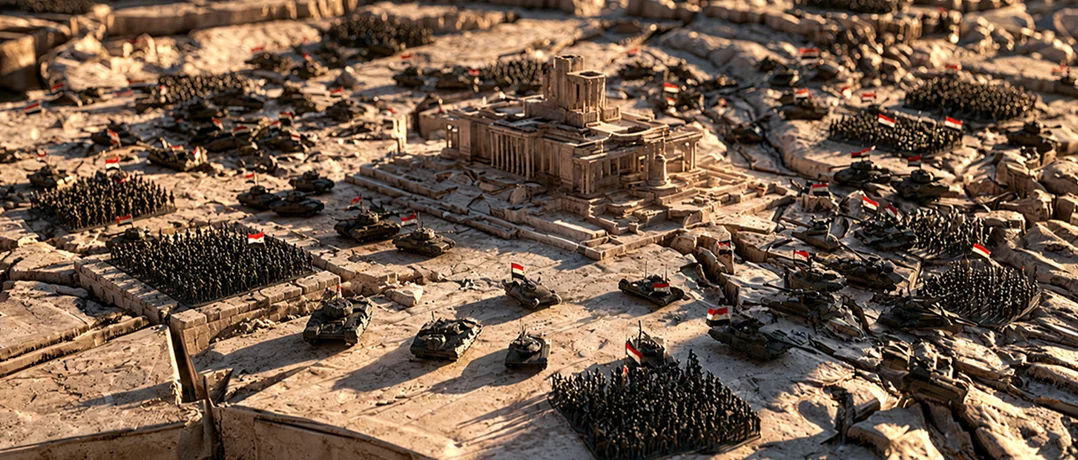
Since the fall of Saddam Hussein’s regime in 2003, Iraq has struggled to rebuild state institutions while managing the influence of powerful non-state armed groups operating alongside official security forces. Among the most significant actors in this environment have been Shiite armed factions.
Today, Baghdad faces one of its most consequential security debates since 2003: whether and how to establish a state monopoly over arms while managing powerful factions that have become deeply embedded in Iraq’s political and security landscape.
The origins of Iraq’s Shiite non-state armed groups
The roots of many Iraqi Shiite non-state armed groups can be traced back to the period of Saddam Hussein’s rule, when the Ba’athist government suppressed religious and political opposition, particularly among Shiite Islamist movements. Following the 1979 Iranian Revolution, Tehran began supporting Iraqi opposition groups that shared ideological links with Iran’s revolutionary model, viewing them as potential partners against Saddam’s government and proxies for its regional ambitions.
After the 2003 United States (U.S.)-led invasion and the collapse of Saddam’s Ba’ath regime, Iraq entered a period of severe instability. The dissolution of the Iraqi Army and weakening of security structures, through the de-Ba’athification policy implemented by the Coalition Provisional Authority (CPA) under the leadership of Paul Bremer, created a power vacuum and incentives in which multiple armed groups expanded their influence. This simultaneously occurred with the eruption of the Iraqi sectarian civil war (2006-2008) between various Shiite and Sunni armed groups, especially after the bombing of Al-Askari Shrine, considered a holy site in Twelver Shi’ism.
Mapping Iraq’s major Shiite armed factions
During this period, several Shiite armed factions emerged or reorganized:
Saraya al-Salam (Peace Brigades):
Created from the reorganization of cleric Muqtada al-Sadr’s Mahdi Army (established in 2003) after 2008, Saraya al-Salam represents the armed wing of the Sadrist movement. Unlike several Iran-aligned factions, it has generally promoted a more Iraqi nationalist position and maintained a more independent relationship with Tehran, although it has continued to retain armed forces outside the conventional Iraqi military structure.
Badr Organization:
Established in the 1980s in Iran as the armed wing of the Supreme Council for the Islamic Revolution in Iraq (SCIRI) and receiving support from Iran’s Islamic Revolutionary Guard Corps (IRGC), the Badr Organization was originally created to oppose Saddam Hussein’s regime during the Iran-Iraq War (1980-1988). Led by Hadi al-Ameri, it later transformed into a major Iraqi political and security actor, maintaining close historical ties with Iran while becoming deeply integrated into Iraq’s post-2003 state institutions and the Popular Mobilization Forces (PMF).
Asa’ib Ahl al-Haq (AAH):
Founded in 2006 by Qais al-Khazali after breaking away from Muqtada al-Sadr’s Mahdi Army, Asa’ib Ahl al-Haq developed into one of Iraq’s most influential Iran-aligned armed factions, developing close relations with Iran’s Quds Force. The group fought U.S. forces after 2003, joined the PMF after the rise of Islamic State in Iraq and Syria (ISIS), and later expanded into politics through its al-Sadiqoun political wing while maintaining military capabilities.
Kata’ib Hezbollah (KH):
Created in the mid-2000s, Kata’ib Hezbollah became one of the most powerful and ideologically committed Iran-aligned militias in Iraq, with strong ties to Iran’s Quds Force. The group gained prominence through attacks against U.S. forces, participation in the fight against ISIS, and its continued role within the PMF structure, while maintaining an independent military identity.
Harakat Hezbollah al-Nujaba (The Nujaba Movement):
Founded in 2013 by Akram al-Kaabi, who had previously been associated with the Mahdi Army and Asa’ib Ahl al-Haq, Harakat Hezbollah al-Nujaba is among the factions most closely aligned with Iran’s regional security network. The group participated in operations against ISIS in Iraq and deployed fighters to Syria during the Syrian civil war (2011-2024), where it supported the Assad regime.
Kata’ib Sayyid al-Shuhada:
Established in 2013, Kata’ib Sayyid al-Shuhada is an Iran-aligned Shiite armed faction that became one of the original components of the PMF after 2014. The group has maintained close links with Iran’s Quds Force and Hezbollah and was involved in military operations in both Iraq and Syria.
Shrine-Based Forces (Hashd al-Atabat):
The shrine-based factions emerged following Grand Ayatollah Ali al-Sistani’s 2014 call to defend Iraq against ISIS and include groups such as the Abbas Combat Division, Ali al-Akbar Brigade, and Imam Ali Combat Division. These forces have generally highlighted loyalty to the Iraqi state and Najaf’s religious authority rather than alignment with Iran, and they have often distinguished themselves from more politically oriented militias.
The ISIS war and the rise of the Popular Mobilization Forces
The expansion of ISIS in 2014 represented a turning point in Iraq’s security history. In June 2014, ISIS captured Mosul, Iraq’s second-largest city, and rapidly seized large areas of northern and western Iraq. The collapse of Iraqi military units in several areas created a major security crisis.
In response, Grand Ayatollah Ali al-Sistani issued a religious call encouraging Iraqis to defend the country against ISIS. The mobilization that followed contributed to the creation of the PMF, or Hashd al-Shaabi, an umbrella organization bringing together numerous armed factions under government supervision.
The PMF was not composed exclusively of Iran-aligned groups. It included several categories, such as Iran-aligned factions (including Kata’ib Hezbollah, Asa’ib Ahl al-Haq, Harakat Hezbollah al-Nujaba, and parts of Badr), Sadrist forces (including Saraya al-Salam), Shrine-linked forces (associated with religious authorities in Najaf and generally highlighting loyalty to the Iraqi state), and Sunni tribal mobilization forces that participated in fighting ISIS.
During the anti-ISIS campaign between 2014 and 2017, PMF units played an important role in several military operations, including the defense of Baghdad, battles around Salah al-Din and Diyala provinces, and operations to retake territory from ISIS.
In 2016, Iraq’s parliament passed the Popular Mobilization Forces Law, formally recognizing the PMF as part of Iraq’s armed forces and placing it under the authority of the commander-in-chief. The law required members to separate themselves from political organizations and operate according to military regulations. However, implementation remained complicated, with several factions maintaining independent political identities and command structures.
From battlefield factions to political and security actors
After ISIS’s defeat, many PMF factions did not dissolve. Instead, several transformed into influential political and economic actors.
Some groups entered parliament through political alliances, including the Fatah Alliance, which was linked to several PMF factions. Others expanded their influence within state institutions, particularly in areas related to security and local administration.
This evolution created a complex situation: while PMF forces were legally incorporated into Iraq’s security architecture, some factions continued maintaining independent identities, leadership structures, and political agendas.
This has weakened the state’s monopoly over force, challenged state authority, created competing chains of command, complicated foreign policy decisions, and increased the possibility that Iraq could become vulnerable to regional rivalries; particularly tensions between Iran and the U.S.
Baghdad’s push for a state monopoly on arms
In light of such a volatile and complex environment, the Iraqi government’s recent efforts, under the leadership of Prime Minister (PM) Ali al-Zaidi, to consolidate weapons under state authority represents one of Baghdad’s most significant initiatives in recent years. The government has repeatedly stated that the objective is not directed against any specific faction or political component, but rather aims to ensure that all weapons are placed under the control of official state institutions in accordance with the constitution.
In August 2026, PM al-Zaidi and National Security Adviser Qasim al-Araji directed the preparation of a draft law aimed at restricting weapons possession to the state within constitutional frameworks.
In September that year, the Iraqi government announced that it had developed a plan to complete the process of bringing factional weapons under state control according to a timetable ending on 30 June 2027, as part of a gradual process intended to avoid destabilizing confrontations.
Parallel efforts have focused on regulating weapons ownership more broadly. In August as well, Iraq’s Ministry of Interior announced the creation of a national database containing information on approximately 6 million weapons, as part of efforts to register arms, improve oversight, and strengthen mechanisms for monitoring possession and use.
These initiatives reflect a broader debate over Iraq’s post-2003 security structure. While successive governments have sought to integrate armed groups into state institutions, the continued existence of factions with separate command structures and political influence has raised questions regarding the state’s ability to maintain a unified security policy. For Baghdad, establishing clearer control over weapons is viewed as essential to strengthening sovereignty, preventing internal fragmentation, and reducing the risk that Iraq becomes an arena for wider regional rivalries.
Who supports disarmament and who rejects it?
The government’s challenge, however, is balancing this objective with the political power and social influence accumulated by armed factions over 20 years. The position of Iraqi armed factions toward state control of weapons varies significantly.
Some factions have expressed willingness to place weapons under state authority or integrate more fully into official structures. These include groups such as Asa’ib Ahl al-Haq, Saraya al-Salam, and other PMF factions. Their argument is generally that their fighters can continue serving Iraq through official channels rather than independent military structures.
Other factions, particularly those aligned with Iran such as Kata’ib Hezbollah and Harakat Hezbollah al-Nujaba, have rejected abandoning their independent military capabilities. They argue that their weapons represent a form of “resistance” and that Iraq continues facing “external threats” requiring armed groups outside conventional state structures.
Nevertheless, Baghdad’s current push for a monopoly over arms thus represents a broader effort to redefine the relationship between armed actors and state institutions. A successful consolidation of weapons under state authority could strengthen Iraqi institutions, reduce internal fragmentation, and allow Baghdad greater independence in managing foreign relations.
-
-

-
Anthony ChamounResearcher/WriterFocusing on Political Science and International Affairs.
-
