



Pakistan’s role in US-Iran crisis diplomacy has become central, highlighting its mediation efforts with KSA, Turkey, and Egypt, and cautious prospects for de-escalation amid the ongoing regional war.
Islamabad at the center of US-Iran crisis diplomacy
Islamabad at the center of US-Iran crisis diplomacy
By The Beiruter | March 30, 2026

Reading time: 5 min
Amid an ongoing open regional war between the United States (US), Israel, and Iran, a parallel and increasingly urgent diplomatic track has begun to take shape. At its center is Pakistan, which has emerged as a key intermediary in efforts to de-escalate tensions and facilitate dialogue.
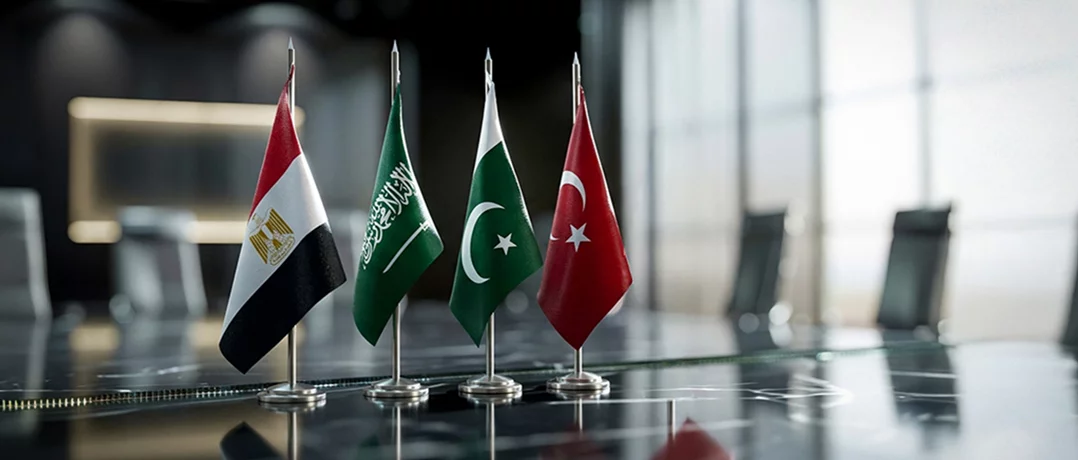
Hosting a high-level meeting in Islamabad, Pakistan has brought together the foreign ministers of Saudi Arabia (KSA), Turkey, and Egypt in what officials describe as the most coordinated regional initiative yet to push Washington and Tehran toward direct engagement. While the war shows no immediate signs of abating, this 4-nation effort reflects a growing recognition that diplomacy, however fragile, may be the only viable path forward.
Pakistan’s role: Islamabad as the new diplomatic hub
The Pakistani capital has, for the moment, become the focal point of international diplomacy surrounding the conflict. The two-day consultations involving the foreign ministers of the 4 countries signal a shift from fragmented mediation attempts to a more structured and coordinated regional approach. Pakistan’s role is particularly notable. Leveraging its longstanding ties with both Iran and the US, Islamabad has positioned itself as a neutral interlocutor capable of relaying messages and potentially hosting direct talks.
Pakistan’s involvement in this diplomatic initiative is not accidental but reflects a broader pattern in its foreign policy. Historically, Islamabad has sought to maintain balanced relations with both Western powers and regional actors, allowing it to operate as a bridge in moments of geopolitical tension. In the current crisis, this positioning has become particularly significant.
As a mediator, Pakistan is performing multiple functions simultaneously: messenger, facilitator, and potential host for dialogue. Senior officials, including the Prime Minister and military leadership, have engaged in direct communications with both Iranian and American counterparts, transmitting proposals and concerns between the 2 sides. This back-channel diplomacy allows for sensitive exchanges that might otherwise be impossible in formal settings.
Pakistan’s credibility as a mediator is also enhanced by its geographic and strategic position. Sharing borders and maintaining historical ties with Iran, while simultaneously retaining military and political cooperation with Washington, gives Islamabad a unique leverage. Moreover, its past experiences in conflict mediation (such as its attempts to ease US-Iran tensions in 2019) demonstrate a consistent willingness to engage in regional diplomacy, even if previous efforts have yielded limited results.
Symbolically, Pakistan’s role represents a neutral platform where dialogue can occur without immediate pressure or escalation. While it cannot impose solutions, it can create the conditions under which solutions become possible.
From Riyadh to Islamabad: The evolution of the “Quad”
The four-nation mechanism did not emerge in isolation. It evolved from broader consultations among Muslim and Arab states held earlier in Riyadh. What began as a general discussion has now crystallized into a more focused diplomatic grouping comprising Pakistan, Saudi Arabia, Turkey, and Egypt.
Originally scheduled to take place in Ankara, the meeting was relocated to Islamabad, reflecting Pakistan’s increasing involvement in back-channel communications between the US and Iran. This evolution highlights a deliberate effort to streamline mediation and avoid the pitfalls of competing diplomatic initiatives.
The initiative has also received tacit international backing. China’s support for Pakistan’s mediation efforts and its encouragement of Iranian participation signal that global powers are beginning to align behind this regional framework, lending it additional legitimacy.
Regional consensus and strategic divergence
The Islamabad meeting also reflects a broader regional consensus on the need for de-escalation. Islamabad, Riyadh, Ankara, and Cairo have all expressed concern over the potential for the conflict to expand, particularly given its impact on regional stability and global energy markets.
At the same time, their positions reveal subtle divergences from Washington’s approach. While these countries have condemned attacks and called for restraint, they have also emphasized the importance of dialogue and mutual respect. This dual stance underscores the delicate balancing act they must perform: maintaining strategic relationships with the United States while advocating for a diplomatic resolution.
Pakistan’s position is especially nuanced. It has condemned Israeli strikes and expressed solidarity with Gulf states affected by Iranian actions, yet it continues to engage constructively with Tehran. This balancing act is central to its credibility as a mediator.
Bridging the divide: Can diplomacy deliver?
Despite the heightened diplomatic activity, expectations remain cautious. The Islamabad meeting is not designed to produce an immediate ceasefire. Instead, its primary objective is to align regional positions and lay the groundwork for potential direct talks between US and Iranian officials.
According to diplomatic sources, preliminary frameworks for such engagement already exist. There is speculation that US Secretary of State Marco Rubio and Iranian Foreign Minister (FM) Abbas Araghchi could meet within days, possibly in Islamabad. Additional figures, including US Vice President (VP) JD Vance, have also been mentioned as potential participants in future discussions.
However, significant obstacles remain. Iranian officials have made it clear that any meaningful dialogue would require confidence-building measures, most notably a temporary halt in US strikes. Without such steps, Tehran is unlikely to engage directly, citing past instances where negotiations coincided with military actions.
Thus, it is important to recognize the limitations of the current initiative. The Islamabad meeting does not include representatives from either the United States or Iran. It is, by design, a preparatory forum rather than a negotiation platform. Its success will depend largely on its ability to harmonize regional positions and provide both Washington and Tehran with the political cover needed to enter talks.
For now, the emergence of a coordinated regional effort offers a glimmer of hope in an otherwise volatile situation. Whether this momentum can be sustained, and translated into meaningful negotiations, remains uncertain. What is clear, however, is that the cost of failure would extend far beyond the immediate parties, risking a broader regional conflagration with global consequences.
-
-

-
The Beiruter
-
