A new Beirut film series revisits the life and legacy of Saint Francis of Assisi through cinema, faith, and cultural dialogue.


A new Beirut film series revisits the life and legacy of Saint Francis of Assisi through cinema, faith, and cultural dialogue.

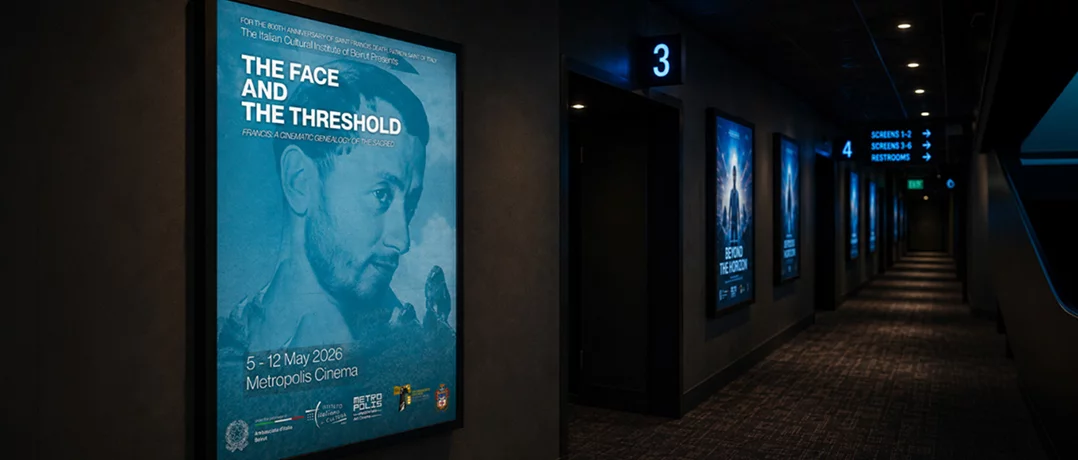
Eight centuries after the death of one of Christianity's most enduring figures, Beirut is set to host a film series about Saint Francis of Assisi.
The Italian Embassy in Beirut and the Italian Cultural Institute, in partnership with Metropolis Art Cinema, the Custody of the Holy Land, and the National Committee for the 800th Anniversary of the Death of Saint Francis of Assisi, have announced the launch of "The Face and the Threshold: Francis, a Cinematic Lineage of the Sacred."
What makes the series particularly compelling is its framing. The curators position Francis as a religious icon and a man who rejected hierarchy, embraced poverty as a political act, and insisted on redefining humanity's relationship with the natural world.
Within the context of his time, Francis emerges as a radically reformist figure. His embrace of poverty, rejection of authority, and insistence on redefining relationships with others and with the natural world constituted a profound break within the dominant medieval culture. Yet what gives his legacy its continuity goes beyond historical significance; it lies in his enduring ability to challenge the present, raising questions about the relationship between spiritual aspiration and institutional form, between individual experience and collective life, and between humanity and the natural order.
Although declared the patron saint of Italy, Francis far exceeds the boundaries of religious tradition. He is a core component of the Italian cultural imagination, with a presence that spans centuries, from art to literature, from thought to performance, finding in cinema a particularly rich space for reinterpretation.
The series begins with early cinema, where Francis was rendered through stable, iconographic imagery rooted in centuries of visual tradition. That equilibrium begins to crack with Roberto Rossellini, whose approach grounds the sacred in the physical textures of daily life, mud, labor, the fragility of human community. Then comes the atmosphere of the 1960s, when Pier Paolo Pasolini and Liliana Cavani transformed Francis into a figure of open confrontation, a test case for the tension between spiritual radicalism and institutional power. Later works move toward something more meditative and participatory, framing the Franciscan experience as a shared and unfinished process.
There is also a dimension that feels especially resonant here. Francis was not only a figure of European religious reform, he was also a traveler who crossed into the Arab world, meeting the Sultan of Egypt in 1219 in a gesture that was, for its time, startling in its openness. The Franciscan presence in the Holy Land and across the Mediterranean has carried that tradition of contact forward ever since. In a city that has long lived at the intersection of civilizations, that history is not abstract. Metropolis Art Cinema, long one of Beirut's most vital cultural spaces, is the natural home for cinema as a serious instrument for thinking about faith, history, and spirituality.
Eight centuries after his passing, Saint Francis of Assisi continues to call the world back to the heart of faith, toward humility and peace. In revisiting his life through cinema, this series becomes an invitation to rediscover a faith lived with sincerity and courage. Francis reminds us that holiness is not distant or abstract, but found in simplicity, compassion, and a willingness to walk with others.

