



Italian Ambassador Fabrizio Marcelli exclusively discusses with The Beiruter Italy’s support for Lebanon, UNIFIL security, reconstruction efforts, Israeli operations, and regional diplomacy amid conflict.
Italy and Lebanon: A persistent partnership amidst war
Italy and Lebanon: A persistent partnership amidst war
By Josiane Hajj Moussa | May 14, 2026

Reading time: 7 min
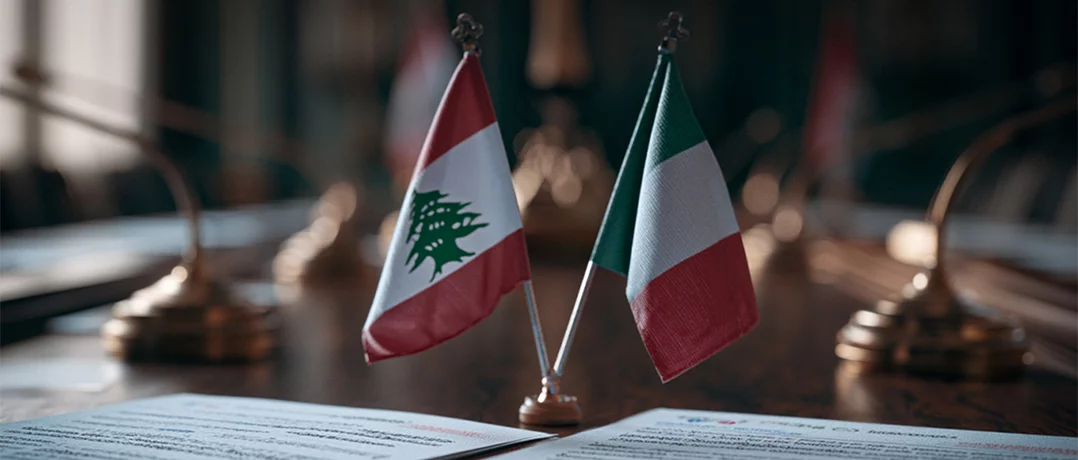
Few European nations have invested as heavily in Lebanon as Italy. With one of the largest military contingents within the United Nations Interim Force in Lebanon (UNIFIL) and a decades-long commitment to Lebanese sovereignty, Rome has long positioned itself as more than a distant observer in the country’s crises; it has sought to establish itself as an invested partner. That role has become increasingly consequential as Lebanon once again finds itself at the center of a widening regional conflict.
Fabrizio Marcelli has served as Italy’s ambassador to Lebanon since May 2024, arriving at a defining moment in the relationship between the two countries and navigating one of the most turbulent periods in recent Lebanese-Italian relations. In April, Italian Foreign Minister Antonio Tajani traveled to Beirut and declared that Italy was prepared to host negotiations between Lebanon and Israel aimed at resolving the conflict and restoring stability. The offer came as Rome’s frustration with Israeli military conduct became increasingly visible. Italy summoned Israel’s ambassador after Israeli forces fired warning shots at a convoy carrying Italian UN peacekeepers in Lebanon, while Marcelli personally oversaw the delivery of €10 million in emergency aid and roughly 40 tons of humanitarian supplies to displaced Lebanese families.
In this context, an exclusive interview by The Beiruter was conducted with Italy’s ambassador to Lebanon, Fabrizio Marcelli, who arrived in May 2024 at a defining moment in the relationship between the two countries, navigating one of the most turbulent periods in recent Lebanese-Italian relations.
Protecting UNIFIL and responding to escalation
Marcelli said the protection of UNIFIL peacekeepers remains one of Rome’s top priorities following repeated incidents in which both Israeli forces and Hezbollah fired toward peacekeeping positions in southern Lebanon. Italy, he said, had “vehemently protested” attacks targeting peacekeepers, stressing that UNIFIL forces are not party to the conflict and are deployed to assist the civilian population.
Marcelli stated
It makes no military or political sense to attack UNIFIL,
referring to the incident in which Israeli forces fired on an Italian UNIFIL convoy in Iraq al-Tuffah; an episode that prompted Rome to suspend its defense agreement with Tel Aviv.
According to Marcelli, Italy summoned the Israeli ambassador in Rome to express its displeasure over the incident and warn against any recurrence. He added that similar official responses have followed previous incidents involving peacekeepers.
“First, they deny it was them. Then they say an investigation is being conducted. At the end of the investigation, they say yes, it was us, but it was not intentional,” he said.
The ambassador also pointed to the broader dangers facing peacekeeping forces in southern Lebanon, noting that 6 peacekeepers (4 Indonesians and 2 French) had recently been killed. While describing such incidents as “accidents,” he acknowledged that troops stationed in active conflict zones remain exposed to fire from both sides.
Italy’s long-term military commitment in Lebanon
Addressing Italy’s continued military presence in Lebanon, Marcelli confirmed to The Beiruter that Rome intends to remain engaged even after the expiration of UNIFIL’s mandate in December 2026 through the MCT4L and MIBIL bilateral missions. Unlike UNIFIL positions south of the Litani River, he said, those missions are based between Beirut and Saida and in Amchit, away from direct combat zones.
“They are mainly there to provide assistance, training, capacity-building and operational support to the Lebanese Armed Forces,” he said, describing the Lebanese Army as
a key institution for the stability of this country.
While Italy officially contributes 746 peacekeepers to UNIFIL, Marcelli said the actual number of Italian military personnel in Lebanon exceeds 1,300 when including additional troops hosted at the Naqoura and Shamaa bases, along with bilateral missions.
Despite criticism from segments of Italy’s political opposition over maintaining troops under active fire, Marcelli said Rome remains committed to its presence in Lebanon.
“We have been here since 1978 without interruption, through the civil war, the 2006 war and beyond,” he said. “It is not without risk, but they are military personnel trained to face such situations.”
Criticism of Israeli operations and offer to host talks
Marcelli addressed Italy’s criticism of Israel’s military operations in Lebanon. Referring to recent remarks by Tajani before Parliament, he described the destruction of villages in southern Lebanon as “totally unacceptable,” particularly attacks affecting Christian villages. Marcelli asserted
As we all know, Christian villages are neutral in the war.
He thus added that “it makes no sense to attack them, destroy water wells and solar panels, make them uninhabitable and push people away from those villages.”
The ambassador confirmed that Italy had offered to host potential Lebanese-Israeli negotiations should bilateral contacts evolve into a more structured diplomatic process. While noting that talks had already begun in Washington, he said Rome could serve as a geographically accessible and politically neutral venue for future discussions. “We have only offered the seat for those talks,” he said, therefore “now it is up to the parties to decide.”
Reconstruction, economic aid and reform conditions
On reconstruction and economic support, Marcelli reiterated to The Beiruter that Italy, like other international donors, is awaiting progress on an agreement between Lebanon and the International Monetary Fund (IMF) before committing large-scale financial assistance. Italian support, he said, has so far focused primarily on grants and emergency aid projects during the war period, with hopes of eventually transitioning toward early recovery and reconstruction programs once the conflict subsides and displaced residents are able to return home.
Italy’s cooperation priorities in Lebanon have traditionally centered on water, energy, and cultural heritage preservation, according to Marcelli, who said Rome remains among Lebanon’s largest contributors in the cultural heritage sector. He highlighted the restoration of the Mar Mikhael train station, a project expected to be completed by the end of the year, following Italy’s support for the restoration of the National Museum’s second floor.
In the energy sector, Marcelli said current initiatives remain limited to small-scale projects implemented by Italian NGOs operating across Lebanon, including solar panel installations for public schools. He also confirmed that the Italian energy company ENI remains part of the offshore gas consortium alongside French and Qatari partners, although the project is currently on hold because of the war.
Asked about reforms required to unlock sustained European support, Marcelli described Lebanon’s reform agenda as extensive, beginning with unresolved financial sector reforms. He cited the pending bank restructuring law and the still-unresolved “gap law” as key priorities, while highlighting that governance reforms and institutional strengthening remain essential.
Furthermore, Marcelli noted that
Europe, the European Union and its 27 member states, is by far the biggest donor to Lebanon,
arguing that many Lebanese underestimate the scale of European assistance compared with support provided by the United States (U.S.) or Gulf countries.
Cultural, educational, and human connections
In addition, the ambassador underscored the longstanding ties between Italy and Lebanon through education, migration, and cultural exchange. He pointed to the recent creation of an Italian alumni network bringing together Lebanese graduates of Italian universities around the world, with roughly 220 members across Lebanon, Italy, the United Arab Emirates (UAE), and broader diaspora communities.
“They form an important bridge between the two countries,” he said, adding that Italy seeks to strengthen not only educational cooperation, but also investment, mobility and people-to-people ties.
Marcelli noted that many Lebanese students who study in Italy ultimately remain there and obtain Italian citizenship, while approximately 3,000 Italian citizens currently reside in Lebanon, most holding dual nationality through marriage, naturalization, or professional ties. He added that many Italian soldiers who served in southern Lebanon married Lebanese women, creating what he described as “heart connections” and “romantic connections” between the two societies.
Sovereignty, Hezbollah, and Lebanon’s strategic future
On the issue of sovereignty and armed groups, Marcelli reiterated Italy’s support for the Lebanese Armed Forces (LAF) as the country’s sole legitimate security actor. He argued that Israel, as a regular army, should be held to an even higher standard than Hezbollah, which he described as a non-state actor.
The ambassador firmly stated that
We wish Israeli forces would leave Lebanese territory as soon as possible because they are an invading army.
At the same time, he called for Hezbollah’s disarmament, arguing that armed struggle had proven “totally counterproductive.” Indeed, “now, with a fifth of Lebanese territory occupied by a foreign army,” Marcelli said, “it is not acceptable.”
Looking ahead, Marcelli described Lebanon as “an essential connection between the Mediterranean and the Middle East,” whose stability carries strategic importance for the wider region. Despite Lebanon’s ongoing crisis, he praised the country’s human resources and reiterated Italy’s willingness to continue supporting Lebanon’s stabilization and development.
In the end, Marcelli concluding by affirming that “we hope for the best,” and that
We are ready to support Lebanon as much as we can because it is also in our interest as a Mediterranean country.
-
-

-
Josiane Hajj MoussaReporter
-
