Italy has pledged €5 million to help revive Lebanon's conflict-hit agricultural sector, supporting thousands of farmers, restoring livelihoods, and strengthening food security.




Italy has pledged €5 million to help revive Lebanon's conflict-hit agricultural sector, supporting thousands of farmers, restoring livelihoods, and strengthening food security.

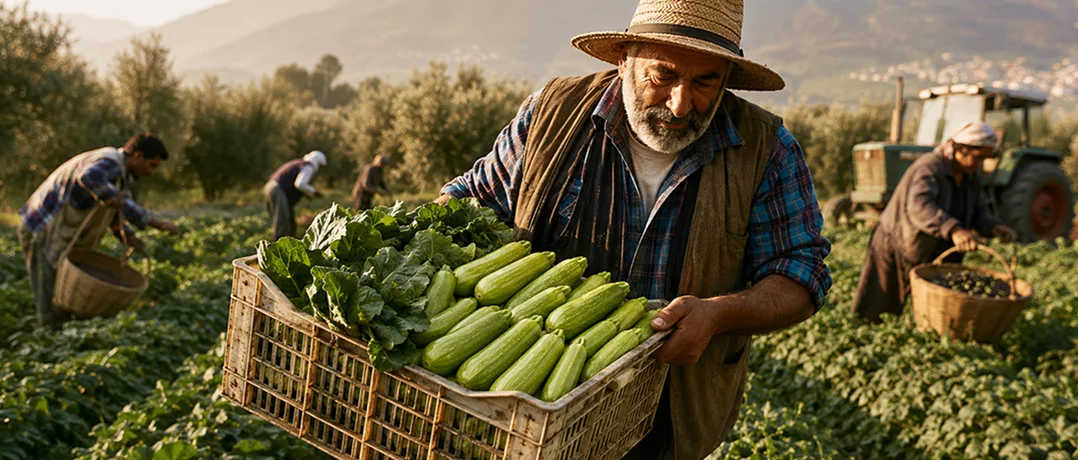
Italy has pledged €5 million to support Lebanon's agricultural and food sectors in the areas hit hardest by conflict, part of a growing international push to keep the country's rural economy from collapsing further.
The funding, channeled through Italy's Ministry of Foreign Affairs and International Cooperation and implemented by the UN Food and Agriculture Organization (FAO), will finance the "Emergency Support and Livelihoods Program for the Agricultural and Food Sector in Conflict-Affected Areas in Lebanon." The program targets South Lebanon, Nabatieh, Bekaa, and Baalbek-Hermel, the same governorates that have borne the brunt of recent fighting and its aftermath.
Lebanon's rural south and east have absorbed the heaviest costs of the country's recent conflict. Farmland has been damaged or rendered inaccessible, entire communities have been displaced from the land they depend on, and the seasonal rhythm of planting and harvest, the backbone of household income in places like South Lebanon, Nabatieh, Bekaa, and Baalbek-Hermel, has been repeatedly disrupted.
Lebanon’s Minister of Agriculture Nizar Hani laid out how the recovery effort for the sector is being phased, and previewed a new solidarity initiative set to launch in the coming days.
Hani told The Beiruter that the recovery plan for rehabilitating the agricultural sector is structured in two stages. The first, he explained, is focused on helping farmers return to their land and resume basic agricultural work, clearing and organizing fields, so they can get farming activity moving again. "That support will grow gradually over time," Hani said, "until we reach the point of supporting larger infrastructure, plastic greenhouse covers, water pumps, and other agricultural infrastructure."
The minister also previewed a separate, farmer-to-farmer solidarity initiative he said would launch soon, following a visit to the south planned for Friday. Under the plan, farmers in less-affected regions would be matched with counterparts in the south to provide direct, in-kind support. Hani offered an example: a beekeeper in the north with spare capacity could support a beekeeper in the south with hives, "one hive, two hives, whatever is needed." The goal, he said, is to rebuild social solidarity among farmers themselves, while working with agricultural companies and the ministry's partners to arrange in-kind contributions for farmers in the south, scaling up the overall volume of assistance reaching the region.
At least 9,850 farming households across the four governorates are set to receive emergency assistance, combining cash support, agricultural vouchers, and essential farming inputs such as seeds, fertilizer, livestock feed, and vaccines. Around 2,200 internally displaced people will also be offered temporary employment through cash-for-work schemes tied to agricultural production, giving displaced families an income source while supporting local farming activity.
The program also has an institutional component: it will work to strengthen 40 agricultural cooperatives and train 60 employees of Lebanon's Ministry of Agriculture in areas such as emergency response, information management, beneficiary identification, and delivery of agricultural services, capacity the ministry will need to sustain support once the immediate emergency phase ends.
Particular attention will go to women, female-headed households, and young people, groups identified as disproportionately affected by the crisis, with the aim of supporting both economic recovery and broader social resilience in rural communities.
The contribution arrives as Lebanon's farm sector faces one of its most difficult periods in years. A damage and loss assessment conducted by FAO with Lebanon's Ministry of Agriculture and the National Council for Scientific Research found that agriculture suffered an estimated $118 million in damages and $586 million in losses from the conflict between October 2023 and November 2024, with Southern Lebanon and the Bekaa Valley the hardest hit. The same assessment put reconstruction and recovery needs at $263 million, with $95 million identified as a priority for 2025/26.
More recent figures underline how fragile the recovery remains. Even after a ceasefire took hold in April 2026, Lebanon's agriculture ministry has estimated that 22% of the country's farmland was damaged by the war, with livestock numbers also down sharply in the south and east. A joint IPC food security analysis released by the Ministry of Agriculture, FAO, and the World Food Program found that nearly 1.24 million people, close to one in four Lebanese, are projected to face crisis-level food insecurity or worse between April and August 2026, a sharp deterioration from the roughly 874,000 people affected between November 2025 and March 2026.
The Italian contribution follows a memorandum of understanding recently signed between Lebanon's and Italy's agriculture ministries aimed at deepening cooperation on agricultural development, sustainability, and production support. Lebanon's Ministry of Agriculture frames the program as one strand of a wider effort by Agriculture Minister Nizar Hani to rally international donors behind the sector, protect farmer livelihoods, and shore up food security nationally.
That international mobilization is intensifying as funding elsewhere comes under pressure. FAO has said it needs roughly $19 million in emergency assistance for Lebanon, even as the organization's global budget shrinks, a squeeze worsened after the United States withdrew a $300 million contribution, roughly 14% of FAO's total budget, in January 2026. Other donors have also stepped in this year: Switzerland pledged CHF 7.5 million (about $9.6 million) in March 2026 for humanitarian aid spanning Lebanon, Syria, and Iran. FAO's newly launched 2026 Global Emergency and Resilience Appeal separately seeks over $519 million for the wider Near East and North Africa region, including Lebanon, as part of a $2.5 billion global appeal.
Italy's contribution is a strategic investment in reviving agricultural production, strengthening food systems, and building the resilience of Lebanon's rural communities. The support plays a pivotal role in ensuring that those who feed the country are not left to withstand the lasting costs of war alone.

