

The first publicly coordinated military strike between Iran’s IRGC and Hezbollah against Israel, examining its implications for regional escalation and the growing risk of a wider Middle East conflict.
Joint Iran–Hezbollah attack escalates Israel conflict
Joint Iran–Hezbollah attack escalates Israel conflict
By The Beiruter | March 12, 2026

Reading time: 5 min
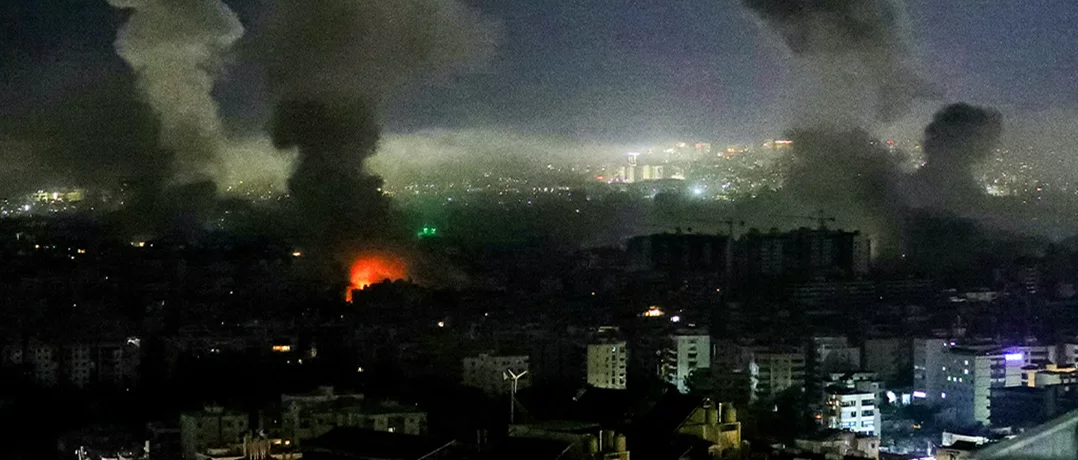
For the first time since the outbreak of the current regional confrontation, Iran Islamic Revolutionary Guard Corps (IRGC) and Hezbollah have publicly announced a coordinated military attack against Israel, marking a significant development in the evolving dynamics of the conflict.
The simultaneous attacks, combining Iranian missile fire with Hezbollah rockets and drones, signal a new escalatory phase in the confrontation. The development also highlights the increasing operational integration between Tehran and its allied armed groups, while Israel has responded with intensified airstrikes inside Lebanon.
A first coordinated strike between the IRGC and Hezbollah
According to a statement issued by the IRGC, the attack represented a “joint and coordinated operation” targeting Israeli positions. The strike reportedly involved Iranian missile launches synchronized with Hezbollah’s firing of rockets and the deployment of drones toward Israeli territory.
The coordinated attack included Hezbollah’s announcement of a large-scale military operation named “al-Asf al-Ma’koul,” a term drawn from a Quranic reference implying devastating destruction. The group launched a series of missile attacks targeting multiple Israeli military installations and settlements in northern Israel.
Among the targets reportedly struck were the Northern Command headquarters of the Israel Defense Forces (IDF), known as the Dado base, as well as the Ein Zeitim base near Safed. Hezbollah also claimed to have targeted the Haifa naval base and the Tirat Carmel base in the city of Haifa. In addition, rockets were fired repeatedly toward the town of Kiryat Shmona, while other salvos struck the settlements of Metula and Shlomi. Hezbollah also reported an attack on the Stella Maris base, a strategic facility used for maritime surveillance along Israel’s northern coastline.
The scale of the barrage was notable. Military analysts estimate that more than 100 rockets were launched toward northern Israel in a single wave, making it one of the largest attacks since the beginning of the war. This suggests that Iran and Hezbollah may be adopting a division of roles within a larger operational framework. Under such an arrangement, Iran could focus on launching long-range missiles capable of reaching deep inside Israeli territory, while Hezbollah concentrates on saturating northern Israel with shorter-range rockets and drones.
The dual-layered approach could serve several strategic objectives. First, it increases the pressure on Israel’s air-defense systems by forcing them to respond to multiple types of threats simultaneously. Second, it reinforces the concept of “multi-front pressure,” a doctrine often associated with Iran’s regional strategy of “forward defense.”
It is worth noting that the attacks came as international leaders have attempted to revive diplomatic channels. Indeed, a trilateral discussion reportedly took place between Lebanese President Joseph Aoun, Syrian President Ahmad al-Sharaa, and French President Emmanuel Macron, focusing on the rapidly deteriorating security situation and the need to prevent further regional escalation.
Israel’s massive retaliatory strikes
Israel responded swiftly to the coordinated attack. Overnight airstrikes targeted Hezbollah infrastructure across several areas of Lebanon, including the southern suburbs of Beirut, the group’s stronghold.
According to the IDF, dozens of rocket-launching platforms were destroyed during the strikes, and several Hezbollah members were killed while preparing to launch projectiles toward Israeli territory. Additionally, the IDF allegedly prevented 2 additional waves of Hezbollah strikes that were meant to be launched against Tel Aviv. The Israeli army also reported striking 10 buildings in Beirut’s southern suburbs that it said were being used as operational headquarters, intelligence facilities, and command centers, including a site associated with Hezbollah’s elite Radwan unit.
Israeli officials reiterated that the military would continue acting forcefully against Hezbollah, accusing the group of joining the war under Iranian direction. Israeli authorities also warned that attacks against Israeli territory would be met with a disproportionate response, signaling that further escalation remains possible.
The risk of expanded Israeli retaliation
Beyond the immediate airstrikes, concerns are mounting in Lebanon that Israel’s response could escalate significantly in the coming days. Israeli rhetoric (be it though media reports or statements from political and military officials) suggest that decision-makers in Tel Aviv are considering broadening the scope of operations in Lebanon if Hezbollah continues its attacks.
Such an expansion could involve targeting infrastructure believed to support Hezbollah’s operational capabilities. However, the scope of potential targets may well extend beyond purely military sites, potentially affecting civilian infrastructure across the country.
Warnings through international intermediaries reportedly conveyed no assurances to the Lebanese government, indicating that Israel may intensify its campaign if rocket attacks persist. In previous conflicts, particularly during the 2006 July War, Israeli strategy included striking roads, bridges, power stations, and other infrastructure in areas perceived to facilitate Hezbollah’s operations, or even to pressure the Lebanese population and government to oppose the group and its doings.
More significantly is the fact that the IDF has not only persisted in its evacuation orders and strikes against southern Lebanon but has also expanded its presence since the start of the current armed conflict. While it had previously retained around 5 strategic positions in the south, the IDF has now occupied a total of 18 positions, according to informed military sources.
The possibility of a similar approach has raised alarm within Lebanon’s political leadership, which is already grappling with a fragile economic situation and limited capacity to absorb large-scale damage to national infrastructure.
In conclusion, the coordinated missile strike carried out by Iran and Hezbollah marks a significant turning point in the current confrontation with Israel. By synchronizing their attacks, Tehran and its Lebanese proxy have signaled a new level of operational cooperation that could reshape the dynamics of the conflict. Israel’s immediate retaliatory strikes, combined with warnings of further escalation, illustrate how fragile the situation has become.
As the military exchanges intensify and diplomatic efforts struggle to keep pace, the risk of a broader regional war remains a growing concern. The possibility that Israel could expand its response to include infrastructure targets across Lebanon underscores the high stakes involved. Whether the recent developments represent a temporary escalation or the beginning of a wider conflict will depend on decisions taken by the key actors in the days ahead.
-
-

-
The Beiruter
-
