

As Iran and Israel trade strikes across its skies, Jordan is carefully calibrating a response that protects its sovereignty without inflaming domestic tensions or provoking either side.
Jordan tiptoes the line

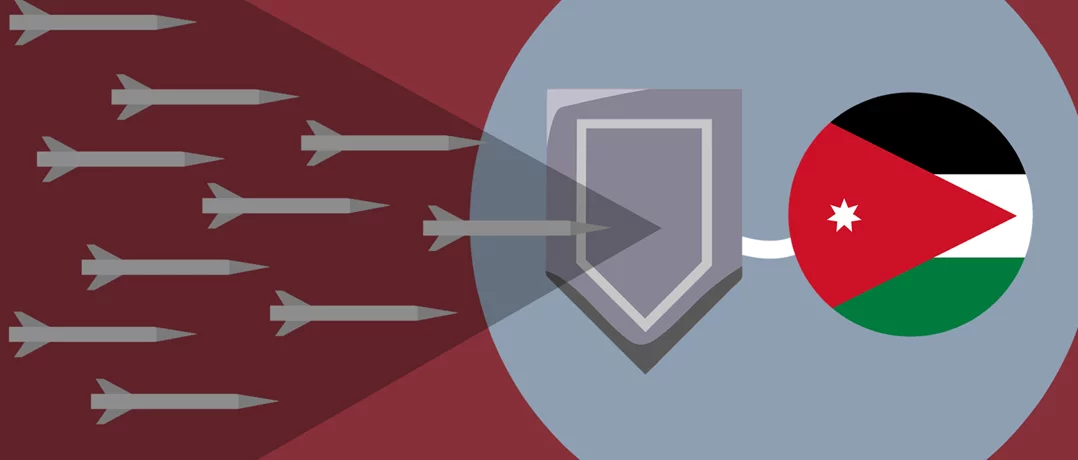
By early April, Jordan's army reported that Iran had targeted the kingdom with 281 missiles and drones since the war began, intercepting 261 of them. Thirty people were wounded in the attacks; all have since been discharged from hospitals. On July 9, Jordan's military intercepted another eight missiles fired from Iran, which said it was targeting a US base in the kingdom.
Since Israel's surprise attack on Iran, Jordan has trod carefully in shaping its public stance. Officials have condemned the "Israeli aggression" as a "blatant violation" of Iran's sovereignty, and Foreign Minister Ayman Safadi told his Iranian counterpart, Abbas Araghchi, that Jordan firmly rejects Israel's "dangerous escalation." At the same time, Safadi made clear that Jordan would not tolerate threats to its own sovereignty or citizens from either side, and would intercept any incursions into its airspace, similar to its positioning during Iran's strikes on Israel in April and October 2024. King Abdullah II has similarly stressed that Jordan will not become a battleground in the Israel-Iran conflict.
Jordanian jets and air defenses have repeatedly intercepted Iranian drones and missiles crossing into Jordanian airspace en route to Israel. The move has drawn backlash from pro-Iranian "Axis of Resistance" supporters, who accuse Jordan of siding with Israel. That claim has been rebuffed by Jordanian officials, who instead frame the interceptions as necessary to safeguard sovereignty and protect populated areas.
Jordan's balancing act
Jordan is currently facing a similar dilemma to its Gulf counterparts. It viewed the presence of US troops and continued US military support as vital for its protection, but was targeted by Iran during the war because it hosted these troops, raising the question as to whether Jordan's reliance on US protection has actually paid off.
According to a 2025 analysis by Emily Milliken, now Deputy Director of the N7 Foundation, Israel-Jordan relations predate the 1994 peace treaty by decades, though the relationship has deepened significantly since normalization. This includes intelligence sharing, security assistance, and select weapons transfers—such as Israel's 2015 delivery of sixteen decommissioned AH-1 Cobra helicopter gunships to Jordan, intended to strengthen the kingdom's ability to counter ISIS and other militant threats emanating from Iraq and Syria. The relationship extends beyond security cooperation as well: Israel provides Jordan with access to more than 100 million cubic meters of water annually, along with a significant supply of natural gas. Milliken also notes that Jordan's cooperation with Israel is widely seen as a key factor motivating the United States to continue providing the kingdom with $1.45 billion in annual aid. Furthermore, Stefan Lukas, founder of the Germany-based consultancy Middle East Minds, told DW that "Jordan can't directly oppose the US" due to the 2021 defense agreement between the two states. The agreement stipulates that US military personnel and vehicles have freedom of movement within Jordan.
According to analyst Curtis Ryan, writing for Arab Center Washington DC, Jordan has clearly backed its Gulf allies against Iranian aggression, but—like most of those allies—its overriding wish is simply for the war to end. Above all, Jordanians want an end to the drones and missiles from both Israel and Iran that continue to cross into and over the kingdom, in a conflict triggered by Israel, Jordan's own supposed peace partner, acting in concert with its closest ally. Ryan argues this war ultimately serves broader Israeli regional ambitions, but for the Jordanian state and its people, the conflict with Iran is already a crisis with the potential to worsen further. The kingdom finds itself squeezed between two fears: that Israel could take increasingly extreme action against Palestinians in Gaza and the West Bank, and that Iran's regional strikes could make Jordan a more direct and frequent target.
External troubles can spill over internally
Jordan should also fear the domestic repercussions of siding too closely with Israel. Jordan's population is composed of a significant number of people of Palestinian descent, who are very sympathetic to the Palestinian cause and the genocide in Gaza. Historically, Jordan has struggled to contain these pro-Palestinian sentiments and argued that its peace process with Israel was in service of the Palestinian cause, to showcase that co-existence is possible.
Moreover, a struggle persists between the population, who are very sympathetic to Palestine, and the regime, which is very dependent on US support for its own survival. This support is heavily conditioned on Jordan maintaining its peace deal with Israel and aiding in its security—support underscored by the US naming Jordan a major non-NATO ally back in 1996. Last year, Donald Trump flirted with the idea of conditioning that support on Jordan "taking in" Palestinians from Gaza, an idea quickly deemed unacceptable by Jordan.
Since Black September, the Jordanian regime has crushed any attempt of Palestinian insurgence from its territory. Hence, Jordan should not only be worried about sovereignty breaches from external actors, but also be wary of potential domestic troubles that could cause problems for the regime.
-
-

-
Peter ChouayfatiPolitical Analyst and Researcher
-
