



Kazakhstan joins the Abraham Accords in a symbolic move reviving U.S. influence and Trump’s diplomacy.
Kazakhstan joins the Abraham Accords: Symbolism, strategy, and a message to the region
Kazakhstan joins the Abraham Accords: Symbolism, strategy, and a message to the region
By Peter Chouayfati | November 13, 2025

Reading time: 5 min
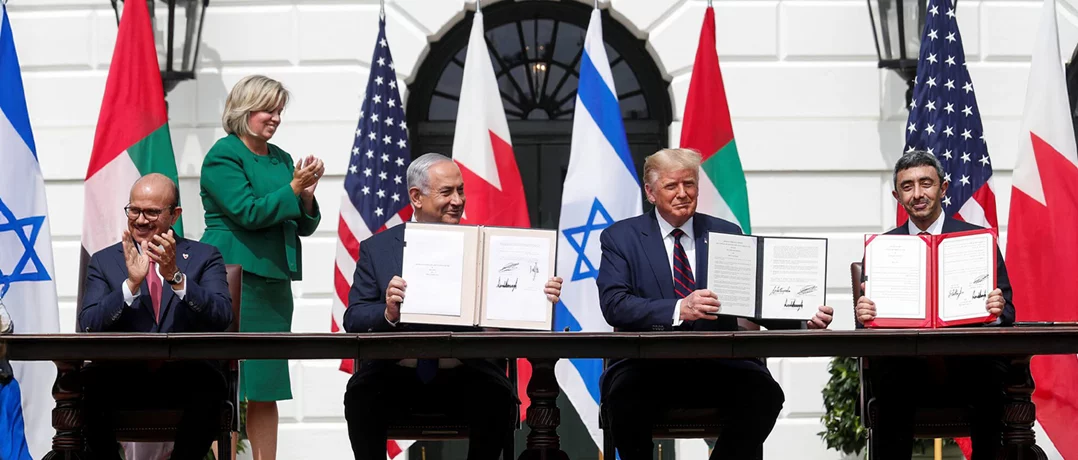
When U.S. President Donald Trump announced that Kazakhstan would join the Abraham Accords, he presented it as proof that the historic normalization framework between Israel and Muslim-majority states was still alive. At first glance, the move might seem groundbreaking. In reality, it’s less about building new diplomatic bridges and more about symbolism, timing, and power politics in a shifting geopolitical landscape.
The origins and promise of the accords
When the Abraham Accords were first unveiled in 2020, they were heralded as the Middle East’s best hope for peace since the Oslo Accords. The initiative, brokered by the Trump administration, led to a series of normalization agreements between Israel and several Arab states. The United Arab Emirates became the first to sign in August 2020, marking the first Arab-Israeli normalization since Jordan (1994) and Egypt (1979).
The UAE was quickly followed by Bahrain, Sudan, and Morocco, each incentivized by American diplomatic rewards. Morocco gained U.S. recognition of its sovereignty over Western Sahara, while Sudan was removed from the U.S. list of state sponsors of terrorism.
In Washington, the Accords were seen as a tool for pragmatic diplomacy: an American-brokered framework that had finally brought Israel and its Arab neighbors closer together without the precondition of resolving the Palestinian question. Both the Trump and Biden administrations sought to expand them further, focusing on the ultimate prize: Saudi Arabia.
Had Riyadh signed on, it would have dramatically reshaped the region, ending Israel’s diplomatic isolation and reaffirming U.S. leadership after China’s surprise mediation of the Saudi-Iran rapprochement in March 2023.
Why Arab states signed on
The motivations behind Arab-Israeli normalization were deeply strategic.
First, many Arab governments saw Iran, not Israel, as the primary threat to regional stability. Normalizing with Israel offered access to advanced defense cooperation and a potential anti-Iran coalition with U.S. backing.
Second, there was a waning commitment among Arab elites to the Palestinian cause. As groups like Hamas drew closer to Tehran, the Palestinian struggle was increasingly viewed not as a fight for Arab self-determination, but as another front in the Iran-Israel confrontation.
Finally, Israel’s high-tech economy appealed to Gulf states eager to diversify beyond oil and gas. Normalization promised cooperation in technology, water management, cybersecurity, and agriculture, as well as political capital in Washington.
The Gaza factor: Momentum lost
That optimism collapsed after October 7, 2023, when Hamas launched its attack on Israel and Israel responded with a devastating assault on Gaza, which has killed an estimated 68,000 Palestinians. Across the Arab world, the reaction was one of anger and disillusionment.
Arab governments that had once embraced quiet ties with Israel came under immense domestic pressure to distance themselves. Comments by Israeli officials suggesting that Arab countries should accept expelled Palestinians only deepened the outrage.
The regional mood has shifted with many Arab countries viewing Israel with more skepticism and fear. That fear proved to be in the right place following Israel’s attack on Qatar.
Kazakhstan’s entry: Symbolism over substance
In this tense environment, Trump’s announcement that Kazakhstan would join the Accords is less a diplomatic breakthrough than a strategic performance. Kazakhstan has maintained full diplomatic and economic relations with Israel since 1992. Its inclusion does not mark a new opening, but rather it signals an effort to reignite interest in a process that has stalled since the Gaza war.
Kazakhstan’s move is primarily symbolic but meaningful in context. The announcement coincided with President Kassym-Jomart Tokayev’s visit to Washington, where he met with Trump alongside other Central Asian leaders. The meeting also concluded with commercial agreement worth $17 billion being signed by the two countries and a reassertion by President Tokayev in support for the Trump Route for International Peace and Prosperity (TRIPP).
For the United States, it represents a bid to reassert influence in Central Asia, a region long under Russian sway and now deeply tied to China’s Belt and Road Initiative.
As Trump declared during their meeting: "Kazakhstan has officially agreed, and that’s official now, to join the Abraham Accords. I just want to thank you, Mr. President. It’s a tremendous honor."
Strategic logic for all sides
For Washington, Kazakhstan’s accession delivers several advantages:
-It revives the narrative that the Abraham Accords are still expanding, despite regional upheaval.
-It extends U.S. reach into Central Asia, countering Russian and Chinese influence.
-It provides a way to keep Saudi Arabia engaged in quiet dialogue, even as Riyadh refuses to normalize without a clear path to Palestinian statehood.
For Kazakhstan, the decision fits neatly within its long-standing multi-vector foreign policy, which seeks to balance relations between Russia, China, and the West. Joining the Accords helps position Kazakhstan as a diplomatic bridge, between East and West, between Muslim-majority states and Israel, and between Washington and the wider region.
There is also an economic rationale. Israel’s expertise in agriculture, water management, cybersecurity, and technology aligns with Kazakhstan’s efforts to diversify its economy beyond hydrocarbons.
For Trump, the announcement revives his image as a deal-maker capable of shaping global alliances. It allows him to argue that his foreign policy vision remains viable, and that the Accords continue to expand under his influence.
The limits of symbolism
Yet the broader outlook remains uncertain. The survival of the Abraham Accords depends on whether the fragile peace in Gaza can hold and whether Israel is willing to offer even symbolic concessions toward a two-state solution. So far, Israeli leaders have refused to do so.
Prime Minister Benjamin Netanyahu, in fact, distanced himself from Trump’s own peace proposal almost immediately after its announcement, insisting he would “never agree to a Palestinian state.” Without at least a gesture toward Palestinian sovereignty, it is difficult to imagine any major Arab power joining the Accords soon.
In that sense, Kazakhstan’s inclusion risks cheapening the brand, offering the illusion of progress without altering the region’s political calculus.
Symbolism as strategy
Ultimately, Kazakhstan’s move is less about creating ties with Israel than about making a geopolitical statement. It allows Washington to signal its return to Central Asia, provides Astana a platform to project itself as a neutral stabilizer, and helps Trump claim that his signature diplomatic project remains alive.
In the Middle East and its periphery, symbolism is strategy, and timing is power. Kazakhstan’s decision to join the Abraham Accords may not transform the region, but it reminds the world that the Abraham Accords are still a viable framework for normalization.
-
-

-
Peter ChouayfatiPolitical Analyst and Researcher
-
