Discover how Artisanat du Chouf is preserving Lebanon's centuries-old embroidery tradition, where every handmade stitch carries the country's cultural identity, history, and craftsmanship into the future.


Discover how Artisanat du Chouf is preserving Lebanon's centuries-old embroidery tradition, where every handmade stitch carries the country's cultural identity, history, and craftsmanship into the future.

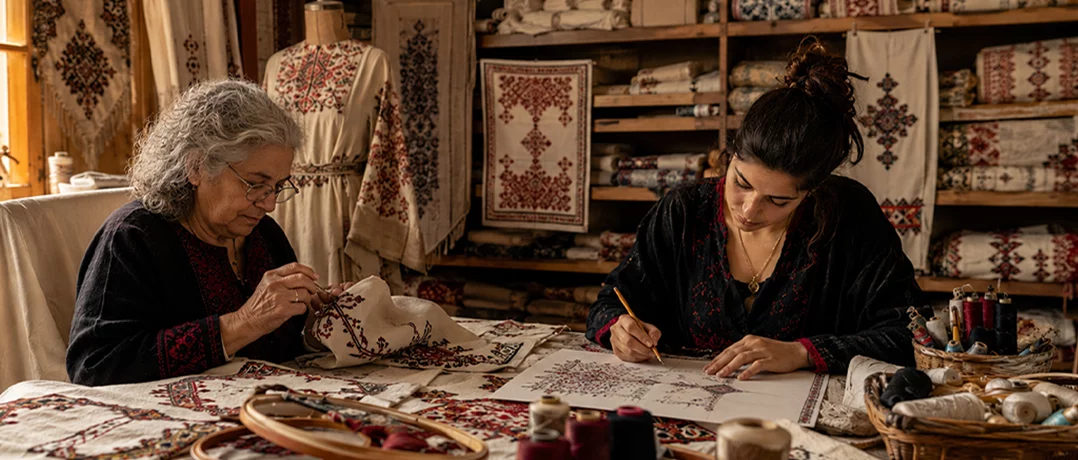
Long before embroidery became a decorative art displayed in homes and museums, it was a language of identity in Lebanon. Across villages and regions, stitches carried stories of place, family, and tradition. Women embroidered garments, household textiles, and ceremonial pieces with patterns that reflected their surroundings, from flowers and landscapes to symbols passed down through generations. Each region developed its own techniques and styles, creating a diverse textile heritage shaped by Lebanon’s many communities.
But like many traditional crafts, Lebanese embroidery faces the challenge of survival in a world increasingly defined by speed and mass production. The time, patience, and skill required to create a single handmade piece are becoming rarer, making preservation efforts not only about protecting an art form, but about keeping a piece of collective memory alive.
At Artisanat du Chouf, in a region of Mount Lebanon known for its cedars and its stubborn attachment to old ways, a small workshop is trying to make sure that a centuries-old craft does not vanish. Everything here is made the way it has always been made, by hand.
The Beiruter spoke with Layla Alameddine Takieddine to reveal the story of her family’s legacy.
“They’re all done by hand,” says Layla Alameddine Takieddine, gesturing at the pieces around her. “Every one of them, by hand.” It is a phrase she returns to more than once. In an age when almost anything can be produced faster and cheaper by machine, the insistence on the human hand is itself a statement.
The pieces on display range from the practical to the astonishing. Some are small, a bit of crochet, a modest panel, the kind of work a beginner might attempt. Others represent months of patient labour. One framed piece stops the conversation cold.
“This frame is very old,” Takieddine explains, “and this one is made from silkworm silk.” She points out the detail worked into it, the fruit rendered thread by thread. Another embroidered piece, she notes almost in passing, took fifteen months of work.
Fifteen months. It is the kind of figure that reorders how a visitor looks at the room. What appears at first as decoration reveals itself as time made visible, hundreds of hours folded into fabric.
The craft is exacting, and Takieddine is candid about its demands. Hand embroidery, she says, does not forgive shortcuts. There is a difference between a quicker local technique and the slow work of the needle, and the difference shows.
“Even if you want to embroider by hand,” she says, “it won’t come out as well, not like this fabric. This one helps me.”
The right cloth, the right method, the right pace: each depends on the others. Rush any of them and the piece announces the compromise.
That honesty about difficulty runs underneath a larger worry. Crafts like this one survive only as long as there are hands willing to learn them, and those hands are getting harder to find.
Asked whether people are still taking up the work today, Takieddine’s answer is quietly reassuring. “Yes, we’re running courses here,” she says.
The workshop is not only a place where old textiles are displayed and sold; it is a place where the knowledge is passed on.
Pressed on whether the tradition is beginning to disappear as modern life speeds up, she is firm. The goal, she says, is precisely to resist that. Preservation is the point.
“Our aim is that this work is protected,” she says, that it endures rather than fades.
There is a sense, listening to her, that she does not see herself as a shopkeeper but as a custodian, holding a line against forgetting.
Part of what makes the effort feel urgent is how much local identity is stitched into the pieces themselves. Takieddine draws attention to work she describes as distinctly of this place, regional embroidery, made here, belonging here.
These are not generic ornaments that could have come from anywhere. They carry the mark of the Chouf, of a particular tradition of makers, of techniques handed down rather than downloaded.
The workshop’s ambitions are modest in scale and large in meaning. “It’s small work,” Takieddine says at one point, almost apologetically, of a piece she is arranging, but the modesty is misleading.
The scale is small; the stakes are not. Each course taught, each visitor who leaves understanding what fifteen months of stitching actually means, is a small hedge against the disappearance of something that cannot easily be recovered once it is gone.
There is a patience to the place that resists the logic of the moment. “It takes time,” Takieddine says simply.
To preserve Lebanese embroidery is therefore to preserve more than a craft. It is to protect a living expression of identity, one that continues to connect Lebanon’s past with its present, stitch by stitch.
