

Kurdish sources speaking to The Beiruter say several thousand fighters are already positioned inside Iran, with additional units preparing to join the offensive if the fighting intensifies.
Kurdish forces will become the ground front against Iran
Kurdish forces will become the ground front against Iran
By The Beiruter | March 09, 2026

Reading time: 5 min
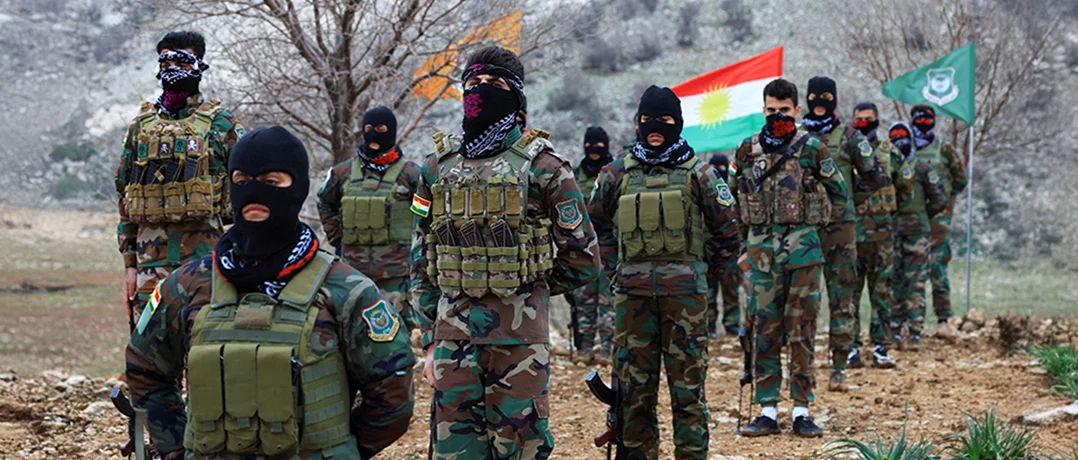
The ongoing conflict involving the United States (US), Israel, and Iran has entered a new phase following a ground offensive by Kurdish fighters into north-western Iran. The operation, launched by Iranian Kurdish militant groups operating from bases in northern Iraq, represents the first large-scale ground challenge to Tehran since the escalation of hostilities in the region.
For decades, Kurdish opposition movements have confronted the Iranian regime through sporadic insurgency and political activism. However, the latest offensive takes place within a broader regional war that already includes extensive air and naval operations by the US and Israel against Iranian military assets.
While the full scope and long-term consequences of the Kurdish incursion remain uncertain, their entry into the conflict introduces a new front that could significantly stretch Iran’s security forces, deepen instability along the Iraq-Iran border, and reshape the strategic landscape inside Iran.
Kurdish fighters launch ground incursion
Thousands of Kurdish fighters crossed into Iranian territory, launching coordinated operations in mountainous areas of western Iran near the border city of Mariwan.
Many of the fighters involved are affiliated with the Kurdistan Free Life Party (PJAK), a long-standing militant organization opposed to the Iranian regime. PJAK operates 2 main armed wings: the East Kurdistan Defense Units (YRK) and the Women’s Defense Forces (HPJ), an all-female combat formation modeled after Kurdish groups that have operated in Syria.
After crossing the frontier, Kurdish units reportedly established positions across sections of the Zagros mountain range, a rugged area historically used by insurgent groups due to its natural defensive advantages. The terrain allows guerrilla fighters to move across the border relatively easily while complicating large-scale counteroffensives by conventional forces.
Reports from Kurdish to The Beiruter sources indicate that several thousand fighters are now positioned inside Iran, with additional units believed to be preparing to reinforce the offensive if the fighting expands.
Kurdish opposition groups and their objectives
Kurdish opposition movements in Iran have long sought greater political rights, autonomy, or federal restructuring within the country.
In recent weeks, 5 major Kurdish opposition parties formed a new alliance known as the Coalition of Political Forces of Iranian Kurdistan (CPFIK). The coalition includes PJAK, the Kurdistan Freedom Party (PAK), Komala, the Democratic Party of Iranian Kurdistan (KDPI), and the Khabat Organization. The formation of this alliance shortly before the outbreak of the current war suggests a coordinated effort among Kurdish factions to capitalize on the shifting regional balance of power.
Many Kurdish fighters participating in the offensive have gained extensive combat experience over the past decade. Several groups fought alongside international coalition forces against the Islamic State in Iraq and Syria (ISIS), gaining familiarity with modern battlefield tactics, coordination with air support, and drone warfare.
Ayhan Saeed to The Beiruter
In an interview with The Beiruter, Ayhan Saeed, an independent researcher and journalist, highlighted the strategic context underpinning Kurdish movements in western Iran. Saeed stressed that the current geopolitical environment in the Middle East has entered a period of instability, prompting Kurdish political and military groups to reassess their positions and potential roles in future developments.
Saeed noted that despite restrictions in recent years, particularly due to security agreements between Iraq and Iran aimed at safeguarding their shared border, Kurdish forces such as PJAK have maintained a significant presence in the mountains of Iranian Kurdistan. These groups possess long-standing organizational structures and experienced cadres, some with decades of operational knowledge in the rugged borderlands.
According to Saeed, Kurdish forces are not only a local presence but also actors with historical experience in cross-border conflicts. “If the conflict escalates into a ground war inside Iran,” Saeed told The Beiruter, “Kurdish forces in western Iran could become one of the main actors on the ground due to their military and political organization.”
He further stressed that Kurdish movements are capable of influencing developments on the ground if the regional balance of power shifts, but warned that the outcome of any confrontation will ultimately depend on broader regional and international dynamics, not solely on Kurdish capabilities. Saeed stressed the importance of considering political coordination and historical expertise in evaluating the Kurdish role, noting that the formation of the CPFIK represents an attempt to unify military and political strategies among various Kurdish factions.
Rezgar Rawshani to The Beiruter
In an interview with The Beiruter, Rezgar Rawshani, a member of the PJAK Diplomacy Committee in Europe, provided a more cautious assessment to the current events.
Rawshani clarified that, contrary to some reports, no coordinated offensive has yet been launched by Kurdish forces inside western Iran.
All reports claiming that Kurdish military forces attacked western Iran are inaccurate.
However, he confirmed that Kurdish political parties remain in a state of readiness, monitoring developments closely and assessing potential scenarios.
Rawshani explained that PJAK has maintained long-standing forces in the mountainous regions of Iranian Kurdistan, where units regularly move across the area. These forces could intervene in the future to defend communities and organize local populations if necessary. At the same time, he emphasized that Kurdish forces from the Kurdistan Region of Iraq, particularly the Peshmerga, are unlikely to participate in any operations in Iranian territory, as their duties are confined to the framework of the Iraqi Kurdish government.
Rawshani also highlighted the broader strategic considerations. Kurdish involvement in the conflict is contingent on clarity regarding the objectives of international actors, such as the United States and Israel. Without guarantees of political and security support, Kurdish forces risk retaliation and significant humanitarian consequences. He warned that entering the war without external backing could complicate Iran’s internal issues rather than resolve them, underscoring the calculated approach adopted by Kurdish movements in this volatile environment.
In conclusion, the launch of a Kurdish ground offensive into north-western Iran marks a significant escalation in the regional conflict surrounding Tehran. By opening a new front within Iranian territory, Kurdish fighters have added an internal dimension to a war that was previously dominated by air and naval operations. As the conflict continues to evolve, the Kurdish incursion highlights the fragile and interconnected dynamics of Middle Eastern geopolitics. Whether the offensive develops into a sustained insurgency or remains a limited operation, its consequences are likely to reverberate across the region for years to come.
-
-

-
The Beiruter
-
