



The Lebanese Army has taken control of two key checkpoints at Beddawi refugee camp, signaling a cautious shift in security coordination with Palestinian factions.
LAF takes over 2 Baddawi Camp checkpoints

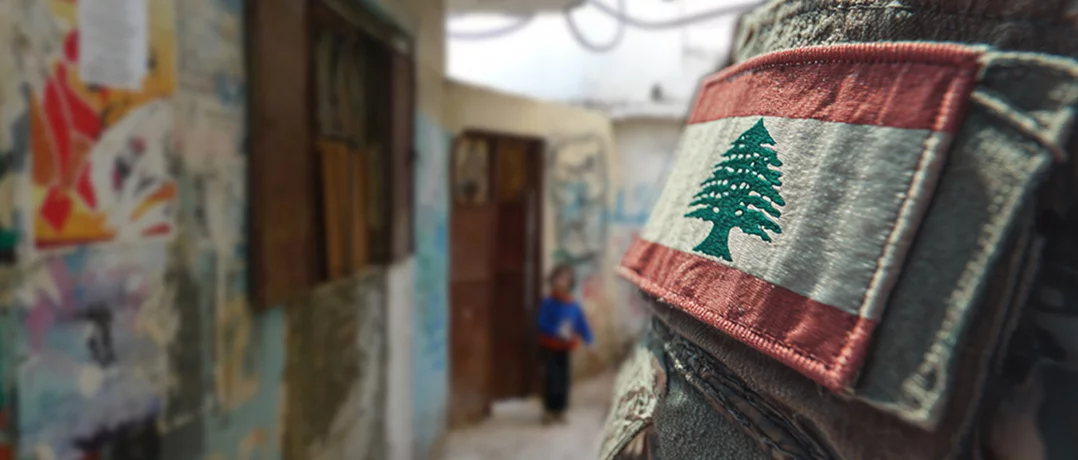
The Lebanese Armed Forces (LAF) has moved to assume control of 2 main security checkpoints at the entrances of the Beddawi Palestinian Refugee Camp (PRC) in northern Lebanon, marking a new phase in the state’s broader effort to extend its authority across all Lebanese territory, including the camps.
The decision was formally communicated to Palestinian factions during a meeting with army intelligence officials in the north and is framed as part of coordinated security measures aimed at stabilizing the camp’s surroundings.
According to informed sources, the plan includes establishing fixed army checkpoints at the camp’s principal entrances and closing secondary access points. The move follows earlier steps taken last year to regulate movement in and out of the camp. Importantly, Palestinian factions did not publicly object to the measure, instead holding internal consultations to coordinate implementation and ensure cooperation with Lebanese authorities.
Balancing sovereignty and camp autonomy
For decades, Lebanon’s refugee camps have operated under a sensitive arrangement: Palestinian factions manage internal security while the LAF maintains a presence around, but not inside, the camps. Beddawi has long been considered one of the more organized camps in the country, with established political and social structures that help manage daily life.
The army’s new role at the entrances does not amount to a full internal deployment but represents a symbolic and practical adjustment. It signals a gradual shift toward stronger state oversight while preserving coordination with Palestinian leadership; namely Fatah which controls the camp. The absence of open resistance from camp factions suggests recognition that improved regulation of entry points may reduce security risks for both residents and neighboring Lebanese communities.
This step also fits into a wider national framework that has recently seen the handover of several armed faction positions to the Lebanese Army in other regions. Officials present these measures as confidence-building actions designed to reinforce stability without undermining the camps’ fragile social fabric.
A parallel message from Ein el-Hilweh
Attention has also turned to Ein el-Hilweh camp in the south following a high-profile visit by Palestinian National Security Commander Major General Ibrahim Khalil. During his tour, Khalil met local commanders and inspected security deployments, praising discipline and readiness. His message stressed that camp security is inseparable from Lebanese security and that preserving civil peace is a shared priority.
Khalil urged residents to rally around national Palestinian institutions and resist rumors or agendas that could inflame tensions. His statements underscored the political dimension of security coordination: maintaining order in the camps is not only an operational matter but also a test of Palestinian unity and responsible leadership.
Background information regarding the Beddawi Camp
Beddawi PRC, established by UNRWA between 1955 and 1957 on a hill 5 km north of Tripoli, is one of the most organized Palestinian camps in Lebanon, known for its relatively planned streets and infrastructure. It was created to house refugees from Galilee, Acre and Jaffa following the 1948 Nakba, and later absorbed additional waves of displaced Palestinians fleeing Lebanon’s civil war, the 1982 Israeli invasion and internal conflicts.
A major demographic shift followed the 2007 destruction of Nahr al-Bared PRC, when tens of thousands fled to Beddawi, nearly doubling its population and placing severe pressure on housing and public services. Today the camp hosts over 22,000 registered Palestinian refugees, in addition to Palestinians from Syria and Syrian nationals who arrived after 2011.
UNRWA operates 6 schools, a health center and a range of social safety, relief, disability and community programs. Local institutions support water, electricity and emergency healthcare services, including facilities run by the Palestinian Red Crescent. Politically, Beddawi is an important hub for Palestinian factions in northern Lebanon, with joint committees working to preserve internal stability. Despite strong social networks and civic life, the camp faces chronic poverty, high unemployment, overcrowding and infrastructure strain, contributing to widespread youth emigration and long-term socioeconomic vulnerability.
In conclusion, the developments in Beddawi reflect a cautious but notable evolution in Lebanese-Palestinian security relations. By placing checkpoints under army supervision while maintaining coordination with camp authorities, both sides appear to be pursuing a model of managed stability rather than confrontation. The success of this approach will depend on sustained dialogue, mutual trust and tangible improvements in daily safety for camp residents and surrounding communities.
-
-

-
The Beiruter
-
