



Michleen Daoud Geagea, an Australian-Lebanese woman, has created a job program in Lebanon that connects local workers to businesses, providing long-term employment during the country's economic crisis.
Lebanese-Australian woman creating jobs in Lebanon
Lebanese-Australian woman creating jobs in Lebanon
By Adella Beaini | April 04, 2026

Reading time: 3 min
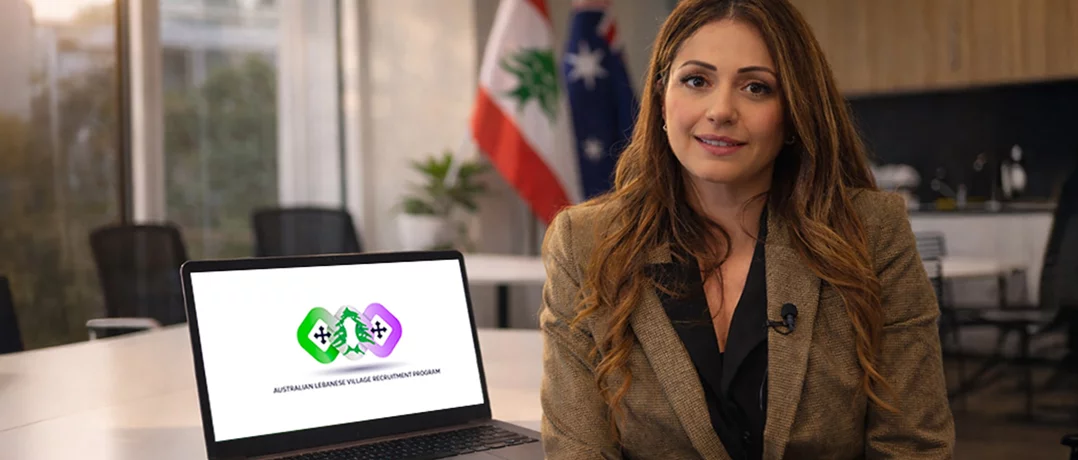
From Australia, Michleen Daoud Geagea is building something few governments or aid programs have managed, a steady stream of jobs into crisis-hit Lebanon.
Working from abroad, the Lebanese-Australian mother has created the Australian Lebanese Village Recruitment Program, connecting businesses to workers in her village, offering long-term employment in place of short-term aid.
Her initiative began during Lebanon’s 2019 financial collapse, when the country’s economy unravelled and everyday life became unaffordable for many.
“In 2019, during the severe financial crisis in Lebanon, life as we knew it changed dramatically,” she said.
Families were unable to access their savings from the banks, the Lebanese lira lost 98% of its value, and the cost of living rose to unbearable levels.
As the crisis deepened, many in the Lebanese diaspora responded by sending financial support to relatives.
Mrs Geagea said she felt that approach, while necessary, was not sustainable on its own.
She selected 100 candidates from 100 families in her village and began training them in practical, income-generating skills, including marketing, communication and digital services.
“I knew I had to take action,” she said.
I selected 100 candidates from 100 different families in our village, determined to create opportunities where there seemed to be none.
The program quickly moved beyond training.
Mrs Geagea integrated participants into the workforce, primarily through her own business operations.
The impact was immediate for families who had lost both income and financial security.
“Out of the 100 candidates, I personally hired 82 into my own business,” she said.
“At a time when families had lost access to their savings, their jobs, and their sense of security, providing regular income changed everything.”
Participants were able to return to study, support their households and plan for the future.
“Several candidates were able to fund and continue their university studies. Others bought homes,” she said.
“A few shared that the financial stability finally allowed them to marry and build their lives.”
Mrs Geagea said the model also shifted how support from the diaspora could function, moving from donations toward employment-based solutions.
However, she said expanding the initiative has proven difficult.
I have struggled to convince more Australian businesses to follow the same model.
Despite the availability of skilled workers in Lebanon, outsourcing often continues to other countries.
“Much of the diaspora continues to outsource services to countries like the Philippines,” she said.
“Imagine if even a small percentage of outsourcing from our community was redirected back to Lebanon. The impact would be exponential.”
Beyond financial outcomes, she said the program has had a strong emotional effect on participants.
“It wasn’t only about income. It was about feeling seen, valued, and supported,” she said.
Her connection to the work is personal, shaped by years of witnessing hardship in her village.
“The truth is, as long as I can remember, my relatives in the village have struggled through wars, conflict, and corruption in Lebanon.”
Faith has also played a central role in guiding her approach.
“At the heart of everything I do is faith,” she said.
I believe that God gives each of us talents and asks us to use them wisely.
The initiative has since grown beyond its original scope, with thousands of applicants seeking similar opportunities.
“Today, I have over 10,000 resumes from people across Lebanon young professionals, graduates, and skilled individuals who are eager to contribute but lack access to opportunities.”
Ms Geagea hopes the model can expand further, evolving into a broader system connecting the diaspora with Lebanon’s workforce.
“My dream is that this initiative becomes a movement.”
