



Lebanon’s Cedars brought Lebanese Australians together at the Rugby League World Cup, turning their match against Tonga into a celebration of heritage, community and connection to the homeland.
Lebanese culture takes center stage in Sydney's Rugby League World Cup
Lebanese culture takes center stage in Sydney's Rugby League World Cup
By Adella Beaini | October 31, 2026

Reading time: 4 min
For Lebanon’s rugby league team, the Cedars, the Rugby League World Cup is about more than what happens on the field.
As thousands of Lebanese Australians gathered at Sydney’s CommBank Stadium to watch their team take on Tonga last week, the occasion became a celebration of heritage, community and the enduring connection between Lebanon and its diaspora.
Lebanon went down 36–0 to Tonga last Friday, but the result did little to diminish the atmosphere inside the stadium, where 25,065 fans watched the match.
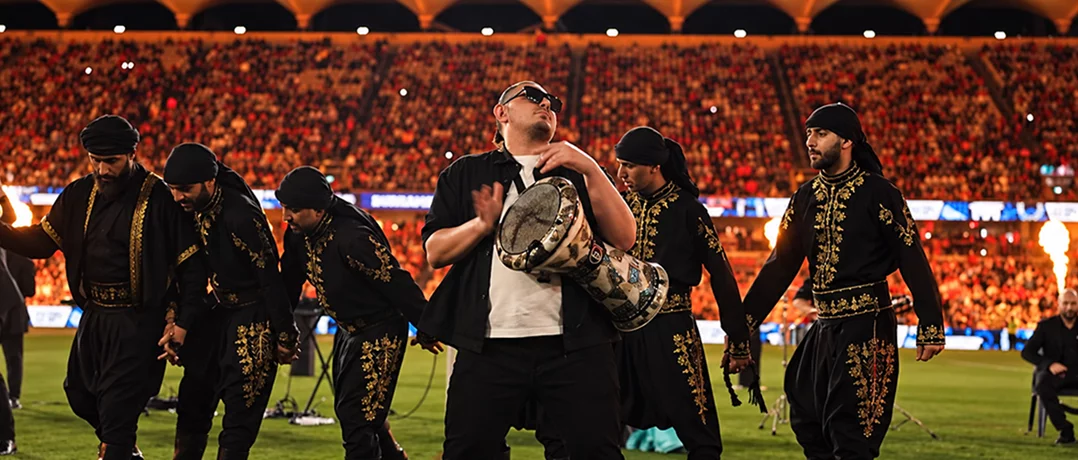
Before kick-off, the Lebanese national anthem rang out across the ground. Traditional drums, Lebanese flags and passionate supporters helped turn the match into a gathering that celebrated the community as much as the sport itself.
For many in the crowd, seeing Lebanon represented on an international stage offered a chance to celebrate their heritage and share that connection with younger generations.
A celebration beyond the game
For Louis Semaan, CEO of The Showtime Crew, the performance at Sydney’s CommBank Stadium was about more than entertaining a crowd. It was an opportunity to bring Lebanese heritage to the international stage and celebrate the sense of belonging that connects generations of the diaspora.
“Performing in front of more than 25,000 people, with Lebanese flags flying and the entire stadium cheering for Lebanon, was a proud experience that The Showtime Crew will never forget,” Semaan told The Beiruter.
What made the occasion particularly meaningful, he explained, was seeing Lebanese Australians from different generations, backgrounds and religions come together through their shared connection to Lebanon. Seeing the youngest drummers perform alongside the rest of the crew, carrying forward traditions passed down through generations, made the experience even more special.
“It reminded me that no matter where in the world we live, our Lebanese identity and connection to our roots will always remain strong,” he added.
Giving hope to Lebanon
After the match, Cedars player Jalal Bazzaz reflected on the significance of representing the country.
“It means a lot. Our little nation of Lebanon has been through a lot… (we’re) giving a little hope to our little nation,” he told The Beiruter.
The sentiment captures the emotional weight of the tournament for a team whose players largely come through Australia's rugby league system but represent a country with which they share family and cultural ties.
It is a sentiment shared by the team's coach, Michael Cheika, who also has Lebanese heritage.
In an interview with BBC Sport ahead of Lebanon's final group match, Cheika reflected on how rugby league had helped connect his family to Australia after his father migrated from Lebanon in 1950.
He described the sport as something that had “built a connection with the country from a distance”, highlighting how representing Lebanon gives players an opportunity to celebrate their heritage through something they are passionate about.
The Cedars' campaign has also highlighted the challenges facing the sport in Lebanon itself.
The national team relies heavily on players who have developed their careers in Australia, while growing participation and establishing stronger local pathways remain important to the country's rugby league future.
A team that brings communities together
The relationship between the Cedars and their supporters is not new.
Ahead of the tournament, captain Alex Twal spoke about the passionate following he expected from Lebanese Australians, particularly in western Sydney, where rugby league and the Lebanese community have strong roots.
“Our fan base will definitely get behind us and support the team,” Twal said.
He also recalled the atmosphere surrounding Lebanon’s 2017 World Cup campaign, describing the support from fans as an unforgettable experience.
For players, representing Lebanon can also be a way to honour their families’ histories.
Jordan Samrani, who made his debut for the Cedars against Papua New Guinea, has spoken about his grandparents’ journey from Lebanon to Australia in the 1960s.
His family’s migration story is one shared by many Lebanese Australians, whose connections to the country have continued across generations.
Through rugby league, those connections become visible in the stands as well as on the field, with supporters coming together around a national team that represents their shared heritage.
The challenge ahead
The Cedars’ results have underlined the difficulty of competing against more established international teams.
Papua New Guinea defeated Lebanon 42–18 in the opening match, before Tonga scored seven tries in its 36–0 victory in Parramatta.
Despite the defeats, Lebanon’s campaign has provided a platform to showcase the team and the community behind it.
Building the game within Lebanon remains a longer-term challenge, with the national side relying heavily on players who develop their careers in Australia. Growing participation and strengthening local pathways will be important if the country is to deepen its rugby league presence in the years ahead.
The Cedars will face France at CommBank Stadium on Sunday, November 1, in their final pool match. Both sides have lost their opening two games and will be looking to finish the tournament with a win.
The fixture is part of a triple-header that also features the Jillaroos against Wales and the highly anticipated Tonga-Samoa clash.
For Lebanon’s supporters, the final match offers another opportunity to rally behind the team.
The Cedars may not have secured the results they hoped for, but the scenes in Sydney have shown that their role extends beyond the scoreboard.
For a community thousands of kilometres from Lebanon, the team offers a way to celebrate their roots, honour their families and pass their connection to the homeland on to the next generation.
And, as Bazzaz’s words suggest, that representation can carry its own kind of hope.
