



Across 26 Lebanese schools, around 300 students debated religion, identity, freedom and faith, showing how dialogue can challenge assumptions and give young people space to engage with difficult questions.
Lebanese students redefine the power of dialogue
Lebanese students redefine the power of dialogue
By Michella Rizk | August 27, 2026

Reading time: 6 min
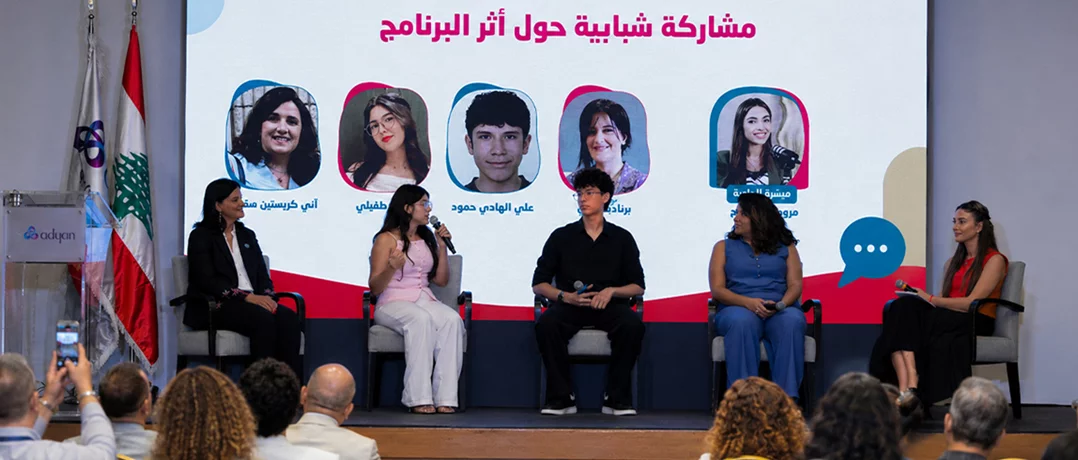
Lebanese teenagers are often described as disengaged, distracted or uninterested in the difficult questions shaping their country. But put them in a room, give them the tools to debate those questions seriously, and a different picture begins to emerge.
During the 2025–2026 academic year, around 300 secondary-school students across 26 Lebanese schools were given that opportunity. They debated religion and identity, freedom of belief, cultural heritage, pluralism, hate speech and the relationship between faith and science, issues that remain sensitive in a country where religious and social differences are closely tied to public life.
The debates were part of the Adyan Foundation’s “Debates on Controversial Topics” project, developed under its Alwan Education for Coexistence program. The aim was not to bring students to a common position, but to give them the time and tools to research different perspectives, construct arguments and engage seriously with opposing views.
For Mayssam Imad Rahme, Education Programs Manager at the Adyan Foundation, working with students across the country challenged some of the assumptions often made about their generation.
“The youth in Lebanon are not the way we sometimes think they are,” Rahme told The Beiruter. “Sometimes we have this stereotype that they are careless and that these topics do not matter to them.”
What she encountered, she said, was the opposite.
I saw promising youth. They just need the space and guidelines.
From one classroom to a wider conversation
The debate initiative did not emerge in isolation.
Alwan Education for Coexistence dates back to 2007, when the program began in a single school. It later expanded to more than 90 schools and eventually reached beyond Lebanon, including France and Iraq.
Over the years, students participating in Alwan explored subjects such as identity, religious diversity and shared values between Christianity and Islam through interactive activities. But educators repeatedly encountered the same limitation: time.
Teachers could introduce a concept and encourage students to think about it, Rahme explained, but there was rarely enough space for students to investigate competing positions in depth, challenge one another's arguments or develop their own.
The idea for Alwan Debate grew partly out of requests from educators themselves.
Rather than discussing a topic briefly, students would now have the opportunity to research it, develop arguments and counterarguments, and debate it through a structured methodology.
The project adopted the Lincoln–Douglas debate format, built around one-on-one debate. Yet behind each debater stood a team of students researching the issue, constructing arguments and anticipating the opposing side's response.
The debates followed defined speaking times and preparation periods, turning what could have been an informal classroom disagreement into a structured exercise in reasoning.
For students, that meant learning that having an opinion was only the beginning. They also had to know how to defend it, and how to listen when someone challenged it.
What Lebanese students wanted to talk about
Around 300 students from different regions participated in the initiative. Of these, 128 participated in debates within their schools, while 35 joined interschool debates centered on the relationship between faith and science.
Their discussions touched on issues deeply connected to Lebanese society: identity and religious diversity, Christian-Muslim understanding, reconciliation and cooperation, media and hate speech, conflict transformation, cultural heritage, freedom of religion and belief, nonviolent communication, pluralism and the relationship between faith and science.
But students across Lebanon were not necessarily drawn to the same questions.
Rahme said one of the project's most revealing observations was how interests varied from one region and community to another.
“Not all youth have the same interests,” she said.
Overall, however, several themes repeatedly captured students' attention. Faith and science generated particular interest, while cultural heritage emerged as an unexpected favorite. Freedom of religion and belief also resonated strongly, particularly in communities where students felt the issue related directly to their own experiences.
Another debate Rahme remembers vividly centered on whether pluralism should be taught in schools.
Students were highly involved in the question, reflecting how subjects that may appear abstract on paper can become intensely personal once young people are given the opportunity to examine what they mean in their own lives.
The exercise was not designed to tell students what conclusions to reach. In some cases, they were asked to defend positions that did not necessarily correspond to their personal convictions.
That distinction was central to the experience.
To argue effectively, students had to step temporarily outside their own viewpoint, research another position and understand the reasoning behind it well enough to defend it. The goal was not necessarily to change their beliefs, but to develop the ability to engage seriously with perspectives different from their own.
Give them the space
The project's results suggest that students embraced that opportunity.
Ninety-nine percent of participants said they were given sufficient space to express themselves, while 89 percent found the topics engaging. Sixty-eight percent said they benefited greatly from the sessions, and 94 percent said they would participate in future debates.
For 33 percent, the greatest benefit was gaining a better understanding of different perspectives. Another 27 percent said the experience helped them express their opinions with greater clarity and confidence.
For Rahme, however, one of the clearest lessons was less about statistics and more about what young people can do when adults create the right conditions around them.
“They just need the space and guidelines,” she said.
Once young people have the know-how and a space where they are encouraged to participate, she added, their abilities become much more visible.
They are creative, smart. They care about Lebanon. They can become agents of change.
The teacher behind the debat
That environment, however, does not emerge on its own. For Rahme, one of the most important lessons of the project was the role played by teachers.
She noticed a clear connection between the enthusiasm of educators and the engagement of their students.
“They are role models,” she said.
The more the teacher was involved, committed and passionate, the more you could see how outstanding the students were.
A teacher's role in this context extends beyond explaining the mechanics of a debate. By demonstrating curiosity, openness and respect for difficult questions, educators can model the very behavior students are being asked to practice.
That may be particularly important when the classroom becomes one of the few spaces where young people can openly examine subjects that remain sensitive within their families, communities or wider society.
Learning how to disagree
The students’ discussions were documented in a booklet titled “Lebanese Students’ Responses to Controversial Topics,” bringing together the ideas and questions raised throughout the initiative.
But the project went beyond the debates themselves. In a country where differences over religion, identity and politics can easily become sources of division, students were encouraged to engage with opposing views without abandoning their own convictions.
For Rahme, the experience showed what young people can do when given the tools and opportunity to engage.
They just need the space.
-
-
-
Michella RizkContent Manager/WriterFocusing on social affairs.
-
