Lebanese zajal is a living poetic tradition rooted in ancient oral, musical, and spiritual practices that continues to shape cultural identity and collective memory in Lebanon.


Lebanese zajal is a living poetic tradition rooted in ancient oral, musical, and spiritual practices that continues to shape cultural identity and collective memory in Lebanon.

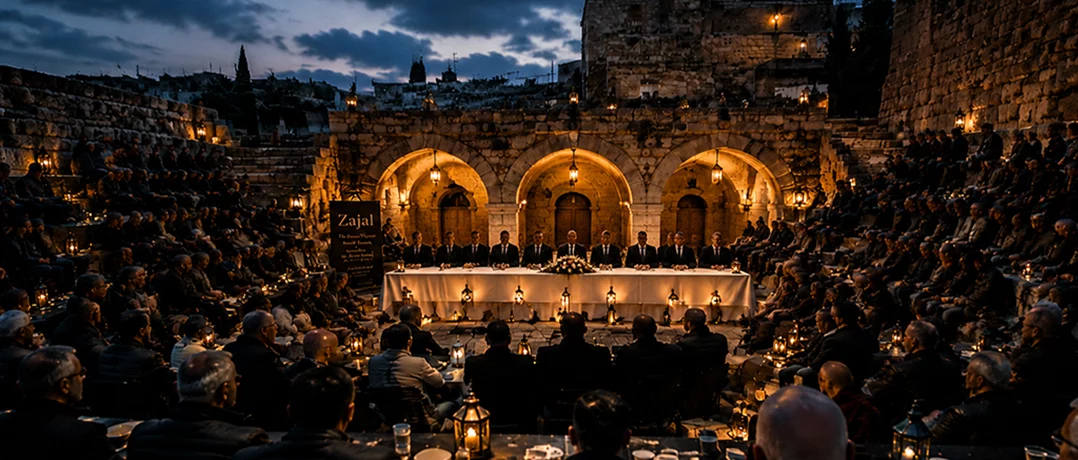
Lebanese zajal is a living performance of memory, rhythm, and identity, a cultural form that continues to echo across villages, generations, and social spaces. Rooted in oral expression, it is one of Lebanon’s most enduring artistic practices, where poetry is not written to be read, but spoken to be lived.
As researcher in Syriac studies Leila Lotti explains, the history of poetic expression stretches far beyond Lebanon and far deeper into ancient human civilization than most assume.
“Poetry itself dates back more than 5,000 years. We found inscriptions in Akkadian written in cuneiform script. Poetry was originally sung before it became recited,” says Leila Lotti.
For Lotti, poetry and music were never separate worlds.
“Poetry was always connected to music. It came first as song, and only later became spoken verse.”
In this sense, zajal is not an isolated Lebanese invention, but part of a much older human impulse: to turn language into rhythm, and rhythm into meaning.
Zajal, as it developed in Lebanon and the Levant, became a distinct form of vernacular poetry rooted in spoken Arabic rather than classical literary language.
“Zajal in Lebanon dates back centuries. It is a popular poetic form that developed in parallel with classical Arabic poetry but followed its own rhythm and structure,” says Lotti.
She challenges the common misconception that zajal is a “simplified” or “broken” form of Arabic poetry.
“Zajal is not broken Arabic poetry. It follows its own musical and rhythmic systems.”
Instead, zajal represents a parallel literary universe, one governed by sound, improvisation, and audience interaction rather than formal written rules.
Unlike written poetry, zajal exists only when it is performed. It is a live, improvisational exchange between poets, often in front of an audience that actively participates in shaping the energy of the moment.
The genre is defined by quick thinking, emotional intensity, and verbal agility. It is poetry as confrontation, dialogue, and celebration, a cultural space where language becomes performance.
This oral dimension has allowed zajal to survive across generations, even in contexts of limited literacy, making it one of Lebanon’s most resilient cultural forms.
Lebanon played a key role in preserving and developing this tradition due to its linguistic diversity and cultural continuity.
“Lebanon preserved the Syriac linguistic and cultural heritage more than many other regions, which allowed traditions like zajal to survive and evolve,” Lotti explains.
Even as Arabic became dominant, older cultural and musical structures remained embedded in local expression, shaping the evolution of vernacular poetry.
Zajal is deeply embedded in Lebanese identity. It reflects humor, emotion, politics, love, and social commentary, often all within the same performance.
It is both elite and popular, ancient and modern, sacred and secular. It is performed in villages and cities, in competitive poetic duels and celebratory gatherings, shaping a shared cultural language that transcends geography and class.
Today, Lebanese zajal remains a living performance art, often presented in poetic duels, festivals, and cultural gatherings. It continues to evolve while maintaining its ancient rhythmic foundations.
Zajal is not a relic of the past, but a continuing expression of identity and collective memory.
Lotti also highlights the deeper historical layers that influenced poetic traditions in the region, particularly Syriac liturgical heritage.
“In the 4th century, Saint Ephrem adapted melodies and created hymns sung by choirs. This structure is very similar to what we see today in zajal, with two groups responding to each other.”
This call-and-response structure remains one of the defining characteristics of zajal today, where poets alternate verses in rhythmic battle-like performances.
It reflects a continuity between sacred chant and popular expression, between church, village, and public square.
Today, Lebanese zajal is officially recognized by UNESCO as part of the Intangible Cultural Heritage of Humanity, affirming its importance as a living tradition rather than a relic of the past.
It is performed across villages, festivals, weddings, and public gatherings, and continues to function as a form of cultural dialogue and social expression.
UNESCO described it as a poetic form that reflects values of dialogue, tolerance, and cultural diversity, and emphasized its role in strengthening social cohesion across communities.
This recognition places zajal alongside Lebanon’s most significant cultural heritage, confirming its place not only in national identity but in global cultural memory.
Early poetic forms were deeply connected to spirituality and ritual life. Language was not only a tool of communication, but also a bridge between humans and the divine.
“Human societies were deeply religious. Poetry emerged as a way to communicate with the divine, to offer beautiful words to the gods,” she explains.
Even rhythm itself was shaped by observation of nature.
“The idea of rhythm came from observing nature, especially birds. Their sounds inspired early musical and poetic structures.”
Over time, this sacred function of poetry gradually transformed into a social one, moving from temples and rituals into communal spaces.

