

An exclusive interview with the head of Lebanon’s Order of Pharmacists reveals the numbers behind a deepening sector crisis, from closures and rising operating costs to shrinking revenues, oversupply and the growing risk to pharmacy access.
Lebanon’s pharmacies face losses, pressure and collapse
Lebanon’s pharmacies face losses, pressure and collapse
By Michella Rizk | September 15, 2026

Reading time: 6 min
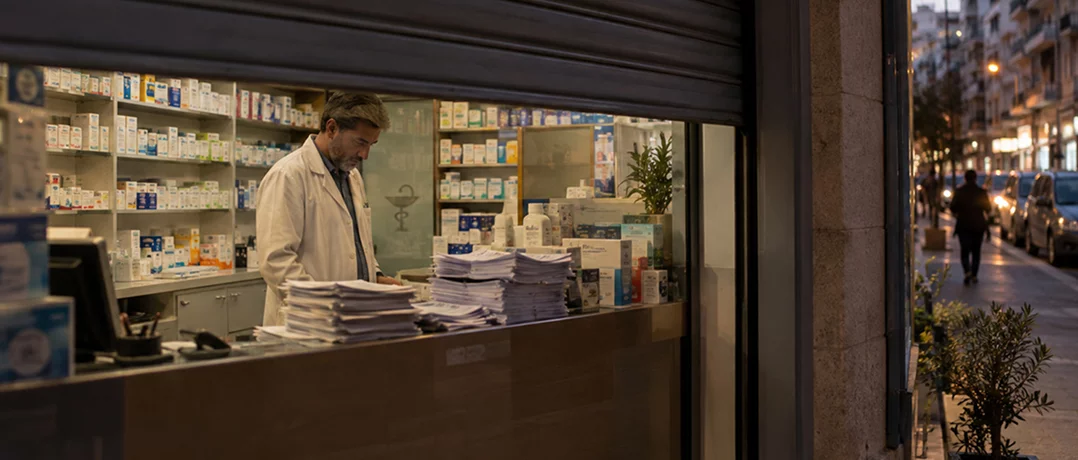
Lebanon’s pharmacies are facing mounting financial strain, with more than 200 closures linked to economic pressures and another 600 businesses considered at serious risk.
“There are still around 3,700 pharmacies across the country” Dr. Abdel Rahman Morkabawi, president of the Order of Pharmacists told The Beiruter, but the sector is being squeezed by rising operating costs, weaker revenues and tougher payment terms from suppliers, years after the financial collapse first hit the profession.
He estimates that 30 to 40 percent of pharmacies are vulnerable in the short term, with that share potentially rising to 80 percent if current conditions persist.
“The biggest problem we have today is the rise in operating costs,” Morkabawi said.
The picture is not uniform, however. Around 300 pharmacies in southern and border areas are currently closed because of security conditions rather than financial failure.
The capital that disappeared twice
Pharmacies entered the financial crisis with losses on two fronts: deposits trapped in banks and capital tied up in medicine stocks.
As subsidies were phased out, pharmacies sold medicines at subsidized prices but often could not replace them at the same value.
A pharmacy carrying around $100,000 in stock before the crisis could be left with just $3,000 to $5,000 to rebuild it.
Some owners sold assets to recapitalize their businesses. Others sold their pharmacies or left the profession.
The pressure did not stop there. Suppliers that once offered payment delays increasingly shifted to cash terms, forcing pharmacies to finance new stock upfront.
For pharmacies that had already lost much of their capital, that meant finding the money to replace stock before it could be sold.
Costs recovered. Revenues did not.
At the same time, the cost of running a pharmacy has risen sharply.
Electricity, generator fees, rent and salaries have all increased, while pharmacies must maintain reliable power to safely store temperature-sensitive medicines. Morkabawi estimates basic monthly operating costs at around $1,500 to $2,000, including roughly $500 to $700 for generator electricity alone.
Unlike most retailers, however, pharmacies cannot simply raise prices to offset higher costs. The Ministry of Public Health publishes official public prices for medicines, with the latest 2026 lists calculated according to an exchange-rate index issued on September 3. The ministry also sets the pricing mechanisms for imported and locally produced medicines, limiting the ability of individual pharmacies to adjust retail prices.
This leaves the sector caught between rising market-driven expenses and regulated medicine prices.
Even the largest pharmacy in Lebanon today has an income that is around 40 percent of what it was in 2019.
The expired box on the shelf
Another source of losses comes from medicines that remain unsold until they expire.
Morkabawi says distributors were once responsible for taking back certain near-expiry products, but that responsibility shifted during the crisis. He says pharmacists increasingly had to absorb the cost of medicines that expired before they were sold, adding another burden to already strained cash flow.
The pressure is greater outside Beirut and other major urban centres, where sales volumes are generally lower.
“The further you go outside the main cities, the higher the percentage becomes,” Morkabawi said, referring to the share of pharmacies under pressure.
He also pointed to the role of dispensaries in peripheral areas.
Dispensaries are very active in those regions, another factor reducing demand for private pharmacies.
Around 1,000 pharmacies are concentrated in densely populated coastal areas, according to figures cited by Morkabawi, while the rest are spread across the country.
That uneven distribution means the impact of a closure can vary sharply. In a crowded commercial area, patients may have several nearby alternatives. In a smaller town, losing one pharmacy can significantly reduce access to medicines.
Too many pharmacies, not enough business
There is, however, a contradiction at the heart of the sector. Lebanon may be losing pharmacies, but it already has far more than it needs.
The country has roughly three times the number of pharmacies required and twice the number of pharmacists needed.
“Each year, around 500 new pharmacists enter the profession, yet only 100 to 150 find work in the field”.
Many of the rest either leave Lebanon or move into other professions.
For Morkabawi, the solution requires “limiting the number entering the profession”. Legislation addressing graduate numbers has already been proposed in Parliament.
At current levels, Lebanon could go several years with sharply reduced pharmacy enrollment before supply begins to match demand.
Licensed pharmacies are also competing with medicines sold outside the channels legally designated for them.
“We need to work so that medicine is legally confined to pharmacies,” Morkabawi told The Beiruter. “We are finding medicine in places where it is not supposed to be: online, in some clinics and in some shops.”
The Ministry of Public Health required medicines to be registered and considered unauthorized import or distribution illegal. In early September, Lebanon’s financial prosecutor opened an investigation into suspected medicine smuggling involving a diabetes and obesity treatment and a cancer immunotherapy drug. Around 30 pharmacy owners were reportedly linked to the case, while several pharmacists were questioned. The investigation also complicated complaints about illegal competition, with some licensed pharmacies themselves alleged to have participated. Beyond lost sales, unregulated medicines raised concerns over authenticity, storage and patient safety.
That oversight is particularly important in a market heavily dependent on imports. Around 70 percent of pharmaceutical products consumed in Lebanon are imported, compared with roughly 30 percent produced locally, according to the U.S. Department of Commerce’s 2026 market guide. Pharmaceutical imports were valued at approximately $737 million in 2024, up from $621 million in 2023.
Pharmacies sit at the end of that chain, between manufacturers, importers, distributors, regulators and patients. At the same time, they are operating in an overcrowded domestic market and competing with medicines circulating outside the regulated system.
For pharmacy owners, the pressure therefore comes from both directions: too many licensed operators competing for limited business, and an illegal market operating beyond the rules they are expected to follow.
Who pays to keep the pharmacy open?
Keeping pharmacies viable will require changes to the current model, including a review of pharmacists’ margins and formal payment for services already provided inside pharmacies. The Order has raised both proposals with the Ministry of Public Health.
But any increase in pharmacy revenue raises a wider question: who ultimately pays for it? Higher compensation could come from suppliers, insurers, the state or patients, who have already absorbed years of rising healthcare costs.
The risk, Morkabawi argues, is that without intervention, the sector will continue to contract through closures, reduced staffing and smaller inventories, particularly in areas where sales are already weak.
If no steps are taken to protect this profession, it is heading toward collapse.
The scale of that risk remains difficult to quantify, but the pressures are clear: depleted capital, higher operating costs, tighter supplier terms, regulated medicine prices, an oversupplied profession and competition from medicines sold outside legal channels.
For Morkabawi, the issue ultimately extends beyond the survival of pharmacy owners. “If the profession collapses,” he said, “the patient’s health collapses with it.”
-
-

-
Michella RizkContent Manager/WriterFocusing on social affairs.
-
