

Lebanon’s skeet shooting champion Samer Sarkis makes history, bringing home a long-awaited Mediterranean Games gold and beating some of the world’s best.
Lebanon’s skeet shooting champion strikes gold
Lebanon’s skeet shooting champion strikes gold
By The Beiruter | September 05, 2026

Reading time 4 min
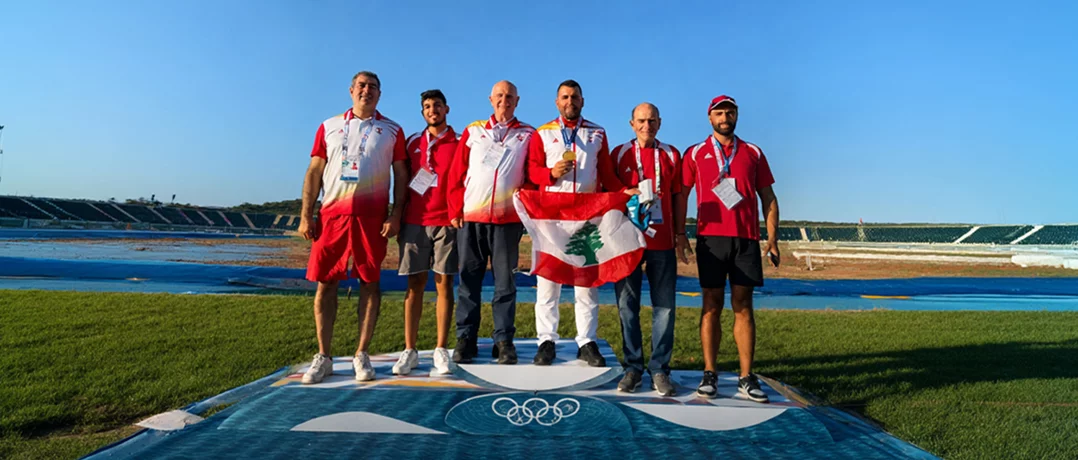
At the 2026 Mediterranean Games in Taranto, Italy, Samer Sarkis stepped onto the skeet shooting range and delivered Lebanon a moment decades in the making, a gold medal in the men's skeet event, achieved against a field stacked with some of the sport's biggest names. It was, by his own account, a medal Lebanon had been waiting a very long time for. What makes the achievement more remarkable is that Sarkis isn't a full-time athlete at all. He's a partner at an international law firm, splitting his life between a demanding legal career in Doha and a training regimen that would exhaust most professional competitors.
From hunting to the world stage
Sarkis's path into competitive shooting began far from any Olympic ambition. “I have been based in Qatar since 2006, but I started shooting competitively in 2013 and began taking the sport seriously the following year. By 2018, I was training under Hani Fakh, an Olympic gold medalist and, at the time, one of the most successful skeet shooters in the world, “ he told The Beiruter
Progress came steadily rather than suddenly. In 2024, Sarkis came agonizingly close to qualifying for the Olympic Games, reaching the final of the Asian Olympic qualification event and finishing fifth, just one place outside the four quota spots. "I was extremely close," he said, describing a pattern that repeated across multiple competitions, strong performances undercut by a single off day, or a final reached without a medal to show for it.
A double life measured in flights
What sets Sarkis apart from most competitors at his level is the sheer logistics of his life. A partner at a top-20 international law firm for the past 13 years, he works primarily on high-stakes corporate transactions, stock market listings, major acquisitions. His family, meanwhile, has remained in Lebanon throughout his two decades based in Doha, meaning a weekly commute has become simply part of his routine. "I have a flight every Friday," he said. "That's only Beirut-Doha, Doha-Beirut. I also travel to our offices in the UK, Saudi Arabia and the UAE."
His training schedule fills whatever time remains. "Some days, I wake up at 6 a.m., go train until 9 a.m., then return to Doha, put on my suit, get to the office around 11 a.m. and stay there until 1 a.m. Then I wake up and do the same thing again the next day." On days he can't get to a range, he practices dry mounting at home, running through the shooting motion with an unloaded shotgun, without targets, simply to maintain muscle memory.
Recovering from injury, then making history
Sarkis's gold medal arrived only months after a shoulder injury had sidelined him from competition entirely. He stopped shooting around February 2026 on the advice of doctors who initially recommended surgery. Instead, under the care of his doctor, he underwent four plasma injections and recovered without going under the knife. "He promised me, 'You will shoot at the Mediterranean Games,'" Sarkis recalled. The Taranto competition marked his first international event of the year following the injury.
The field he beat to get there was formidable. Sarkis competed against Gabriele Rossetti, an Olympic gold medalist and world number two; Eric Piccini, world number four; and Azmy Mehelba, a multiple-time world champion ranked 19th globally, effectively the entire top tier of international skeet shooting. His win marked Lebanon's first Mediterranean Games gold medal since 1991, a drought Sarkis described in even starker terms from within his own event, calling it a result the country had been chasing for 75 years.
The mental game behind the trigger
Sarkis explained why skeet shooting is far more demanding than it might appear. Unlike trap shooting, competitors cannot mount the shotgun until calling for the target, and every clay gets a single shot rather than two attempts. From the moment he calls "pull" to the moment he fires, he has roughly half a second to under a second to react, sometimes to two targets released simultaneously. "It is definitely a game of focus. It is highly mental," he said, noting that during one competition day, he shot 86 targets in a combined 26 minutes of actual performance time, yet burned around 6,000 calories, a physiological toll he attributes entirely to sustained mental strain.
He was realistic about the gap between his circumstances and those of full-time competitors. He estimated that he shoots roughly 50,000 targets a year, compared to the 170,000 to 180,000 a professional Chinese or Indian shooter might fire annually. "If they can reach the level required for a gold medal in two years, I have to be realistic and understand that it might take me 10 years," he said.
The dream to reach Los Angeles
With the Asian Games in Nagoya, Japan just weeks away, Sarkis is already looking toward his next target, the 2028 Los Angeles Olympics. Missing Olympic qualification in 2024 by a single position still stings, but his outlook remains steady. "You have to believe in your abilities and keep fighting," he said. "You need resilience... consistency... mental training... focus." For a man balancing 15-hour workdays, weekly transcontinental flights, and world-class competition, that resilience may be the true medal-winning skill.
-
-

-
The Beiruter
-
