

Lebanon has approved a $250 million plan to build new grain silos at Beirut, Tripoli, and the Bekaa to restore food reserves, with Economy Minister Amer Bisat outlining concessional financing and international support.
Lebanon advances new grain silo plan to boost food security
Lebanon advances new grain silo plan to boost food security
By The Beiruter | February 04, 2026

Reading time: 6 min
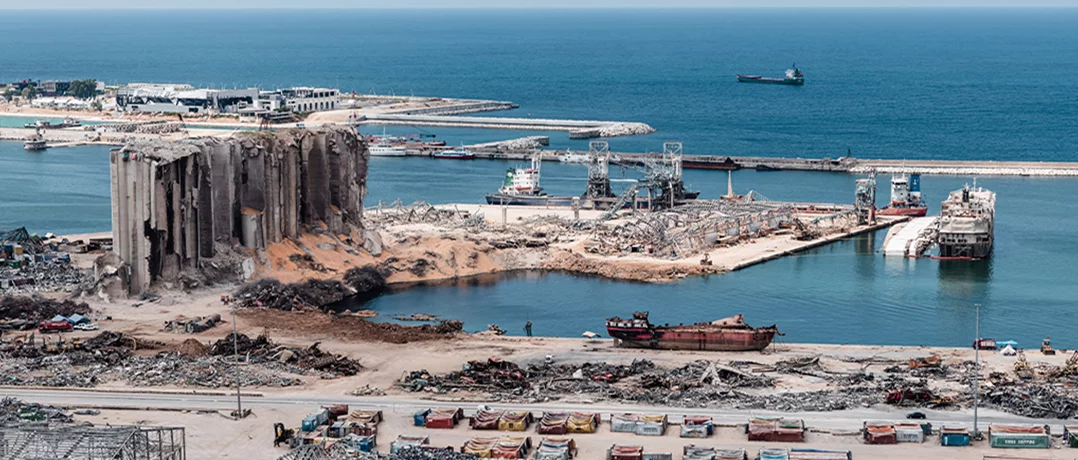
Source: Nida Al Watan – Patricia Jallad
The government approved, around 2 weeks ago, the national strategy for establishing grain silos and strengthening food security, which includes building 3 new grain silos at the Port of Beirut, the Port of Tripoli, and an inland site in the Bekaa region. A phased implementation was decided, starting with the Port of Beirut due to its immediate national impact. The Minister of Economy and Trade was also tasked with contacting external partners to secure the necessary concessional financing. Has the construction of the silos become imminent, and what about the studies submitted for the reconstruction and development of the port?
The Ministry of Economy and Trade worked jointly with the Council for Development and Reconstruction to prepare a “National Strategy for Establishing Grain Silos” to enhance food security and provide a safe place to store imported grain, with a capacity sufficient to meet Lebanon’s needs for 6 months. A preliminary feasibility study was completed by Khatib and Alami company in November 2025.
The national strategy
According to the strategy presented to the Council of Ministers, a copy of which was obtained by Nida Al Watan, Lebanon relies mainly on the import of wheat and fodder, with the absence of sufficient strategic reserves since the destruction of the Beirut Port silos in the 4 August 2020 explosion. This has led to the absence of public sector storage, increased exposure to supply shocks, and reliance on emergency imports and exceptional subsidies, along with the pressures these place on public finances.
The study concluded that a state-led national grain storage program is technically feasible and economically justified, recommending the construction of 3 silos at the ports of Beirut and Tripoli and in the Bekaa. The strategic wheat reserve would cover 6 months, distributed between public sector-managed reserves for 3 months and privately managed, monitored stocks for another three months.
Financial cost and funding
The investment cost of the 3 silos is estimated, as explained by Minister of Economy and Trade Amer Bisat to Nida Al Watan, at approximately $250 million, with the Beirut Port alone costing about $125 million. Funding will be secured through concessional loans.
In this context, the Council of Ministers tasked the Minister of Economy and Trade with coordinating with the port authority to determine the construction site and begin preliminary consultations on conditions, with final decisions to be presented to the Cabinet. The Ministry of Economy and the Council for Development and Reconstruction were also authorized to communicate with development partners to secure concessional financing and necessary grants.
According to Bisat, funding will be requested from Arab funds and will be based on the feasibility study and the property on which the silos will be built, expressing hope that this will be completed within several months, noting that identifying the property should take only a few days. Once the location of the silos at the Port of Beirut is determined, financing for construction must be secured.
After the port authority determines the property designated for the silos at Beirut Port, Bisat said that they will approach Arab funds to obtain financing.
Partial funding for the project is already available from the Kuwait Fund for Arab Economic Development, but it is insufficient. It is worth noting that if concessional loans are secured with a weighted average cost of capital of 2.5% annually, the state, according to Bisat, would be able to repay the loan through silo revenues while achieving a modest profit at a later stage.
A tender will also be launched to prepare a detailed engineering study expected to take about three months, including seismic and structural studies. There is also a grant from the Kuwait Fund for these studies worth $1.5 million. Once the engineering study is ready, tender documents will be issued and a construction tender announced, after which several months will be needed to consult with construction companies and select one.
Based on these data, Bisat believes that the cornerstone-laying announcement, if matters proceed as planned, will take place at the end of summer. In parallel, during the summer, the same process will be repeated to establish silos at the Port of Tripoli.
Previous studies
Regarding studies submitted by international parties such as France, Germany, and the World Bank on the reconstruction of the port, including grain silos, will they be taken into consideration?
In response, Bisat revealed that the new port administration is preparing a comprehensive strategy that takes into account the studies submitted by France, Germany, and the World Bank for the reconstruction of the port. Selecting the property for building the port silos is a small part of this broader strategy being developed by the port authority, and they will not wait for the completion of the port development study, which requires time, due to the need to build silos to ensure food security.
Fate of the old silos
As for the old silos damaged by the port explosion, their fate has been decided: they will not be demolished but will remain as a heritage site. Bisat said that dealing with them is not limited to engineering considerations but also includes social, moral, and ethical dimensions due to their connection to the memory of the port explosion, noting a tendency to transform them into a memorial and tourist landmark. It should also be noted that there is an insurance policy worth $30 million that remains pending a judicial ruling related to the Beirut Port explosion.
Accordingly, work on the plan to build new silos will proceed in parallel with efforts to convert the old silos into a tourist landmark, after the Council of Ministers, in its session held on 5 August, decided to reverse the previous government’s decision to demolish the remaining wheat silos at the Beirut Port.
Minister of Culture Ghassan Salameh included the silos on the “General Inventory of Historic Buildings,” in response to a request from the families of the port explosion victims, which halts any decision to demolish them and protects them as part of Beirut’s urban heritage.
At present, the Ministry of Economy and Trade and the Council for Development and Reconstruction are awaiting notification of the expected property location within days, after which they will begin the detailed engineering study and seek financing through concessional loans to build the silos. The Ministry of Economy is also working in parallel on preparing an independent study to determine the optimal model for operating the silos, whether through state management, as was previously the case, or through a management contract with a private sector operator, as stated in the National Strategy for Establishing Grain Silos.
Between local production and imports
Lebanon imports approximately 675,000 tons of wheat annually, while domestic production does not exceed 50,000 tons, mainly used for kaak and pasta manufacturing, leaving the country 85% dependent on imports.
According to the national strategy study, if 3 silos are built, the expected storage capacity will reach 414,000 tons, including 235,000 tons in Beirut, 138,000 tons at the planned silos at the Port of Tripoli, and 41,000 tons in Riyaq in the Bekaa, compared to the old silos’ capacity of only about 150,000 tons.
-
-

-
The Beiruter
-
