

The Beiruter examines Lebanese PM Nawaf Salam’s visit to Iraq and how Lebanon-Iraq energy cooperation could reshape regional integration and stability.
Lebanon and Iraq reconnect

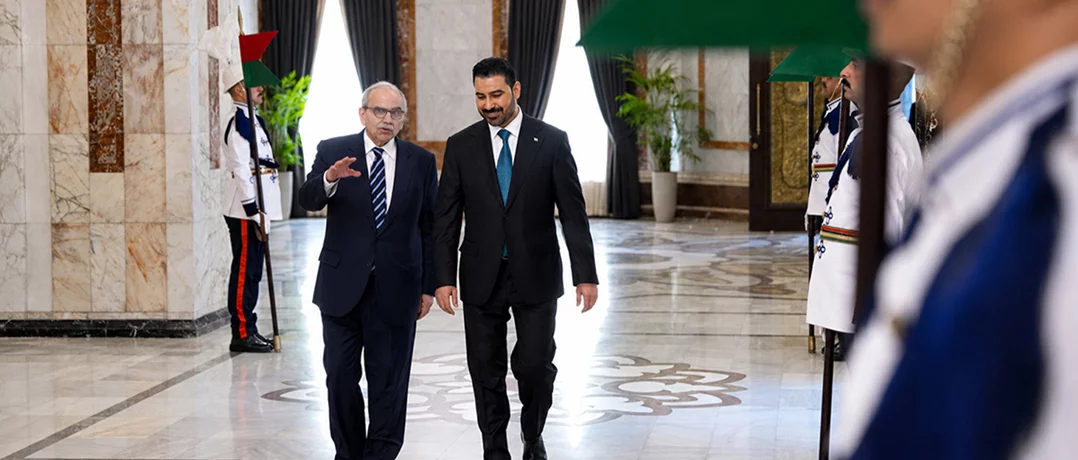
Lebanese Prime Minister (PM) Nawaf Salam’s official visit to Baghdad reflects the emergence of a broader strategic vision centered on economic integration, regional connectivity, and long-term cooperation. While extending Iraq’s fuel supply agreement to Lebanon remains an immediate priority for addressing Lebanon’s persistent electricity crisis, discussions between the two governments also focused on ambitious infrastructure projects capable of reshaping the economic future of both countries.
Among the most significant proposals is the revival of the historic Kirkuk-Baniyas-Tripoli oil pipeline, a project that could restore Lebanon’s role as a Mediterranean energy hub while providing Iraq with an additional export corridor to international markets.
To better understand the significance and implications of this visit, The Beiruter reached out to Iraqi political analyst and academic Dr. Ihsan al-Shammari.
A visit that reflects a changing regional landscape
According to Dr. al-Shammari, the importance of PM Salam’s visit lies first in its timing, coming at a moment when the Middle East is undergoing significant geopolitical transformation.
He argued that recent regional developments, particularly following the U.S.-Israeli-Iranian confrontation, have altered the regional balance of power and created conditions that encourage countries to redefine their relationships based on new strategic realities.
He also noted that the visit coincides with what he described as a gradual decline in Iranian influence in both Lebanon and, to a certain extent, Iraq. In his assessment, this evolving regional environment is creating space for Baghdad and Beirut to establish a more independent and mutually beneficial partnership.
This visit coincides with the beginning of a decline in Iranian influence in both Beirut and, to some extent, Baghdad.
Dr. al-Shammari further linked the visit to broader international efforts aimed at building what he referred to as an “Alliance of Stability” that could eventually include Iraq, Lebanon, Syria, Jordan, and the Gulf Arab states. Within this framework, he views the Baghdad meetings as an early step toward strengthening regional cooperation through shared political and economic interests.
Rather than representing a routine diplomatic engagement, he believes the visit could become the foundation for redefining Lebanese-Iraqi relations across political, economic, and even security sectors.
The Kirkuk-Tripoli pipeline and regional economic integration
One of the most ambitious topics discussed during the visit was the possible rehabilitation of the historic Kirkuk-Baniyas-Tripoli oil pipeline.
For Dr. al-Shammari, restoring the pipeline would significantly reshape regional energy trade and provide Iraq with greater flexibility in exporting its oil.
He explained that reopening export routes through Syria’s Baniyas terminal and Lebanon’s Tripoli would diversify Iraq’s access to Mediterranean markets at a time when regional tensions continue to raise concerns over the security of maritime shipping routes through the Strait of Hormuz. Expanding export options, he argued, would strengthen Iraq’s economy by reducing dependence on a limited number of energy corridors while increasing resilience against future regional disruptions.
Lebanon, meanwhile, would benefit from becoming more deeply integrated into Iraq’s economy through expanded energy cooperation and commercial exchange. According to Dr. al-Shammari, this degree of economic interdependence would naturally strengthen bilateral relations while generating broader opportunities for investment, logistics, and regional trade.
If eventually implemented, the revival of the Kirkuk-Baniyas-Tripoli pipeline could restore Tripoli’s historical position as one of the eastern Mediterranean’s most important energy and logistics centers. Modernizing petroleum storage facilities, expanding the Port of Tripoli, and strengthening transport infrastructure could attract new investment while creating employment opportunities across engineering, logistics, shipping, and industrial services.
The project could also complement broader efforts to develop northern Lebanon through the Tripoli Special Economic Zone and other strategic infrastructure initiatives, positioning the city as an important commercial gateway connecting Iraq to European and Mediterranean markets.
At the same time, Lebanon would continue benefiting from Iraq’s fuel support in the short term while working toward longer-term reforms in its electricity sector and broader economic recovery.
Nevertheless, he cautioned that the project faces substantial obstacles. Among the most important challenges, he identified the regional political environment, including factors that could complicate efforts to restore a major strategic energy corridor. Security considerations also remain critical, as protecting hundreds of kilometers of pipeline infrastructure across three countries would require sustained coordination and stability. Financing represents another significant obstacle. Iraq, Syria, and Lebanon all face considerable fiscal constraints, making it likely that implementation would require external investment, international partners, or private-sector participation.
Despite these difficulties, Dr. al-Shammari believes the potential economic returns are substantial. Successful rehabilitation of the pipeline would generate significant revenues for all three participating countries while revitalizing infrastructure that once played a central role in regional energy trade.
If implemented, the pipeline would generate substantial economic returns and significant financial revenues for Baghdad, Damascus, and Beirut.
Building a long-term strategic partnership beyond energy interests
Although energy cooperation dominated the official agenda, Dr. al-Shammari believes the visit carries far greater strategic significance.
He acknowledged that renewing Iraq’s fuel exports to Lebanon and discussing the rehabilitation of the Kirkuk-Tripoli pipeline are important achievements. Likewise, agreements concerning infrastructure development and economic cooperation represent tangible progress. However, he argued that these initiatives should be understood within a much broader strategic framework.
In his view, the discussions between the two prime ministers reflected preparations for what he described as a “post-Iran phase” in both Iraq and Lebanon, where regional cooperation may increasingly rely on sovereign state institutions rather than traditional geopolitical alignments.
For this reason, Dr. al-Shammari considers the Baghdad visit to be primarily strategic rather than merely economic. He noted that both leaders discussed wider regional developments and ways to enhance stability, strengthen bilateral coordination, and expand cooperation across multiple sectors.
He believes that this broader dialogue demonstrates a shared interest in developing a lasting partnership capable of adapting to evolving regional dynamics while serving the long-term interests of both countries, despite the political, financial, and security challenges that remain.
-
-

-
The Beiruter
-
