Lebanon returns to the 61st Venice Biennale with Don’t Get Me Wrong, a monumental immersive installation by Nabil Nahas exploring art, spirituality, and identity through cosmic abstraction.




Lebanon returns to the 61st Venice Biennale with Don’t Get Me Wrong, a monumental immersive installation by Nabil Nahas exploring art, spirituality, and identity through cosmic abstraction.

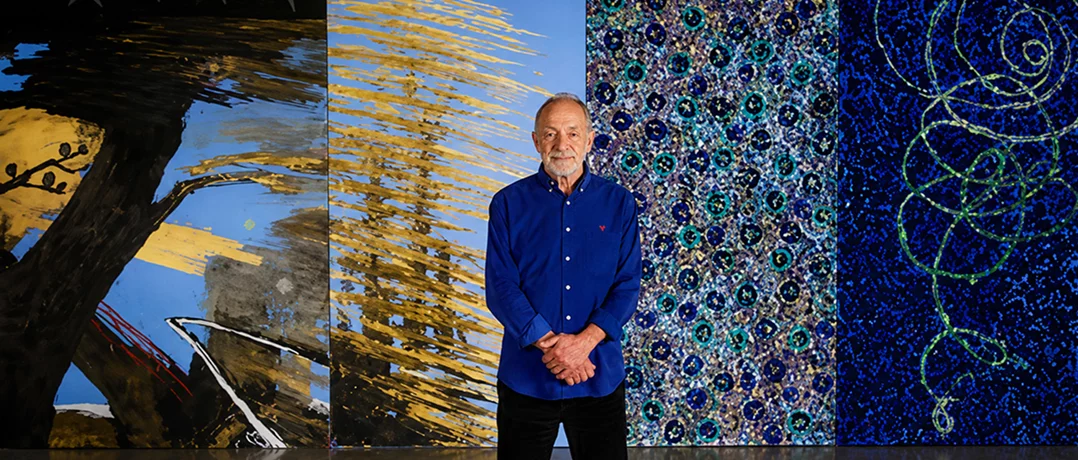
Lebanon returns to the Venice Biennale this year with a powerful artistic statement. At the 61st International Art Exhibition, La Biennale di Venezia, the Lebanese Pavilion will present Don't Get Me Wrong, an immersive installation by Lebanese-American artist Nabil Nahas, curated by Dr. Nada Ghandour and organized by the Lebanese Visual Art Association of Paris. The Beiruter sat down with Ghandour to discuss what Lebanon's participation means at this particular moment, and the vision behind the pavilion.
"Lebanon's participation in Biennale Arte 2026 carries strong symbolic weight at a time when the country is facing profound and ongoing crises," says curator Dr. Nada Ghandour. "Being present on such an international platform affirms that, despite instability, Lebanon's voice remains active, relevant, and engaged in global conversations, notably through its art and culture, which act as a form of soft power." For Ghandour, artistic expression has always been central to Lebanese identity, and Venice is proof that it endures.
Lebanese-American artist Nabil Nahas, known for his vivid textured paintings of fractal, geometric patterns incorporating organic elements such as seashells and starfish, represents Lebanon at the 61st Venice Biennale. The work presented is titled Don't Get Me Wrong. Spanning forty-five linear meters within the Arsenale, it consists of twenty-six acrylic-on-canvas panels, each rising three meters high, arranged side by side to form a monumental, enveloping frieze that invites visitors to navigate within it. Inspired by Persian miniature formats, the non-linear installation resists fixed interpretation and invites multiple readings through grouped connections across geometric, figurative, and fractal compositions.
The visual and spiritual ambition of the work is unmistakable. The geometric forms evoke the mathematical structure of the cosmic order, while the spiral, a symbol of infinity drawn from Sufi mysticism, acts as a hypnotic force on the mind, guiding an intimate, inward journey. The tree motif, central to Nahas's work, embodies the tension between rootedness and transcendence through species found in biblical texts, including the cedar and the olive. "This work is a combination of art, culture and spirituality," Ghandour explains. "You can see the influence of Islamic art, occidental abstraction, and themes and symbols that come from the Bible."
The selection of Nahas was, by Ghandour's account, the result of a rigorous and thoughtful process. "The chosen artist was selected based on the strength of his practice," she says. "Nahas is an internationally recognized artist, capable of developing a project that meets the level and ambition of the Biennale. Consideration was also given to how effectively the work could resonate with an international audience while remaining rooted in a distinct Lebanese perspective." The selection committee noted that he offers a poetic vision of the world, navigating the tensions between chaos and harmony, resonating with contemporary concerns while evoking both the spiritual and the material, the intimate and the cosmic.
The long-term aspirations behind the pavilion run deeper than a single season. Ghandour hopes the participation will "create sustainable international exposure and access for Lebanese artists to key networks, institutions, and collaborations," while strengthening the cultural infrastructure within Lebanon itself, its galleries, museums, universities, and collectors. The pavilion, she insists, is an affirmation of Lebanon's place as a vital contributor to the worldwide cultural landscape.
As Ghandour has put it: "At a time of global uncertainty and instability, it is essential that nations promote voices other than violence. Space must be given to the imaginative and conciliatory power of artists who express a shared, open and free language, because art has the ability to create bonds that transcend geographical, cultural, historical, and ideological boundaries."
Don't Get Me Wrong is, in the end, exactly that, a bridge built from pigment, memory, and cosmic wonder, exhibited in the heart of Venice by a Lebanese artist who transformed abstraction into a universal language of connection, proving that even across distance, history, and difference, art remains one of humanity’s most powerful ways of understanding one another.

