

Lebanon launches symbolic south reconstruction with limited funds, highlighting deep financial crisis and political constraints.
Lebanon formally launches reconstruction efforts
Lebanon formally launches reconstruction efforts
By The Beiruter | December 15, 2025

Reading time: 3 min
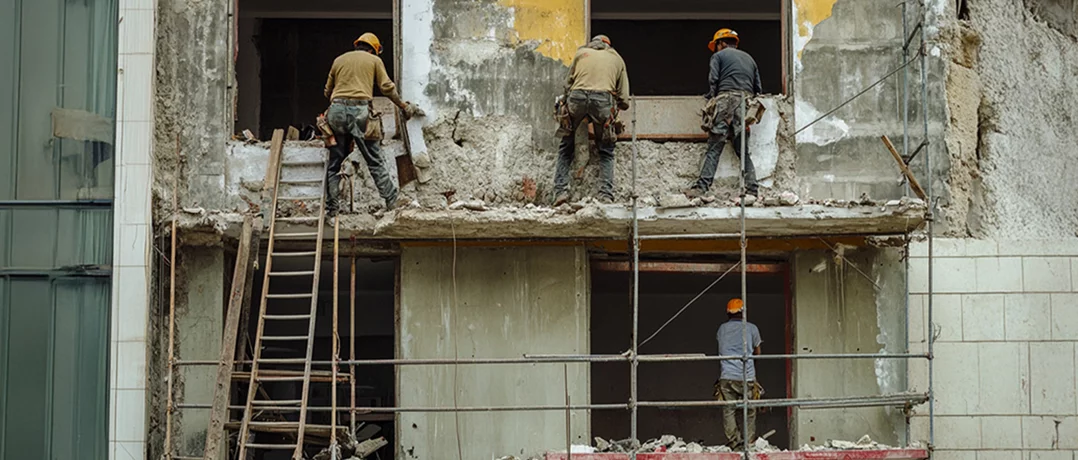
More than a year after the end of the devastating war between Israel and Hezbollah, the Lebanese state has formally launched its long-awaited reconstruction effort in the country’s south. The move marks a symbolic turning point after months of paralysis, but it also exposes the severe financial and political constraints facing the government, as the funds allocated fall far short of the scale of destruction caused by the conflict.
Modest allocations, symbolic start
The reconstruction effort was set in motion through the 2026 state budget, after Parliament’s Finance and Budget Committee approved allocations for several key public bodies, including the Council for Development and Reconstruction (CDR), the Council of the South, and the Higher Relief Committee. The aforementioned committee also endorsed transferring money from the emergency budget reserve to fund urgent shelter and repair needs.
According to parliamentary sources, a total of $90 million was released from the reserve, with $67 million allocated to the Council of the South and $24 million to the Higher Relief Committee. Committee chairman MP Ibrahim Kanaan described the move as a “positive signal” to citizens affected by the war, stressing that it was carried out within strict budgetary limits and without increasing overall spending.
However, experts stress that the approved funds barely scratch the surface. Estimates direct war damage at $8.5 billion, with reconstruction costs around $2.3 billion. Thus, the limited state funding underscores Lebanon’s weakened capacity and reinforces expectations that meaningful foreign aid will not arrive without a durable political and security settlement.
Reconstruction still faces certain conditions and barriers
Lebanese officials have made no secret of the fact that public funds alone cannot sustain reconstruction.
Foreign envoys have repeatedly told Beirut that large-scale international support depends on deep financial reforms and, more controversially, on the state achieving exclusive control over weapons. These conditions have complicated prospects for external aid, especially as reconstruction has become intertwined with unresolved political and security arrangements with Israel.
Adding to the uncertainty is the fate of a reconstruction conference championed by France. While initially intended to mobilize donor support, Paris has recently shifted its focus toward organizing a conference to support the Lebanese Armed Forces (LAF), expected early next year.
Reconstruction efforts have also been slowed by internal political disputes. Deep divisions in parliament over expatriate voting have stalled legislative work, delaying the approval of World Bank loans that could reach between $250 million and $500 million. Kanaan warned that these loans risk being withdrawn if parliament fails to ratify them before the end of the year.
Lawmakers from Hezbollah and the Amal Movement parliamentary blocs pushed strongly for reallocating part of the budget reserve toward reconstruction, arguing that citizens in the south had been abandoned for too long. Other MPs agreed under public pressure, amid growing fears of unsafe housing and potential building collapses.
Meanwhile, criticism has also emerged from the Lebanese Forces (LF) party, which argued that reconstruction should be handled through a dedicated, internationally supervised fund, while prioritizing support for the Lebanese army to ensure long-term stability.
This is the first instance of direct state funding for reconstruction since the war ended in November 2024, following more than a year of waiting for foreign assistance that never arrived.
Hence, Lebanon’s decision to launch reconstruction with its own limited resources represents a long-delayed acknowledgment of state responsibility toward war-affected communities. Yet the modest scale of funding highlights the country’s deep financial crisis and political fragmentation. Without reforms, international backing, and institutional trust, reconstruction risks remaining more symbolic than transformative, leaving many residents of the south waiting for a recovery that still feels uncertain.
-
-

-
The Beiruter
-
