



At the London Education Forum, Lebanon highlighted its school crisis as Beirut’s Alsama Project won a major global education prize.
Lebanon pushes education reform on global stage

Lebanon has long staked its identity on education, producing doctors, engineers, writers, and thinkers who have shaped the Arab world and beyond. That legacy makes the current assault on Lebanon's school system all the more painful, and all the more urgent to defend.
With that weight in mind, Lebanese Education Minister Dr. Rima Karami led a delegation to the global "Innovation and Collaboration in Education" forum in London this week, putting Lebanon's battered school system before an international audience of ministers, experts, and education innovators from around the worl, and returning with an unexpected distinction.
A system under siege
The Education World Forum, which convened ministers, policymakers, and education innovators from across the globe, provided the Lebanese delegation with an international platform to articulate what those inside the country have long known.
The Ministry of Education told The Beiruter, “During the opening sessions, the Lebanese delegation presented the current state of the sector candidly, stressing the urgent need for sustained international support to maintain even basic access to learning. Officials also participated in a strategic dialogue session on national education priorities, focusing on identifying long-term support mechanisms and reform pathways that could help the system recover and adapt.”
On the sidelines of the forum, Lebanese officials held meetings with representatives of the UK's higher education quality assurance authority, exchanging expertise on academic standards and governance mechanisms, a signal that Lebanon's engagement in London went beyond advocacy and into concrete institutional exchange.
From Shatila to the global stage
While the official delegation made Lebanon's case in conference rooms, a grassroots organization born in one of Beirut's most overcrowded refugee camps was stealing the show on a different stage entirely.
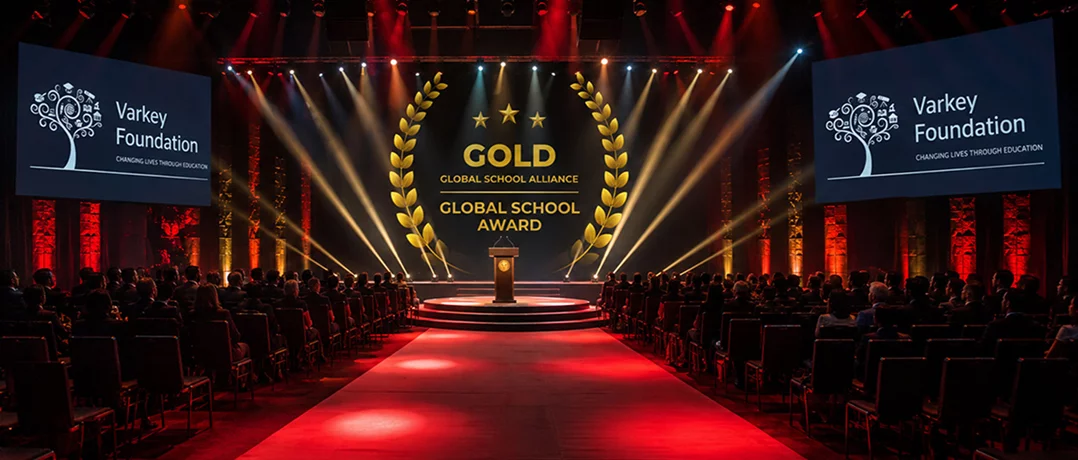
Lebanon's Alsama Project, a refugee-led education organization transforming the lives of displaced Syrian and Palestinian teenagers excluded from traditional schooling, was named the winner of the inaugural Global Schools Prize, taking home $500,000 in prize money to scale its impact globally.
The winner was announced at the Education World Forum in London by celebrated filmmaker and charity campaigner Richard Curtis, who named Alsama the standout school from nearly 3,000 applications and nominations across 113 countries. He was joined by Sunny Varkey, founder of the Varkey Foundation, in presenting the award to Alsama's co-founder Kadria Hussein.
Founded in 2025 by UAE education pioneer and philanthropist Sunny Varkey, the Global Schools Prize joins the Global Teacher Prize and Global Student Prize as part of a trilogy celebrating educators, learners, and schools.
A sky built from the ground up
Founded in 2020 with just 40 teenagers in Beirut's Shatila refugee camp, Alsama, Arabic for "sky", has grown into a pioneering education organization serving more than 1,100 displaced young people across Lebanon and Syria.
The numbers behind Alsama's work are striking. While most refugee education programs focus on younger children, Alsama uniquely targets adolescents, an overlooked age group trapped in a system where 85% of Syrian refugees in Lebanon cannot attend school, and fewer than 2% complete secondary education. Around 90% of students arrive unable to read, write, or perform basic math. "Within six months, most can do all three," said co-founder Kadria Hussein upon accepting the award.
The organization's accelerated curriculum takes mostly illiterate 13 to 14-year-olds to potential university entry within six years, half the time of traditional education pathways. Alsama's first cohort graduates this July, with students already securing prestigious scholarships to the University of Cambridge, the University of Leicester, and Arizona State University.
The project's resilience has been tested repeatedly. Even during the conflicts that hit Lebanon in 2024 and 2026, the Alsama Project continued to teach its students daily, pivoting rapidly between in-person teaching, online instruction, and travelling directly to refugee shelters to bring learning to students wherever they were.
The organization's community-led model is as notable as its results. Seventy-two percent of staff are refugees, 96% come from refugee or local communities, and most senior leaders have refugee backgrounds.
The London forum also saw Alsama announce a landmark partnership: Cambridge University Press and Assessment signed an agreement with the Alsama Project to collaborate on the G12++ qualification, a new credential for refugees and displaced young people designed to provide a recognized pathway to further education and skilled employment. The first G12++ examination was launched in February 2026 in the Shatila refugee camp, with several students who arrived unable to read or do basic math already earning the qualification.
Recognition with purpose
Co-founder Meike Ziervogel was direct about what the $500,000 prize means in practice. "Half a million dollars will allow us to open more education centres in Lebanon and Syria," she said, adding that it would permit hundreds of illiterate teenagers to reach university entry within the next six years.
For Lebanon, the week in London offered a moment of recognition for what persists and innovates despite the chaos. The Ministry of Education's presence at the forum, combined with Alsama's historic win, sent a message that Lebanon's commitment to education, however strained, remains alive and, at its best, world-class.
-
-

-
The Beiruter
-
