



In the 1960s, a group of students and a young Armenian-Lebanese professor built rockets in Beirut that became the Arab world’s first to reach the edge of space.
Lebanon reached the edge of space in the 1960s

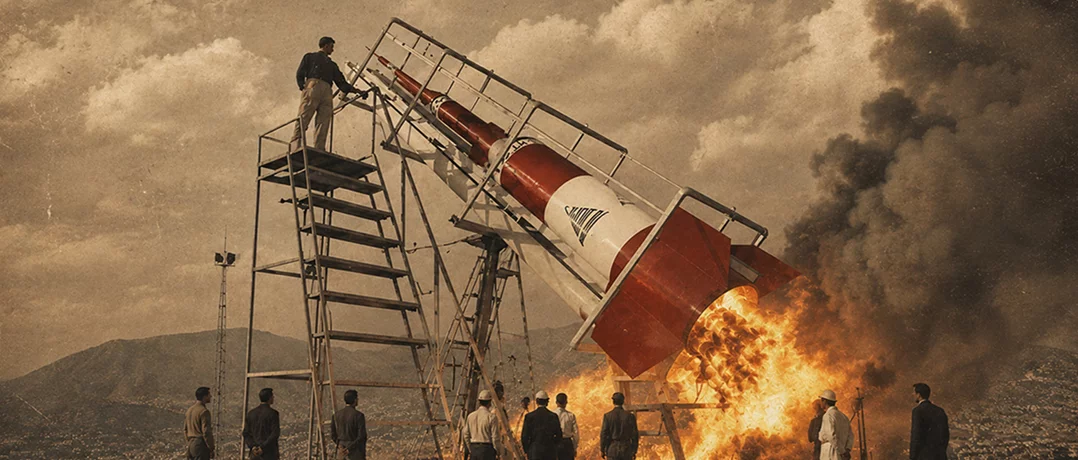
In 1960, a 25-year-old mathematics instructor tacked a handwritten notice onto a bulletin board at a small Armenian college in Beirut. "Do You Want to Be Part of the Haigazian College Rocket Society?" it read. Seven freshmen answered the call. Within three years, they had launched the Arab world's first rocket capable of reaching the edge of space, all on an extremely tight budget.
The man behind that notice was Manoug Manougian, an Armenian-born scientist who had grown up in Jerusalem dreaming of the cosmos. As a boy, he would climb the Mount of Temptation and stare at the night sky, inspired by Jules Verne novels and rocket sketches he'd carved into his school desk. After winning a scholarship to the University of Texas, he graduated in 1960 and immediately accepted a teaching post at Haigazian College in Beirut, a newly established institution founded as a refuge for survivors of the Armenian Genocide.
With an initial donation of just 750 Lebanese pounds, Manougian and six students, among them Simon Aprahamian, Garabed Basmadjian, and Hampartsum Karageuzian, began building solid-fuel rockets from scratch. They had no testing facilities, no specialized equipment, and no instruction manuals. Early prototypes were fired from the mountain home of a society member, sometimes with precarious results. After a series of failures, their first success came in April 1961: a single-stage rocket climbed to roughly one kilometer above the Lebanese hills.
Rising higher
The rockets grew bolder with each passing year. In April 1961, Cedar-1 cleared its first real milestone, climbing to roughly one kilometer above the Lebanese hills, modest by any measure, but proof that a handful of college students with no formal aerospace training could make something fly. By May 1962, Cedar-7 had reached 11,500 meters, a feat significant enough that the Lebanese Army stepped in to provide security at the launch site.
The ambitions of the society were escalating fast. In November 1962, they rolled out Cedar-3, a three-stage solid-propellant rocket standing 6.8 meters tall and weighing 1,250 kilograms, a machine that bore no resemblance to the cardboard-and-pipe prototypes of the early days.
Then came the moment that stopped the country. On November 21, 1963, Lebanese Independence Day, Cedar-4 tore into the sky above Dbayeh and reached an altitude of 140 kilometers, skirting the edge of low Earth orbit where satellites circle the planet. Fifteen thousand people had gathered to watch. The government commemorated the achievement on a postage stamp.
Three years later, in August 1966, Cedar-8 settled the question entirely. The 18-foot two-stage rocket climbed past 62 miles and crossed the Kármán line, the internationally recognized frontier of space. A group of students from a small college in Beirut had gone where almost no nation on Earth had ever gone before.
The end of the dream
Yet as the rockets grew more powerful, so did unwanted attention. The Lebanese military began asking pointed questions about payload capacity and range. Foreign intelligence agents were rumored to be watching. Arab governments sought to recruit Manougian for their own weapons programs. The project he had conceived as a scientific teaching tool was drifting into territory he had never intended. In the summer of 1964, while Manougian was abroad completing his master's degree, an unsupervised student attempted to prepare rocket propellant alone. The resulting fire severely injured two students. The Lebanese Rocket Society never fully recovered. A final launch was made in August 1966, with Cedar-8 reaching beyond 87 miles, breaching the Kármán line. Shortly after, the program was quietly shuttered, reportedly under pressure from France, which feared the geopolitical implications of a small Middle Eastern nation possessing long-range rocket technology.
The Lebanese Rocket Society faded from public memory, eclipsed by civil war and political upheaval. It was only in 2012, when filmmakers Joana Hadjithomas and Khalil Joreige stumbled upon an old postage stamp bearing the image of a Cedar rocket, that they began excavating the story. Their 2013 documentary, The Lebanese Rocket Society, reintroduced the world to Manougian and his students. A life-size replica of Cedar-4 now stands at the entrance to Haigazian University.
Manougian, who passed away in March 2024 at the age of 88, spent his final decades as a professor at the University of South Florida. He remained convinced of what might have been. Yet, what they did, with unstoppable ambition, was extraordinary enough.
-
-

-
The Beiruter
-
