



Lebanon's new wildfire prevention strategy, examining how climate change, conflict, and forest mismanagement have intensified fire risks and how a GEF-backed initiative aims to strengthen prevention, preparedness, and landscape resilience.
Lebanon strengthens wildfire defenses

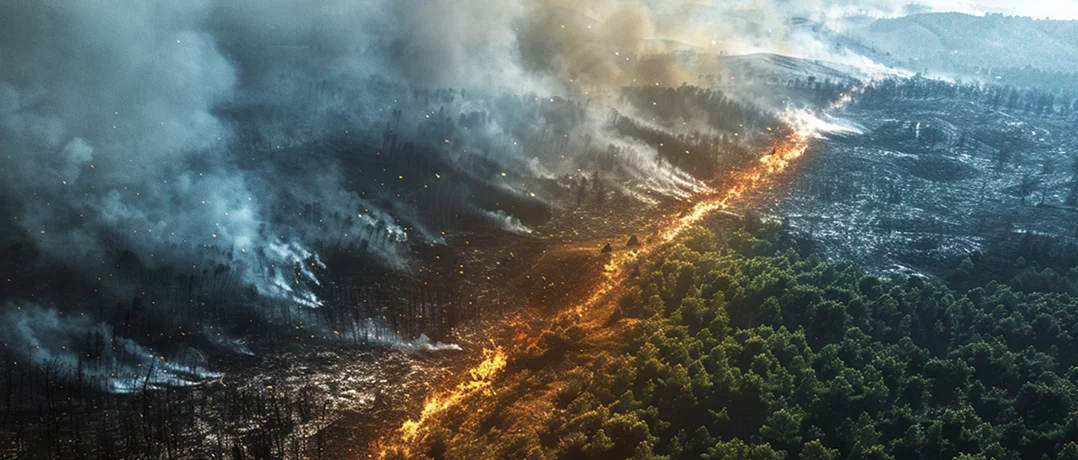
Lebanon's forests have been burning at an alarming rate. Over the past three fire seasons, the country has recorded thousands of wildfires, driven by a combustible mix of climate stress, neglected land management, and, in the south, a war that has turned entire hillsides to ash. The toll has fallen hardest on rural communities whose livelihoods depend on the land, and on a state apparatus already stretched thin by years of crisis.
Now Lebanon is moving to overhaul how it prevents and responds to those fires. The effort is anchored by a project funded by the Global Environment Facility (GEF), designed to strengthen early warning systems, improve coordination among the many agencies involved in firefighting, and build up frontline capacity in the country's most fire-prone regions.
A sharp rise, then a partial retreat
Data from the Lebanese Ministry of Environment and the National Council for Scientific Research (CNRS) shows how volatile the last three fire seasons have been. Roughly 4,276 fires were recorded in 2023. That number jumped to 6,412 in 2024, a nearly 50 percent increase, before falling back to 2,421 in 2025.
The 2024 spike coincided with escalating conflict in the country's south. Human rights organizations and Lebanese researchers have documented extensive use of white phosphorus munitions by Israeli forces along the border during this period, which independent monitors and Lebanon's government have linked to hundreds of fires that tore through forests, olive groves, and farmland in border districts.
Public Works Studio, a Lebanese research group, estimated that more than 2,000 hectares of southern countryside burned, including hundreds of hectares of dense oak, pine, and gum forest, while Lebanon's Ministry of Environment has separately cited CNRS damage assessments running into the billions of dollars.
Those events sit alongside a longer-running trend: Lebanon's National Adaptation Plan warns that rising temperatures, longer dry summers, and more erratic rainfall are pushing wildfire risk sharply upward nationwide, with the risk expected to roughly double by the end of the century in hotspots such as Chouf, Akkar, and Mount Lebanon.
What the project covers
The GEF-funded initiative, implemented with World Bank supervision over a five-year period, is built around reducing wildfire risk through better forest landscape management rather than firefighting alone. It targets three hotspots chosen for their fire risk, biodiversity value, and proximity to populated areas: Akkar, Minieh-Dinnieh, and Aley-Chouf, with related activity also extending into parts of Metn-Baabda.
The plan rests on several pillars. One is a national early warning system to flag fire risk before flames spread, paired with a coordination mechanism meant to close longstanding gaps in how the Ministry of Environment, Ministry of Agriculture, and other bodies work together during a crisis. A second pillar funds hardware for first responders, portable water tanks, fire trucks and other vehicles, watchtowers, protective apparel, and first-aid kits, along with training. A third component centers on community-based forest management, helping municipalities take a direct role in maintaining the land around them and restoring areas after fires occur. The project also calls for a forest fire academy focused on fire forensics and research into topics such as post-fire recovery, prescribed burning, and other nature-based risk-reduction techniques, plus ongoing monitoring and evaluation to track progress.
Implementation draws on a wide coalition of Lebanese institutions: the Ministry of Environment, Ministry of Agriculture, Ministry of Interior and Municipalities, the Lebanese Army, Civil Defense, and the Higher Relief Council, working alongside CNRS. The United Nations Office for Project Services (UNOPS) is carrying out several of the project's operational activities. Notably, the initiative traces back to a $3.8 million GEF grant, titled "Community-based Wildfire Risk Management in Lebanon's Vulnerable Landscapes", that the Ministry of Environment requested after an earlier World Bank knowledge program on forest management, with implementation originally slated to begin in September 2024.
The significance behind the initiative
Wildfires in Lebanon are no longer isolated seasonal disasters. They have become a recurring national challenge shaped by climate change, years of underinvestment in forest management, and, more recently, the destruction wrought by war. Each fire leaves behind more than scorched trees, it erodes biodiversity, threatens water resources, devastates agricultural livelihoods, and strips rural communities of a vital layer of protection against erosion and desertification.
The success of this initiative will ultimately depend on sustained political commitment, long-term funding, and coordination long after international support ends. If effectively implemented, it could shift Lebanon from a reactive model, where fires are fought only after they ignite, to one centered on prevention, preparedness, and resilient landscape management. As rising temperatures continue to make wildfires more frequent and more intense, protecting Lebanon's forests has become an investment in the country's ecological security, economic resilience, and future.
-
-

-
The Beiruter
-
