

Lebanon leads the Arab world with nearly a fifth of its economy dependent on tourism, a distinction that reflects both the sector's enduring power and the country's deep structural vulnerabilities.
Lebanon tops Arab countries in tourism dependence
Lebanon tops Arab countries in tourism dependence
By The Beiruter | May 25, 2026

Reading time: 3 min
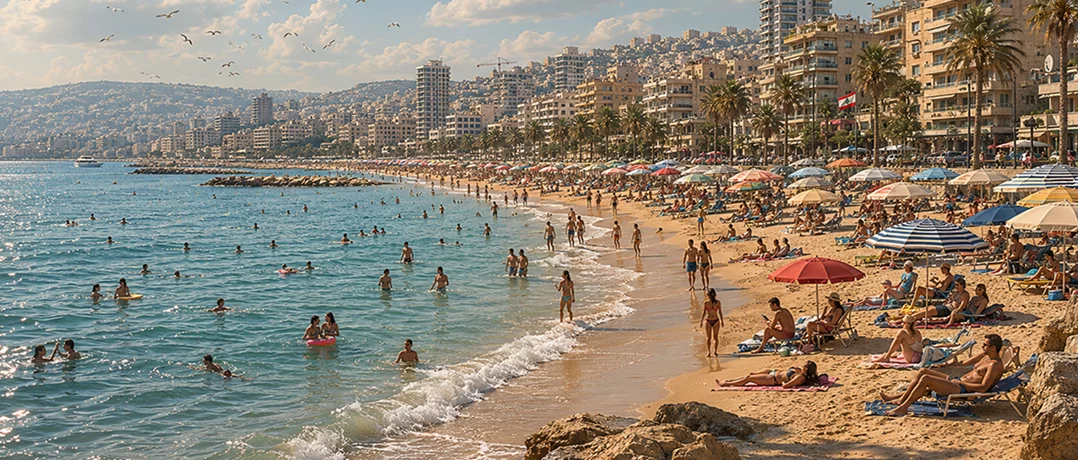
Lebanon ranks as the Arab country most dependent on tourism as a share of its economy, according to data from the World Travel and Tourism Council (WTTC) cited by International Information. The sector contributed 19.8 percent of the country's gross domestic product in 2024, a figure that places Lebanon well above any other Arab nation in terms of how much of its economic output hinges on visitors arriving, spending, and staying. The industry also supports an estimated 315,000 jobs, representing approximately 19.6 percent of total national employment.
A long-established reliance
Lebanon's relationship with tourism is not new, and the figure of roughly 19 to 20 percent of GDP is not an anomaly produced by crisis. Even before the financial collapse of 2019, Lebanon's tourism sector was generating close to that share of output. In 2019, the last full year before the twin shocks of the financial meltdown and the COVID-19 pandemic, the country welcomed nearly two million international visitors and generated over $8 billion in tourism revenue, accounting for approximately 19 percent of GDP. The sector has long ranked as Lebanon's second most vital source of foreign currency after expatriate remittances, which officially approach $7 billion annually.
What makes the current 19.8 percent figure remarkable is the context surrounding it. Lebanon's overall economy contracted by roughly 7.5 percent in 2024, and the country's total economic decline since 2019 has been nearly 40 percent, one of the steepest peacetime contractions recorded anywhere in the world in modern history. The World Bank's Spring 2025 Lebanon Economic Monitor noted that the conflict with Israel worsened an already dire crisis, with agriculture, tourism, and commerce together accounting for 77 percent of all economic losses. Against that backdrop, tourism's share of what remains of the economy has risen not only because the sector has recovered, but also because so many other sectors have collapsed further.
The numbers behind the figure
The WTTC data reports approximately $4.7 billion in annual tourism revenues for Lebanon, a significant decline from the $6 billion recorded in 2023 and the $8 billion-plus of the pre-crisis peak, but still a figure that dwarfs the contribution of most other sectors to Lebanon's foreign currency earnings.
Visitor arrivals tell a similar story of volatility. The Ministry of Tourism recorded just 1.13 million visitors in 2024, down sharply from 1.66 million the year before, a 32 percent decline attributed to regional insecurity and the effects of the conflict with Israel. In 2025, arrivals rebounded to approximately 1.63 million, a 44.6 percent recovery from the 2024 trough, with Beirut hotels reporting occupancy rates between 80 and 90 percent during peak summer months.
The diaspora plays an outsized role in shaping these numbers. Arab country visitors arrived second overall in 2025 with around 360,000 visitors, while European and American travelers contributed meaningful shares. Gulf visitors, whose travel bans from Saudi Arabia and other states had significantly suppressed arrivals in recent years, are slowly returning following diplomatic thawing. The UAE lifted its travel advisory, Kuwait followed, and Lebanon's tourism ministry has been actively courting Gulf travelers as a central pillar of its recovery strategy.
A sector under pressure
The designation of Lebanon as the Arab world's most tourism-dependent economy is as much a warning as a distinction.
Lebanon's natural assets, its cuisine, its mountain landscapes, its Mediterranean coastline, its archaeological wealth, its extraordinarily cosmopolitan culture, have not diminished. The country can still offer what very few places in the world can: skiing in the morning and swimming in the afternoon, Phoenician ruins alongside modern restaurants, a hospitality culture that is embedded in national identity. The challenge is ensuring that these assets exist within an economy stable enough to make them sustainable, rather than a brilliant surface stretched over a fragile foundation.
The data confirming Lebanon's position at the top of the Arab world in tourism dependence should prompt not only pride in what the sector contributes, but urgency about what must change to protect it.
-
-

-
The Beiruter
-
